


Case Details
| Case Name | Swiss Ribbons Pvt. Ltd. & Anr. v. Union of India & Ors. |
| Court | Supreme Court of India |
| Bench | Justice Rohinton Fali Nariman and Justice Navin Sinha |
| Date of Judgment | 25 January 2019 |
| Citation | (2019) 4 SCC 17; 2019 SCC OnLine SC 73 |
Introduction
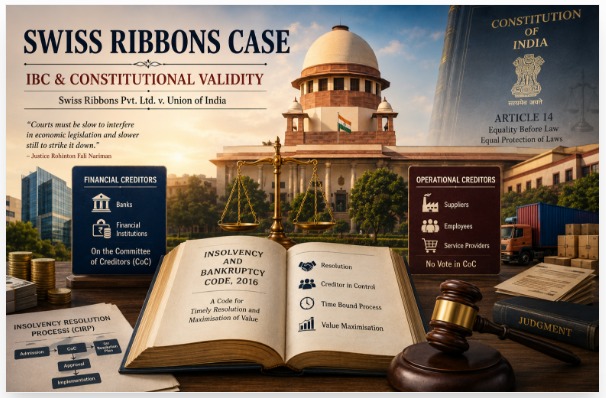
The Swiss Ribbons Case is a landmark Supreme Court judgment that upheld the constitutional validity of the Insolvency and Bankruptcy Code, 2016 (IBC). When the Insolvency and Bankruptcy Code, 2016 (IBC) came into force it promised to fix a problem that had haunted Indian banking for decades companies that defaulted on loans and simply carried on while creditors waited years for courts to act. The Code was bold fast-moving and for many stakeholders uncomfortable. Within two years of its enactment its constitutional validity was challenged before the Supreme Court in Swiss Ribbons Pvt. Ltd. v. Union of India. The petitioners argued that several provisions of the Code were arbitrary and violated Article 14 of the Constitution. The Supreme Court’s answer delivered by Justice Rohinton Fali Nariman not only upheld the Code in its entirety but also gave India one of its most cited judgments on economic legislation and the limited role courts should play in second guessing policy choices made by Parliament.
Facts of the Case
The case did not arise from a single dispute but from a bunch of writ petitions and a special leave petition filed by different parties including corporate debtors promoters and trade associations such as Swiss Ribbons Pvt. Ltd. These petitioners were all affected in one way or another by the Corporate Insolvency Resolution Process (CIRP) introduced by the IBC. Because the challenge was to the constitutionality of the statute itself rather than to the facts of any particular insolvency proceeding the Supreme Court made it clear at the outset that it was not going to examine the individual facts of each connected case.
The provisions under attack included Section 7, which allows a financial creditor to trigger the CIRP on default Section 12A, which lays down a high threshold (approval of ninety per cent of the Committee of Creditors) for withdrawing an insolvency application once admitted Section 29A, which disqualifies certain persons including promoters linked to earlier defaults from bidding for the defaulting company during resolution; and Section 53, which lays down the order of priority for distributing assets during liquidation. The petitioners also questioned the manner of appointing members to the National Company Law Tribunal (NCLT) and the National Company Law Appellate Tribunal (NCLAT) and objected to the fact that the NCLAT sits only in New Delhi forcing litigants from across the country to travel there.
At the heart of the petitioners’ grievance was the distinction the Code draws between financial creditors, such as banks, and operational creditors, such as suppliers or employees. Only financial creditors sit on the Committee of Creditors and vote on the resolution plan operational creditors have no such vote. The petitioners argued that this unequal treatment was arbitrary and discriminatory and that the Code as a whole tilted too heavily in favour of financial creditors and the resolution process at the cost of natural justice for others.
Issues Before the Court
The Court was called upon to decide broadly whether the appointment process for NCLT and NCLAT members complied with its earlier ruling in Madras Bar Association v. Union of India whether the absence of circuit benches of the NCLAT outside Delhi rendered the remedy under the Code inefficacious whether the classification between financial and operational creditors under Sections 21 and 24 violated Article 14 and whether Sections 12A, 29A and 53 were manifestly arbitrary and therefore unconstitutional. Underlying all these specific questions was a larger one how much deference should courts give to economic legislation of this kind especially one still finding its feet.
Arguments of the Parties
Senior counsel appearing for the petitioners, including Mr. Mukul Rohatgi argued that treating financial and operational creditors so differently made no real sense since both categories are ultimately owed money by the same defaulting company and both suffer when a company goes under. They contended that excluding operational creditors from the Committee of Creditors left them with no say in decisions that directly affected their recoveries which was manifestly unfair. On Section 29A, it was argued that disqualifying promoters and related persons from bidding for their own company sometimes retrospectively was harsh and disproportionate. The petitioners also pressed the point that a solitary NCLAT bench in Delhi imposed an unreasonable burden on litigants from distant states defeating the purpose of an accessible appellate remedy.
The Union of India represented by the Attorney General and the Solicitor General, defended the Code as carefully designed economic legislation born out of the failure of earlier recovery mechanisms. They argued that financial creditors by virtue of their expertise in assessing viability and restructuring are better placed to decide the fate of a company than operational creditors, who are typically concerned only with recovering what is owed to them. On Section 29A, the government explained that keeping defaulting promoters out of the bidding process was necessary to prevent them from buying back their companies cheaply after having driven them into insolvency in the first place. The Union also pointed to steps already taken to make the resolution process more accessible and urged the Court to apply the settled principle that economic laws deserve greater latitude than ordinary legislation.
Judgment
The Supreme Court upheld the constitutional validity of the Insolvency and Bankruptcy Code in its entirety. It rejected each of the challenges raised by the petitioners though it did issue certain clarifications and directions along the way. The Court read down Section 29A(j) to require actual involvement in management or control before disqualifying a person, and it clarified that Section 12A’s ninety per cent voting threshold for withdrawal was reasonable given the collective nature of the CIRP. On the question of tribunal benches the Court directed the Union Government to set up circuit benches of the NCLAT in line with its earlier directions in the Madras Bar Association case so litigants would not be forced to travel to Delhi for every hearing.
Importantly, in Swiss Ribbons case the Court held that the classification between financial and operational creditors was not discriminatory since the two categories are differently placed and the distinction bears a clear connection to the objects the Code seeks to achieve. In one of its most quoted lines, Justice Nariman observed that the Code had brought the economy back to its rightful position and that the defaulter’s paradise, which existed before the IBC was now lost.
Reasoning of the Court
The Court’s reasoning rested on a few connected ideas. First, it reaffirmed the principle, drawn from earlier decisions such as Balco Employees’ Union v. Union of India, that courts must show greater restraint while reviewing economic legislation than while reviewing laws touching civil or personal liberties. Complex economic problems, the Court said are usually addressed through trial and error and a law should not be struck down merely because a different or better method could have been chosen. This reasoning explains why the Court was reluctant to fine-tune the policy choices embedded in the Code and instead focused on whether those choices were rational.
On the financial versus operational creditor divide the Court explained that financial creditors typically extend long-term secured credit and possess the financial expertise needed to assess whether a company can be revived while operational creditors are usually concerned only with recovering dues for goods or services already supplied. This difference the Court held amounts to an intelligible differentia that has a direct nexus with the Code’s object of reviving viable companies rather than merely settling claims. The Court also pointed out that operational creditors are not left without protection, since the Code requires that they receive, at the least what they would have received in liquidation.
On Section 29A, the Court accepted the government’s reasoning that allowing promoters who had driven a company into default to re-acquire it cheaply through the resolution process would defeat the very purpose of the Code. At the same time, recognising that the provision could catch people with no real connection to the company’s mismanagement the Court read in a requirement of actual involvement before a person could be disqualified striking a balance between preventing abuse and avoiding overreach. On the tribunal related objections the Court held that the appointment process broadly complied with the safeguards laid down in the Madras Bar Association case while still directing the government to widen access through circuit benches. Throughout the judgment, the Court repeatedly stressed that the Code should be read as a whole, keeping its underlying purpose of resolution rather than liquidation, firmly in view.
Significance of the Judgment
Swiss Ribbons gave the still-young insolvency framework the constitutional certainty it needed to function with confidence. Banks, resolution professionals and investors could now rely on the Code’s core mechanisms without the shadow of a pending constitutional challenge which in turn encouraged more active participation in the resolution process. The judgment has since been cited repeatedly in later insolvency cases to explain why financial and operational creditors are treated differently and why courts should hesitate before interfering with the working of the Committee of Creditors. Its restatement of judicial restraint in matters of economic policy has also travelled well beyond insolvency law being invoked whenever courts are asked to strike down legislation dealing with complex financial or regulatory questions. Some scholars have pointed out that the judgment left certain tensions unresolved such as how Section 29A of the Code interacts with related provisions of the Companies Act but its central holding, that the IBC is constitutionally sound has remained undisturbed.
Conclusion
Swiss Ribbons v. Union of India is remembered less for any single legal rule and more for the confidence it gave to a fledgling piece of economic legislation at a critical moment. By upholding the Code while fine tuning a few of its rougher edges, the Supreme Court managed to protect both the intent of Parliament and the interests of those the Code might otherwise have treated unfairly. Nearly six years on the judgment continues to be the starting point for understanding why India’s insolvency framework looks the way it does, and it remains a clear example of how courts can support economic reform without losing sight of constitutional safeguards.
References
Swiss Ribbons Pvt. Ltd. & Anr. v. Union of India & Ors., (2019) 4 SCC 17.
Insolvency and Bankruptcy Code, 2016.
Balco Employees’ Union v. Union of India, (2002) 2 SCC 333.
Madras Bar Association v. Union of India, (2014) 10 SCC 1.
