


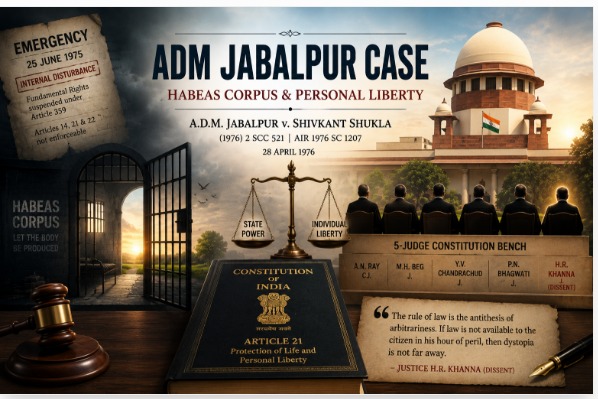
Case details
Case Name – Additional District Magistrate (A.D.M.), Jabalpur v. Shivkant Shukla
Court – Supreme Court of India
Bench – 5-Judge Constitutional Bench
Judges- A.N. Ray C.J., M.H. Beg J. , Y.V. Chandrachud J.,P.N. Bhagwati J., and H.R. Khanna J.
Date of Judgment – 28 April 1976
Citation – AIR 1976 SC 1207 and (1976) 2 SCC 521
Case Number – Criminal Appeal No. 279 of 1975
Introduction
A.D.M. Jabalpur v. Shivkant Shukla is one of the most controversial cases of Indian history covering the extend of protection of personal liberty during National Emergency. In this case, the Supreme Court was confronted with the question whether the third limb of Dicey’s doctrine was an integral part of Indian concept of rule of law.
This case arose during the National Emergency of 1975–1977. During the Emergency, several political leader were detained under the Maintenance of Internal Security Act, 1971(MISA). They were not even informed grounds of their intention which led them to turn to High Courts to challenge the illegal detention and pray for the issue of writ of have as corpus. Hence, it is also known as the habeas corpus case.
The case therefore involves the relationship between Emergency powers ,Article 21, Article 359, Article 226, Personal liberty, Judicial review, Rule of law.
Facts of the Case
On 25 June 1975, Emergency was proclaimed by Indira Gandhi’s Government on account of “internal disturbance”. As per Article 358 of the Indian Constitution, citizens’ right to freedom under Article 19 was suspended. Later on, the President of India issued an order to suspended the enforcement of Article 14, 21, 22. This Emergency led to extensive preventive detention of many political leaders under MISA. Many of them weren’t even informed their grounds of detention.
This led to several cases in different High Courts where the petitioners were claiming that they have been deprived of their personal liberty in violation of the procedure established by law but their plea was dismissed on the ground that Article 21 has been suspended by the Presidential Order.
The governments of concerned states and Indian Government filed appeals in the Supreme Court against the decisions of High Courts.
Shivkant Shukla was also detained under MISA. His detention was challenged before the Madhya Pradesh High Court through a petition of habeas corpus. The detainees argued that even during Emergency their detention was extraneous and malafide. The Supreme Court clubbed the matters together due to the constitutional importance of the case.
Issues before Court
- Whether a person can be deprived of their Right to Life and Personal liberty under Article 21 of Indian Constitution during National Emergency?
- Whether Judical Review of such detention was permissible?
Arguments of Parties
Argument of the State
1. The government contended that the Presidential Order under Article 359(1) barred citizens to approach to courts for enforcement of Fundamental Rights including Article 14, 21, 22.
2. The executive requires wide power to maintain public order and national security therefore the Court shouldn’t interfare with prevention detentions during Emergency.
Argument of the detenu
1. The respondents asserted that the exists “rule of law” in India apart from and irrespective of Article 21 of the Indian Constitution.
2. Personal liberty is natural and fundamental right and it existed even before the Constitution. Hence, State cannot deprive a citizen of their personal liberty.
3. Article 359 does not give State unlimited power and it should be check by the judiciary under writ of habeas corpus.
Judgement
The Supreme Court decided the case by 4:1 majority. The majority consisted of Chief Justice A.N. Ray , Justice M.H. Beg , Justice Y.V. Chandrachud, Justice P.N. Bhagwati. The only one judge who expressed his dissent was Justice H. R. Khanna.
The majority was of the opinion that Article 21 is the sole source of Protection of Personal liberty. Therefore, when the enforcement of Article 21 was suspended under Article 359, the detainee couldn’t seek the enforcement of Article 21 in the Court. This also led to the contention that the relief through Article 226 cannot be granted as it would lead to enforcement of Fundamental Rights.
It was held that Article 21 is our rule of law regarding life and personal liberty. There cannot be any pre- Constitution or post- Constitution rule of law which can run counter to the rule of law emboided in the Constitution. The Constitution itself prohibited enforcement of certain Fundamental Rights during Emergency hence, the judiciary has to abide by the Constitutional arrangement created by Article 359.
Khanna J, gave a powerful dissent. In his view, Rule of Law is the antithesis of arbitrariness. He stated that the principle that no one shall be deprived of his life and personal liberty without authority of law wasn’t the gift of the Constitution. It is necessary for sanctity of life and liberty, and it existed even before Constitution came into force. Even if Article 21 didn’t exist, State has got no authority to deprive a person if his life or liberty without the authority of law.
Critical Analysis
It is well established and respectfully submitted that the dissent of Khanna J is in consonance with law while the majority judgement is unjust and contrary to the doctrine of rule of law. The majority judgement weekend the principle of rule of law and gave the Executive unlimited authority which can lead to arbitrariness. This was fundamentally inconsistent with the principle that government itself is subject to law.
The majority treated Article 21 as the sole source for enforcement of right to personal liberty. This stance was criticized because right to life and personal liberty are not the concept created by Article 21 of Indian Constitution. Article 21 only provided Constitutional protection to these interests.
The majority judgement also weekend the scope of writ of habeas corpus. They also gave too much emphasis on existence of Emergency and too little emphasis on the principle of Constituionalism.
Significance of the Case
The significance of A.D.M. Jabalpur case goes beyond the question of habeas corpus. It covers important aspects like Judical Review, Article 21, role of judiciary, power of Executive, National Emergency.
This A.D.M. Jabalpur case becomes a landmark case in aspect of Article 21. It examined whether a person can seek judicial protection of Article 21 during Emergency in cases of illegal detention. It also talked about rule of law and whether rule of law is apart from Article 21.
This case also showcased what can happen when Executive has unchecked powers. It dealt with the effect of Presidential order under Article 359(1) and demonstrated enormous Constitutional consequences of suspending Fundamental Rights during Emergency. This case also became a major authority in discussions concerning the relationship between habeas corpus and personal liberty.
Conclusion
The importance of A.D.M. Jabalpur case resulted in significant judicial and Constitutional developments. The 44th Constitutional Amendment Act, 1978 ensured that right to life and personal liberty cannot be taken away by Executive even during Emergency. It stated that Article 21, 22 will prevail even during Emergency. Subsequently, the Supreme Court of India expanded the scope of Article 21 in cases such as Maneka Gandhi v. Union of India. Later on, in Justice K.S. Puttaswamy (Retd.) v. Union of India (2017), a nine-judge Constitution Bench expressly overruled ADM Jabalpur and rejected its approach towards Article 21.
Thus, this case demonstrates the importance of rule of law, Judical Review and protection of personal liberty.
Reference
1.Constitution of India, Article 14, Article 19, Article 20, Article 21, Article 22 , Article 32, Article 226, Article 352 , Article 358 Article 359 ,Article 359(1)
2.Maintenance of Internal Security Act, 1971 (MISA)
3.A.K. Gopalan v. State of Madras (1950)
4.R.C. Cooper v. Union of India (1970)
5.ADM Jabalpur v. Shivkant Shukla (1976)
6.Maneka Gandhi v. Union of India (1978)
7.Union of India v. Bhanudas Krishna Gawde
8.Justice K.S. Puttaswamy (Retd.) v. Union of India (2017)
9.44th Constitutional Amendment Act, 1978
