


Introduction
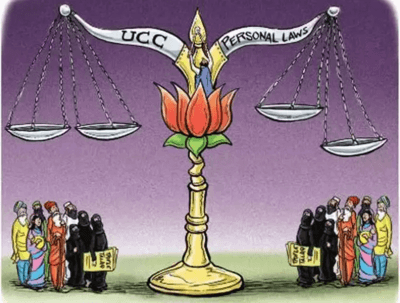
Article 44 of the Constitution has waited over seven decades for implementation. Uttarakhand finally broke this silence with its Uniform Civil Code in 2025. The state became the first in independent India to enact such comprehensive legislation. This legislation replaced separate religious personal laws with one common civil framework. Supporters celebrated it as a long overdue step toward genuine gender equality. Critics condemned it as a selective and politically motivated attack on minorities. This article examines the doctrinal fault lines running beneath this pioneering legislation. It explores whether Uttarakhand’s model can survive sustained constitutional scrutiny over time. The analysis also considers how this state level experiment fits within India’s broader federal structure.
The Long Road to a Uniform Civil Code
Article 44 directs the state to secure a uniform civil code for citizens. As a directive principle, it remains legally unenforceable through ordinary courts directly. The Constituent Assembly debated this provision with considerable disagreement among its members. Some members favoured immediate implementation, while others urged gradual, consensual reform instead. Successive governments avoided the issue, wary of significant political and social backlash. The Shah Bano case in 1985 briefly reignited this national conversation dramatically. Parliament’s subsequent legislative response effectively shelved serious momentum for decades afterward.
Courts occasionally urged implementation, notably in Sarla Mudgal v. Union of India. That judgment addressed the misuse of religious conversion to circumvent bigamy laws. The Court there expressed hope that Parliament would eventually enact a uniform code. Successive Law Commissions also examined the feasibility of such comprehensive reform.
The 21st Law Commission, in 2018, found a uniform code neither necessary nor desirable then. It instead recommended targeted reforms within each existing personal law system. This decades long delay reflected genuine anxiety about communal harmony and political stability. Governments across party lines generally preferred incremental reform over a single sweeping code. Personal law reform instead proceeded piecemeal, through targeted amendments to specific religious statutes. The Hindu Code Bills of the 1950s exemplify this more gradual reform approach. Muslim, Christian, and Parsi personal laws largely remained untouched by comparable comprehensive legislation.
Key Features of the Uttarakhand Model
- The Uttarakhand Uniform Civil Code Act received Assembly approval in February 2024. It came into force on 27 January 2025 after considerable procedural preparation. The Code applies uniformly to all residents, regardless of their religious affiliation.
- It notably exempts Scheduled Tribes and certain other protected communities entirely.
- The Code bans polygamy, halala, and triple talaq under Muslim personal law specifically. It mandates equal inheritance rights for sons and daughters across every community.
- It requires compulsory registration of marriages, divorces, and live in relationships online. This digital registration system links directly with the state’s broader e-governance infrastructure. Non registration of live in relationships can attract fines or even imprisonment. Authorities justify these penalties as necessary to ensure genuine, widespread compliance across the state.
These provisions collectively represent a significant departure from India’s traditional personal law pluralism. Chief Minister Pushkar Singh Dhami described the Code as fulfilling a core election promise. An expert committee, led by a retired judge, drafted the legislation over several months. The committee reportedly consulted various stakeholders, though critics questioned how genuinely inclusive this process was. Over four to five lakh registrations occurred through the Code’s online portal within its first year.
Equality, Religious Freedom, and the Exemption Question
The Code’s tribal exemption creates a genuine and difficult equality problem. Article 14 prohibits arbitrary classification lacking a rational connection to legitimate objectives. Supporters justify this exemption by citing existing constitutional protections for tribal customs. Critics respond that this reasoning undermines the very claim of true uniformity. If uniformity matters so greatly, they ask, why exempt any community at all. This selective structure fuels persistent accusations that the Code specifically targets Muslim practices.
Opposition leaders have repeatedly described the Code as politically motivated rather than principled reform. Government representatives, however, insist the law applies genuinely equally to all covered communities. Provisions on polygamy and iddat map closely onto existing Muslim personal law. The Code, however, leaves many Hindu customary practices comparatively less affected overall. This asymmetry raises serious questions under Articles 25 and 26 as well. These articles protect the freedom to practise and manage religious affairs. The All India Muslim Personal Law Board has publicly called the Code unconstitutional. It argues the legislation singles out one community under the guise of neutral language. Jamiat Ulama i Hind has similarly challenged specific provisions before constitutional courts.
Some legal scholars, however, defend the Code as addressing genuine, long standing gender injustices. They argue that practices like triple talaq caused documented and severe hardship to women. Balancing these competing claims requires careful, fact sensitive constitutional analysis rather than simple slogans.
Federalism and the Limits of State Level Uniformity
Article 44 addresses “the state,” a term including both the Union and States. Yet personal law traditionally falls within the Concurrent List under Indian federalism. This shared jurisdiction allows both Parliament and State Assemblies to legislate on marriage and succession. Entry 5 of the Concurrent List specifically covers marriage, divorce, and family related matters. A single state enacting its own code creates an obvious practical problem. A person’s civil status could change simply by crossing a state boundary. Other states, including Madhya Pradesh and Gujarat, are now considering similar legislation. This growing patchwork approach may eventually require Parliament’s decisive intervention nationally.
Legal scholars increasingly question whether true uniformity can emerge from disparate state initiatives. Each state’s version may differ in scope, exemptions, and enforcement mechanisms significantly. Such divergence would ultimately defeat the founding purpose behind Article 44 itself. A genuinely uniform code, almost by definition, may require a single national law.
Privacy Concerns in the Registration Regime
The Code’s mandatory registration requirement for live in relationships raises distinct privacy concerns. Justice K.S. Puttaswamy v. Union of India recognised privacy as a fundamental right. That judgment protected both informational privacy and intimate decisional autonomy from state intrusion. Mandatory disclosure of a live in relationship arguably compels citizens to reveal deeply personal choices. Failure to register can result in fines or short term imprisonment under the Code.
Critics argue this creates a surveillance style regime over consensual adult relationships. Supporters respond that registration protects vulnerable partners, particularly women, from later abandonment. They argue documented relationships simplify future claims for maintenance and property rights. This tension between protective intent and privacy intrusion remains genuinely difficult to resolve. Courts will likely need to apply the proportionality test from Puttaswamy carefully here.
Suggestions
- Parliament should seriously consider enacting a genuinely national Uniform Civil Code eventually. This would resolve the current constitutional and federalism related concerns comprehensively.
- Any future code should adopt transparent, broad based consultation with all religious communities. This process should include public hearings, written submissions, and independent legal review. Genuine consensus building would strengthen both the legitimacy and durability of reform.
- Lawmakers should reconsider the current tribal exemption to ensure principled, consistent application. Privacy safeguards must accompany any mandatory registration requirement for personal relationships. The Government should commission independent studies assessing the Code’s actual social impact. Such studies should track outcomes for women, minority communities, and live in partners specifically.
- Courts should closely scrutinise pending constitutional challenges without undue procedural delay. Timely judicial resolution would provide much needed clarity for citizens and other states alike. Law schools and bar associations should organise structured public debates on this significant reform.
Conclusion
Uttarakhand’s Uniform Civil Code marks a genuinely historic moment in Indian law. It advances important gender equality goals while exposing significant constitutional vulnerabilities. Its selective exemptions and privacy implications remain open to serious legal challenge. How India ultimately resolves these fault lines will shape personal law nationally. The debate over uniformity, equality, and religious freedom is far from concluded. Uttarakhand has simply opened a chapter that other states and Parliament must now continue.
References
The Uttarakhand Uniform Civil Code Act, 2024.
Mohd. Ahmed Khan v. Shah Bano Begum, AIR 1985 SC 945.
Sarla Mudgal v. Union of India, (1995) 3 SCC 635.
Justice K.S. Puttaswamy (Retd.) v. Union of India, (2017) 10 SCC 1.
The Constitution of India, 1950.
