


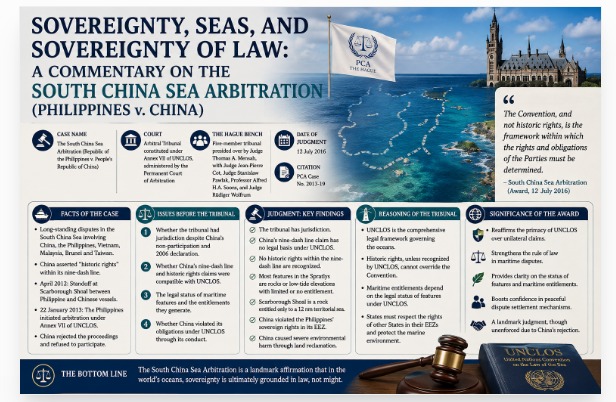
Case Details
Case Name: The South China Sea Arbitration (Republic of the Philippines v. People’s Republic of China)
Court: Arbitral Tribunal constituted under Annex VII of the United Nations Convention on the Law of the Sea (UNCLOS), administered by the Permanent Court of Arbitration,
The Hague Bench: Five-member tribunal presided over by Judge Thomas A. Mensah, with Judge Jean-Pierre Cot, Judge Stanislaw Pawlak, Professor Alfred H.A. Soons, and Judge Rüdiger Wolfrum
Date of Judgment: 12 July 2016
Citation: PCA Case No. 2013-19
Introduction
The South China Sea Arbitration stands as one of the most consequential rulings in the modern law of the sea. Brought by the Philippines against China in 2013, the dispute concerned competing claims over maritime entitlements, the status of various reefs and rocks, and China’s assertion of “historic rights” through its nine-dash line. The tribunal’s award, delivered on 12 July 2016, rejected China’s claims almost in their entirety, reaffirming the primacy of UNCLOS over unilateral historical assertions. The case is significant not only for its legal findings but for what it reveals about the limits of international adjudication when a major power refuses to participate.
Facts of the Case
Tensions in the South China Sea had simmered for decades, with China, the Philippines, Vietnam, Malaysia, Brunei, and Taiwan all asserting overlapping claims over islands, reefs, and surrounding waters. China’s claims rested substantially on the nine-dash line, a boundary first depicted on Chinese maps in the late 1940s, encompassing nearly the entire South China Sea and asserting historic rights over its resources.
Matters escalated in April 2012 when a standoff occurred between Philippine and Chinese vessels at Scarborough Shoal, after Philippine authorities attempted to inspect Chinese fishing boats accused of illegal fishing. China subsequently restricted Filipino access to the shoal’s waters. Frustrated by the failure of bilateral negotiations and regional diplomatic mechanisms to resolve the dispute, the Philippines initiated arbitration proceedings against China on 22 January 2013 under Annex VII of UNCLOS.
China rejected the arbitration from the outset, declining to appoint an arbitrator or participate in the proceedings, and reiterated its position through diplomatic notes and a position paper issued in December 2014. Despite China’s non-appearance, the tribunal proceeded under Article 9 of Annex VII, which permits arbitration to continue in the absence of one party, provided the tribunal satisfies itself of jurisdiction and the merits of the claim. The tribunal delivered a preliminary award on jurisdiction and admissibility on 29 October 2015, followed by its final award on the merits on 12 July 2016.
Issues Before the Court
The tribunal was asked to determine several interlinked questions. First, whether it had jurisdiction to hear the Philippines’ claims despite China’s non-participation and its 2006 declaration excluding certain disputes from compulsory settlement. Second, whether China’s nine-dash line and its claim to historic rights over resources within it were compatible with UNCLOS. Third, the legal status of various maritime features, namely whether they qualified as islands, rocks, or low-tide elevations, and the entitlements each generated. Fourth, whether China’s conduct, including land reclamation and interference with Philippine fishing and resource activities, violated its obligations under the Convention.
Arguments of the Parties
The Philippines argued that China’s nine-dash line claim had no basis in international law, as UNCLOS provided the exclusive framework for determining maritime entitlements, and that historic rights claims not expressly preserved under the Convention could not override it. It contended that features such as Scarborough Shoal and various reefs in the Spratly Islands were either rocks incapable of sustaining human habitation or economic life, and therefore entitled only to a limited territorial sea, or were low-tide elevations generating no entitlement at all. The Philippines further argued that China had violated its sovereign rights within its exclusive economic zone by interfering with fishing and hydrocarbon exploration, and had caused severe environmental harm through large-scale land reclamation and construction on reefs.
China did not formally submit arguments before the tribunal, maintaining that the dispute was fundamentally about territorial sovereignty and maritime boundary delimitation, matters it considered outside the tribunal’s jurisdiction and excluded by its 2006 declaration under Article 298 of UNCLOS. Through its position paper and public statements, China maintained that its historic rights in the South China Sea predated UNCLOS and were not displaced by it, and that the Philippines’ claims amounted to an abuse of process designed to circumvent negotiated settlement.
Judgment
The tribunal ruled overwhelmingly in favour of the Philippines. It held that it had jurisdiction over most of the Philippines’ submissions, finding that the dispute concerned the interpretation and application of UNCLOS rather than territorial sovereignty or maritime delimitation as such. On the merits, the tribunal concluded that China’s claim to historic rights over resources within the nine-dash line had no legal basis, as any such rights had been superseded by UNCLOS to the extent they exceeded the entitlements the Convention allows.
The tribunal further held that none of the features in the Spratly Islands were capable of generating an exclusive economic zone, and that of the seven features on which China had conducted land reclamation, four were classified as rocks and three as low-tide elevations incapable of appropriation. It found that China had violated the Philippines’ sovereign rights in its exclusive economic zone, interfered unlawfully with Philippine fishing at Scarborough Shoal, and caused severe damage to the marine environment through island-building activities.
Reasoning of the Court
The tribunal’s reasoning proceeded methodically through jurisdiction before merits. On jurisdiction, it distinguished between disputes over territorial sovereignty, which fall outside UNCLOS altogether, and disputes over the source and extent of maritime entitlements, which fall squarely within it. By characterising the Philippines’ claims as concerning entitlement rather than sovereignty, the tribunal avoided the jurisdictional bar that would otherwise have applied. It also rejected China’s implicit argument that the 2002 China-ASEAN Declaration on the Conduct of Parties in the South China Sea constituted a binding agreement requiring exclusive resolution through negotiation, finding the declaration to be a political document without binding legal effect.
On the substantive question of historic rights, the tribunal undertook a detailed textual and historical analysis of UNCLOS, concluding that the Convention was designed to establish a comprehensive framework for maritime zones that left no room for competing historic claims exceeding those zones, except where expressly preserved, such as historic bays or established fishing rights within a limited area. China’s nine-dash line claim, encompassing resource rights across most of the South China Sea, could not be reconciled with this framework and was therefore extinguished upon UNCLOS’s entry into force for China.
On the classification of maritime features, the tribunal applied Article 121 of UNCLOS, which distinguishes islands capable of sustaining human habitation or economic life, entitled to a full 200 nautical mile exclusive economic zone, from rocks, entitled only to a 12 nautical mile territorial sea, and low-tide elevations, entitled to none. The tribunal examined historical evidence of habitation and economic activity on the disputed features, concluding that none had sustained an independent, stable human community or non-extractive economic life, and were therefore rocks or low-tide elevations at best. This finding significantly curtailed the maritime space China could lawfully claim, even setting sovereignty questions aside.
On China’s conduct, the tribunal found that large-scale dredging and construction activities had caused irreparable harm to coral reef ecosystems, breaching China’s obligations under Articles 192 and 194 of UNCLOS to protect and preserve the marine environment. It also found that China’s law enforcement vessels had operated in a manner creating serious risk of collision, violating international navigational safety rules.
Significance of the Judgment
The award carries substantial weight for the law of the sea, even though the tribunal lacked enforcement powers and China refused to recognise the ruling. It clarified, for the first time in binding form, the relationship between historic rights claims and UNCLOS, confirming that the Convention’s framework prevails over generalised historical assertions. Its detailed application of Article 121 to the classification of maritime features has since become an influential reference point in other maritime disputes, narrowing the scope for states to claim expansive entitlements from minor features.
The ruling also demonstrated that arbitration under Annex VII can proceed meaningfully even when a major power boycotts the process, reinforcing the integrity of compulsory dispute settlement mechanisms under UNCLOS. At the same time, China’s continued rejection of the award and its ongoing activities in the region have exposed the practical limits of international adjudication absent an enforcement mechanism, raising broader questions about compliance and the authority of international tribunals in disputes involving major powers.
Conclusion
The South China Sea Arbitration represents a landmark contribution to the law of the sea, offering a rigorous and comprehensive interpretation of UNCLOS on questions of historic rights, maritime entitlement, and state responsibility for environmental harm. While China’s non-participation and continued non-compliance underscore the structural weaknesses of international dispute resolution, the award remains a significant legal precedent, shaping subsequent state practice and scholarly discourse. Its long-term influence will depend less on immediate compliance than on its gradual normative effect on how maritime claims are assessed and justified under international law.
References
- The South China Sea Arbitration (Philippines v. China), PCA Case No. 2013-19, Award, 12 July 2016.
- The South China Sea Arbitration (Philippines v. China), PCA Case No. 2013-19, Award on Jurisdiction and Admissibility, 29 October 2015.
- United Nations Convention on the Law of the Sea, 1982.
- Permanent Court of Arbitration, Press Release: The South China Sea Arbitration, 12 July 2016.
- Position Paper of the Government of the People’s Republic of China on the Matter of Jurisdiction in the South China Sea Arbitration, 7 December 2014.
