


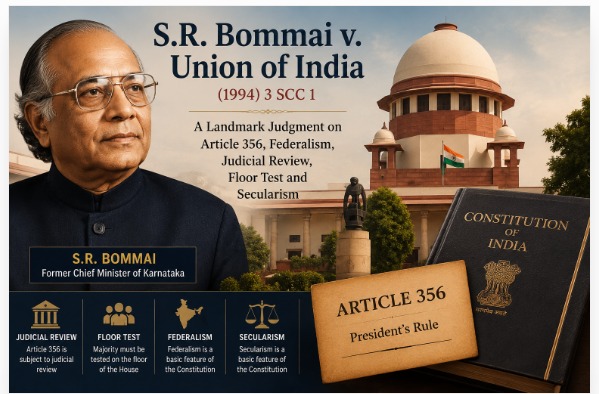
Case Details
Case Name: S.R. Bommai v. Union of India
Citation: AIR 1994 SC 1918; (1994) 3 SCC 1
Court: Supreme Court of India
Date of Judgment: 11 March 1994
Bench: Nine-Judge Constitution Bench
Constitutional Provisions: Articles 356, 355, 74, 163, 174 and related provisions concerning Centre-State relations
Introduction
S.R. Bommai v. Union of India is a landmark Supreme Court judgment that significantly shaped the constitutional limits on Article 356.
The Constitution of India establishes a federal system that divides powers between the Union and the States. However, Article 356 gives the Union an exceptional power to intervene in the functioning of a State when the State government cannot function in accordance with the Constitution.
In practice, governments often criticised Article 356 because successive Union Governments allegedly used it for political purposes, particularly to dismiss State governments led by opposition parties. The Supreme Court’s landmark decision in S.R. Bommai v. Union of India fundamentally changed this position by imposing significant constitutional limitations on the Union’s power under Article 356.
The judgment holds a prominent place in Indian constitutional law because it strengthened federalism, democratic accountability and judicial review. It also recognised secularism as a basic feature of the Constitution.
Facts of the Case
S.R. Bommai was the Chief Minister of Karnataka heading a Janata Dal government. In 1989, several legislators allegedly withdrew their support from his government. The Governor of Karnataka, P. Venkatasubbaiah, reported to the President that Bommai had lost the majority required to continue in office.
Bommai, however, claimed that he still commanded the confidence of the Legislative Assembly and requested an opportunity to prove his majority on the floor of the House.
Instead of allowing a floor test, the Governor recommended action under Article 356. The President subsequently issued a Proclamation imposing President’s Rule in Karnataka and the State Legislative Assembly was dissolved.
The controversy did not remain confined to Karnataka. Similar questions arose concerning the dismissal of governments in other States, including Meghalaya and Nagaland, as well as the proclamations imposed in Madhya Pradesh, Rajasthan and Himachal Pradesh in 1992. The Supreme Court therefore had to examine the constitutional limits on the use of Article 356.
Issues Before the Court
The Supreme Court was required to determine, among other things:
- Whether the President’s satisfaction under Article 356 is subject to judicial review.
- Whether the Governor can determine that a State government has lost its majority without requiring a floor test.
- Whether the President can dissolve the State Legislative Assembly before Parliament approves the Proclamation.
- Whether the Supreme Court can restore a dismissed State government if the Proclamation is found unconstitutional.
- Whether federalism and secularism form part of the basic structure of the Constitution.
- What constitutional limitations should govern the exercise of power under Article 356.
Judgment of the Supreme Court
The nine-judge Constitution Bench delivered its judgment on 11 March 1994. The Court significantly restricted the arbitrary use of Article 356 and laid down principles that continue to govern Centre-State relations.
1. Article 356 is subject to Judicial Review
One of the most important holdings was that the President’s satisfaction under Article 356 is not completely immune from judicial review.
The Union cannot simply argue that because Article 356 uses the expression “satisfaction of the President”, the courts have no authority to examine the decision.
The Court can examine whether there was relevant material supporting the Proclamation and whether the constitutional power was exercised within its limits.
This was a major constitutional safeguard because it prevented Article 356 from becoming an unchecked political power.
2. Majority must ordinarily be tested on the floor of the House
The Court made an extremely important distinction between the Governor’s opinion and the actual strength of a government in the Legislative Assembly.
If the question is whether the Chief Minister has lost majority support, the proper method is ordinarily a floor test.
The logic is simple:
The Governor should not decide who has majority support merely on the basis of letters, claims or counterclaims. The elected Legislative Assembly should determine it.
The Supreme Court later reiterated this principle, explaining that the Legislative Assembly represents the will of the people and that a government’s loss of confidence should ordinarily be demonstrated on the floor of the House.
3. Federalism is a basic feature of the Constitution
The judgment strengthened the federal character of the Indian Constitution.
Although India has a strong Union, the States are not merely administrative units of the Centre. They possess constitutionally protected powers and a constitutionally recognised political identity.
Therefore, Article 356 cannot be interpreted in a manner that destroys the autonomy of State governments.
The Court recognised federalism as an essential feature of the constitutional structure.
4. Secularism is part of the Basic Structure
Another major contribution of the judgment was its treatment of secularism.
The Court recognised secularism as a basic feature of the Constitution. Secularism does not merely mean tolerance of different religions; constitutionally, it requires the State to maintain equal treatment towards different religions.
Therefore, if a State government acts in a manner fundamentally inconsistent with constitutional secularism, such conduct can become relevant while examining whether constitutional machinery is functioning properly.
This part of the judgment connected Article 356 with the Basic Structure Doctrine.
5. Dissolution of the Legislative Assembly is not automatically valid
The Court also placed restrictions on the Union’s power to dissolve the State Legislative Assembly after issuing a Proclamation.
The existence of a Proclamation under Article 356 does not mean that every subsequent action of the Union automatically becomes constitutionally valid.
If the Proclamation itself is unconstitutional, the Court can provide an effective remedy.
This strengthened the principle that constitutional power remains subject to constitutional limitations.
Ratio Decidendi
The core principle emerging from S.R. Bommai is that:
The power under Article 356 is an exceptional constitutional power, not an unrestricted political power. Its exercise is subject to constitutional limitations and judicial review.
Where the question concerns the majority of a government, the appropriate constitutional mechanism is ordinarily the floor test, rather than the Governor independently determining the government’s majority.
The decision therefore transformed Article 356 from an area of largely executive discretion into one governed by constitutional accountability.
Critical Analysis
The significance of S.R. Bommai lies in the fact that the Court did not merely decide whether the dismissal of one particular government was valid. Instead, it addressed a much larger constitutional problem:
How can the Constitution prevent an exceptional emergency power from becoming a political weapon?
Before Bommai, Article 356 had been used repeatedly to dismiss State governments. The possibility of political misuse created tension between the Union and the States and weakened the federal principle.
The judgment responded to this problem through three major constitutional safeguards:
First, judicial review prevented the President’s satisfaction from becoming completely unquestionable.
Second, the floor-test principle reduced the possibility of Governors replacing constitutional determination with political assessment.
Third, recognition of federalism and secularism as constitutional fundamentals placed structural limits on the manner in which Article 356 could be used.
However, the judgment does not make Article 356 practically impossible to use. The provision remains an important constitutional mechanism for situations where constitutional government genuinely breaks down. The Court’s approach is therefore not to eliminate Article 356 but to ensure that it is used as an exceptional constitutional remedy rather than an ordinary political instrument.
Significance of the Case
The judgment has had a lasting impact on Indian constitutional law.
For Federalism
It strengthened the autonomy and constitutional position of State governments.
For Democracy
It reinforced the principle that the elected House, rather than the Governor’s subjective assessment, should ordinarily determine whether a government enjoys majority support.
For Judicial Review
It confirmed that even a high constitutional power exercised under Article 356 can be examined by courts.
For Secularism
It firmly recognised secularism as a basic feature of the Constitution.
For Centre-State Relations
It created constitutional restraints against arbitrary dismissal of State governments and therefore became a major authority on Indian federalism.
Conclusion
S.R. Bommai v. Union of India represents a major moment in the development of Indian constitutionalism. The judgment established that constitutional authorities must exercise their powers within constitutional limits.
Article 356 addresses genuine constitutional breakdowns; it does not empower the Union Government to remove State governments merely because they are politically inconvenient. By subjecting the exercise of Article 356 to judicial review, emphasising the importance of the floor test, and protecting federalism and secularism, the Supreme Court placed meaningful constitutional checks on the Union’s power.
The lasting message of S.R. Bommai is therefore simple: the Constitution does not merely confer power; it also controls the manner in which that power is exercised.
References
- S.R. Bommai v. Union of India, (1994) 3 SCC 1; AIR 1994 SC 1918 — Supreme Court of India, Nine-Judge Constitution Bench, 11 March 1994.
- Constitution of India, Articles 355, 356 and 357 — provisions dealing with the Union’s duty regarding States and President’s Rule.
- Rameshwar Prasad v. Union of India, (2006) 2 SCC 1 — important for understanding judicial review of Article 356 and dissolution of a State Assembly.
