


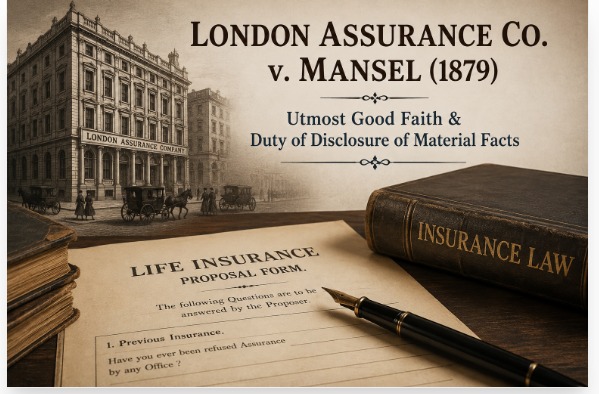
Case Details
Case: London Assurance Co. v. Mansel
Year: 1879
Citation: 11 Ch. D. 363
Court: Chancery Division, England
Judge: Jessel, M.R.
Subject: Insurance Law
Main Principle: Utmost good faith and disclosure of material facts
The case is mainly remembered for explaining the importance of complete disclosure by a person seeking insurance.
Introduction
London Assurance Co. v. Mansel (1879) is an important and frequently discussed case in insurance law, particularly in relation to the principle of utmost good faith (uberrimae fidei) and the duty of disclosure of material facts.
An insurance contract is different from an ordinary contract. In most ordinary contracts, both parties can independently investigate the subject matter before entering into the agreement. In insurance, however, the insurer often has to depend heavily on the information provided by the person seeking insurance. For example, in life insurance, the proposer may know about his previous insurance applications, health history, occupation, financial circumstances and other personal facts that may not be easily known to the insurer.
Because of this, the law requires the person seeking insurance to act with complete honesty and good faith. The proposer is expected to disclose facts that are material to the risk. A material fact is one which may influence a reasonable insurer in deciding whether to accept the risk, what premium to charge or what conditions to impose.
The case of London Assurance Co. v. Mansel is significant in insurance law because it dealt with the question of previous rejection of insurance proposals. The Court considered whether the fact that other insurance companies had previously refused to insure the proposer was something that he was required to disclose.
The case ultimately established that previous refusals by other insurance companies can constitute material facts, and failure to disclose such information may allow the insurer to avoid the contract.
Background of the Case
To understand the case properly, it is important to understand why insurance law places such importance on disclosure.
When a person applies for life insurance, the insurance company has to determine whether that person’s life represents an acceptable risk. The company does not know everything about the applicant. It therefore asks questions through the proposal form and relies upon the applicant’s answers.
Suppose, for example, that a person has already approached five insurance companies and all five have refused to insure him. If he approaches a sixth company and does not mention these previous refusals, the sixth company may believe that there is nothing unusual about his insurance history.
The insurer may therefore accept the proposal on terms that it would not have offered if it had known the complete history.
This is exactly the kind of problem that arose in London Assurance Co. v. Mansel.
Facts of the Case
Mr. Mansel wanted to obtain life insurance from the London Assurance Company.
As is usual in life insurance, he was required to complete a proposal form. The proposal form contained questions relating to his existing insurance and his previous dealings with insurance companies.
Mansel stated that he was already insured with two other insurance offices for a considerable amount and that those policies had been issued at ordinary rates.
However, there was an important part of his insurance history that was not disclosed.
Before applying to the London Assurance Company, Mansel had made proposals to several other insurance companies. Those companies had declined or refused his proposals.
The London Assurance Company was not initially aware of these previous refusals.
Later, the company discovered that other insurance offices had previously refused to accept proposals on Mansel’s life.
The company considered this information important because repeated refusal by other insurers could indicate that there were circumstances concerning Mansel’s risk which required further investigation.
The London Assurance Company therefore argued that Mansel had failed to disclose a material fact.
The dispute eventually came before the Court.
Main Issue Before the Court
The central question before the Court was:
Whether the failure of Mansel to disclose that other insurance companies had previously declined his proposals amounted to non-disclosure of a material fact, thereby giving the London Assurance Company the right to avoid the insurance contract.
The Court therefore had to determine:
- What amounts to a material fact in an insurance contract?
- Is previous rejection by another insurer a material fact?
- Does the proposer have a duty to disclose such information?
- Can an insurer avoid the policy when such information has not been disclosed?
Principle of Utmost Good Faith
The most important legal principle involved in the case is uberrimae fidei, meaning utmost good faith.
Insurance contracts are traditionally regarded as contracts of utmost good faith.
This principle requires both parties to act honestly, but the duty of disclosure is particularly important for the person seeking insurance because the proposer generally possesses information about the risk which the insurer may not possess.
For example, in life insurance, the proposer may know:
- his previous medical history;
- previous insurance applications;
- previous rejection of insurance;
- hazardous occupation;
- financial difficulties;
- previous claims; and
- other circumstances relevant to the risk.
If such information is material, it should be disclosed.
The principle is therefore based on the idea that:
The insurer should be given a fair opportunity to decide whether it wants to accept the risk after knowing the important facts relating to that risk.
Meaning of Material Fact
The concept of a material fact is central to the judgment.
A material fact is a fact which would influence the judgment of a prudent insurer in deciding whether to accept the risk or in determining the terms on which the insurance should be provided.
It does not necessarily mean that the fact must actually change the insurer’s decision.
The question is whether the fact is of such a nature that it could influence the insurer’s assessment of the risk.
For example, if an applicant for life insurance has a serious medical condition, that is obviously material.
Similarly, if an applicant has previously been refused insurance by several insurance companies, this may also be material because it may cause the insurer to ask:
- Why were the earlier applications rejected?
- Was there some medical problem?
- Was there some financial concern?
- Was there some unusual circumstance relating to the applicant?
- Was the risk considered too high by other insurers?
Therefore, previous rejection may be important even if the applicant does not know the exact reason for the rejection.
Arguments of the London Assurance Company
The London Assurance Company argued that Mansel had failed to provide the company with the complete information necessary to assess his risk.
The company’s arguments can be understood as follows:
1. Previous refusals were relevant
The company argued that the fact that other insurance companies had previously refused Mansel’s proposals was relevant to the assessment of his life insurance risk.
2. The information could influence the insurer
If the company had known that several other insurers had already rejected Mansel, it might have investigated his case more carefully.
It might have:
- requested additional medical information;
- charged a higher premium;
- imposed additional conditions; or
- refused to insure him altogether.
3. The duty of utmost good faith required disclosure
The company argued that Mansel could not simply provide technically correct answers while leaving out information which was important to the assessment of his risk.
4. The omission was material
According to the company, the previous refusals were not irrelevant personal information. They directly concerned Mansel’s history of obtaining insurance.
Therefore, the company argued that the omission was material non-disclosure.
Arguments of Mansel
Mansel disputed the insurer’s position.
His case could essentially be understood on the following grounds:
1. He had answered the proposal form
Mansel argued that he had provided the information asked for in the proposal form.
He had disclosed that he already held insurance policies with other companies.
2. He had successfully obtained insurance elsewhere
Mansel had not been completely unable to obtain life insurance. He already had insurance policies with other insurers.
Therefore, according to him, the fact that some other companies had refused his proposals did not necessarily mean that he represented an unacceptable risk.
3. No deliberate deception
Mansel’s position was that he had not deliberately made a false statement about his health or life expectancy.
He therefore disputed the suggestion that his conduct justified avoiding the policy.
4. Previous rejection should not automatically invalidate insurance
He essentially argued that the previous refusals did not necessarily establish that he was a bad insurance risk, especially when other insurers had accepted him.
Judgment of the Court
The Court decided in favour of the London Assurance Company.
The Court considered the previous refusals of insurance to be material information.
The reasoning was practical.
An insurance company is entitled to know information that may reasonably affect its decision to accept a particular risk. The fact that other insurance companies had already refused proposals concerning the same person’s life could reasonably influence the insurer’s assessment.
Therefore, Mansel should have disclosed those previous refusals.
His failure to do so amounted to material non-disclosure.
The insurer was consequently entitled to avoid the insurance contract.
Reasoning of the Court
The judgment is particularly important because it demonstrates that the Court does not look only at whether the proposer has made an outright false statement.
The Court looks at the overall truthfulness and completeness of the information provided.
A person cannot avoid the duty of good faith simply by saying:
“I did not make a false statement.”
There may be situations where a person gives a technically correct answer but still creates a misleading impression by leaving out an important fact.
For example, if an insurance proposal asks whether a person has insurance with other companies and the person says “yes”, but does not disclose that several other insurers had previously rejected him, the answer may technically contain some truth but still fail to provide the insurer with the complete material picture.
The Court therefore placed emphasis on the substance of the information rather than merely the technical wording of the answers.
What the Case Established
The case established several important principles.
First — Insurance is a contract of utmost good faith
The parties, particularly the proposer, must act honestly and fairly when entering into the insurance contract.
Second — Material facts must be disclosed
The proposer must disclose facts which may influence the insurer’s assessment of the risk.
Third — Previous insurance rejection may be material
If other insurers have previously refused a proposal, that information may be material and should be disclosed.
Fourth — Technical truth is not enough
A proposer cannot deliberately provide incomplete information and then argue that every individual answer was technically correct.
Fifth — Non-disclosure can have serious consequences
Where material information is suppressed, the insurer may be entitled to avoid the contract, subject to the applicable law.
Application in Indian Insurance Law
Although London Assurance Co. v. Mansel is an English case, its principle has been influential in the development of Indian insurance law.
Indian courts have repeatedly recognised the principle of utmost good faith in insurance contracts.
The same principle is particularly important in life insurance disputes where an insurer alleges that the insured:
- concealed a disease;
- gave incorrect information about health;
- failed to disclose previous insurance;
- concealed previous rejection;
- gave false information in the proposal form; or
- suppressed another fact which was material to the risk.
Indian courts have referred to London Assurance v. Mansel while dealing with questions relating to material non-disclosure.
Indian Legal Position
The principle of utmost good faith operates alongside Indian statutory law.
A. Indian Contract Act, 1872
Sections 17 and 18 deal with fraud and misrepresentation.
If a party deliberately provides false information or suppresses relevant information in circumstances amounting to fraud or misrepresentation, the contract may be affected according to the applicable legal principles.
B. Insurance Act, 1938
The Insurance Act, 1938 contains specific provisions governing insurance contracts.
For life insurance, Section 45 is particularly important. It places statutory restrictions on when a life insurance policy can be called into question on grounds such as misstatement or suppression of material facts.
Therefore, while the principle established in London Assurance v. Mansel remains important, an Indian court must also consider the requirements and protections provided by Indian legislation.
Application by Indian Courts
The principle from London Assurance v. Mansel has been considered by Indian courts in cases involving non-disclosure.
Mani Luxmi Patel v. Hindusthan Cooperative Insurance Society Ltd.
In this case, the Court considered the significance of previous insurance proposals being declined.
The principle recognised was that information about earlier refusals can be relevant because it may affect the insurer’s assessment of the risk.
This reflects the reasoning in London Assurance v. Mansel.
Smt. Benarasi Debi v. New India Assurance Co. Ltd.
The Patna High Court also considered the principle that information capable of influencing an insurer’s judgment can amount to a material fact.
The case demonstrates the continuing relevance of the duty of disclosure in Indian insurance law.
All India General Insurance Co. Ltd. v. S.P. Maheswari
The Madras High Court also referred to the principle of utmost good faith and cited London Assurance v. Mansel while discussing the obligation of an insured person to disclose material circumstances.
Thus, the English case has continued to have persuasive value in Indian insurance jurisprudence.
Simple Example to Understand the Case
Suppose A wants to purchase life insurance.
Before approaching Company X, A applies to five different insurance companies.
All five companies refuse his proposal.
A then approaches Company X.
Company X asks about his insurance history. A tells Company X that he already has one insurance policy with another company but does not mention that five other companies had rejected his proposals.
Company X accepts the policy.
Later, Company X discovers the previous rejections.
Under the principle of London Assurance v. Mansel, those previous refusals may be considered material facts, because Company X may have wanted to investigate the matter before accepting the risk.
This is the basic lesson of the case.
Importance of the Case in Insurance Law
The case is important because it explains why the duty of disclosure exists in insurance contracts.
Insurance companies cannot physically know every circumstance relating to the person or property they insure. They therefore depend upon information provided by the proposer.
If people were allowed to hide important information, insurance companies would be forced to accept risks without knowing their true nature.
This would ultimately affect the entire insurance system because insurers would have to compensate for unknown risks through:
- higher premiums;
- stricter conditions; or
- refusal to insure certain categories of people.
Therefore, the duty of disclosure protects not only the insurer but also the fair functioning of the insurance system.
Critical Understanding of the Case
The decision does not mean that an insured person has to disclose every single fact about their life.
The duty is limited to material facts.
For example, an applicant does not have to tell the insurer about every ordinary event in their life. The information must have some reasonable connection with the risk being insured.
The important question is:
Could this fact reasonably influence the decision of a prudent insurer?
If the answer is yes, the fact is likely to be material.
This distinction is important because otherwise the duty of utmost good faith could become unreasonable and impossible to comply with.
Relevance in Modern India
The principle remains relevant even today.
Modern insurance companies use detailed proposal forms, medical examinations, databases and technology to assess risk. However, the insurer still depends heavily upon the truthfulness of the information provided by the proposer.
For example, while purchasing life or health insurance, an applicant may be required to provide information regarding:
- existing illnesses;
- previous treatment;
- previous insurance;
- previous claims;
- occupation;
- lifestyle-related risks; and
- other relevant circumstances.
If a person knowingly conceals a material fact, the insurer may take action in accordance with the terms of the policy and applicable law.
Thus, the basic principle from London Assurance v. Mansel continues to have practical importance.
Conclusion
London Assurance Co. v. Mansel (1879) is an important case for understanding the principle of utmost good faith in insurance contracts.
The case arose because Mansel failed to disclose that several other insurance companies had previously refused his proposals. The Court considered this information material because it could influence the insurer’s assessment of the risk.
The judgment makes an important point: the duty of good faith is not satisfied merely by avoiding direct lies. A person seeking insurance must also disclose material information which could reasonably influence the insurer’s decision.
The case therefore established the importance of complete and honest disclosure in insurance contracts.
In India, this principle continues to be relevant and has been recognised by Indian courts while dealing with cases involving suppression of material facts, misrepresentation and non-disclosure. It operates together with the provisions of the Insurance Act, 1938 and the Indian Contract Act, 1872.
