


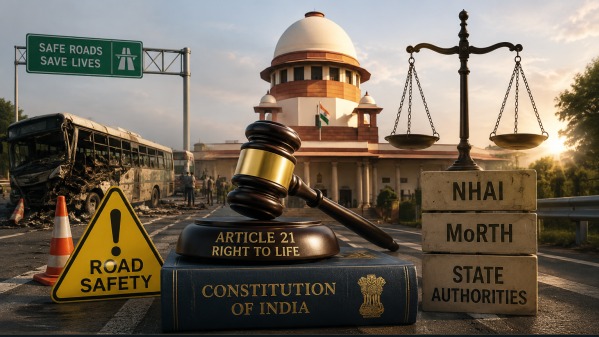
Case Details
- Case Name: In Re: Phalodi Accident v. National Highways Authority of India and Others
- Neutral Citation: 2026 INSC 388
- Court: Supreme Court of India
- Bench: Justice J.K. Maheshwari and Justice Atul S. Chandurkar
- Date of Judgment/Order: 13 April 2026
- Nature of Proceeding: Suo motu writ petition
- Key Provisions Involved: Article 21, Article 142, Control of National Highways (Land and Traffic) Act, 2002
- Prior Order in the Proceedings: Phalodi Accident, In re, 2025 SCC OnLine SC 2428
- Case Referred: Gyan Prakash v. Union of India, 2025 SCC OnLine SC 1189
Introduction
The Supreme Court took suo motu cognizance of two tragic highway accidents in late 2025 in In Re: Phalodi Accident v. NHAI. Together, these accidents claimed 34 lives in Phalodi, Rajasthan, and Rangareddy, Telangana. The Court did not treat these deaths as isolated tragedies. Instead, it identified a recurring pattern of administrative negligence across India’s national highway network. Consequently, the Bench used the proceedings to convert scattered infrastructural failures into a structured constitutional inquiry.
This commentary examines how the Court interpreted Article 21 as imposing a positive obligation on the State. It further analyses the wide-ranging interim directions issued under Article 142.
Facts of the Case
- On 2 and 3 November 2025, two separate accidents occurred within a span of two days.
- The first accident took place on the Bharatmala Expressway near Phalodi, Rajasthan. A tempo traveller rammed into a stationary trailer truck, killing ten women and four children.
- The second accident occurred in Rangareddy district, Telangana. Together, the two incidents caused 34 fatalities and left several persons injured.
- The Supreme Court took suo motu cognizance of these accidents shortly afterward. It issued notice to the National Highways Authority of India and the Ministry of Road Transport and Highways.
- The Court also sought a survey of unauthorised dhabas operating along the accident stretch. Additionally, it directed a report on road maintenance norms followed by contractors in the area.
- During subsequent hearings, the Solicitor General appeared for the NHAI and filed affidavits explaining the lapses. However, the Bench remained unsatisfied with NHAI’s tendency to shift blame onto contractors and local administration.
- Justice Maheshwari specifically questioned whether NHAI possessed independent statutory power to prevent encroachments.
- The Court noted that similar unresolved issues existed on highways passing through villages and institutions elsewhere, including Goa.
- Eventually, the Solicitor General and the Amicus Curiae jointly submitted suggestions for interim directions. The Court incorporated these suggestions into its order dated 13 April 2026.
Issues Before the Court
The Court examined several interlinked issues arising from the accidents.
- It considered whether commuter safety on highways falls within the scope of Article 21.
- It examined whether the State bears a positive obligation to prevent avoidable highway deaths.
- The Court assessed the institutional and regulatory gaps enabling illegal parking and encroachments.
- It considered whether existing enforcement mechanisms adequately addressed accident blackspots.
- The Bench examined whether interim directions under Article 142 were necessary and justified.
- The Court considered how to ensure coordinated compliance across NHAI, MoRTH, and State authorities.
Arguments
The Solicitor General, appearing for the Union and NHAI, placed affidavits on record explaining the circumstances of both accidents. NHAI’s report attributed several encroachments to local contractors and district administrations. However, the Bench pressed the Solicitor General to clarify which authority held legal responsibility for preventing unauthorised eateries near highways.
The Amicus Curiae argued that earlier judicial directions on encroachment removal had never been fully implemented. An intervenor further highlighted specific instances, including highways cutting through a medical college and inhabited villages in Goa. The intervenor also referred to an earlier Supreme Court judgment directing NHAI to develop a standard operating procedure for encroachment removal.
Ultimately, the Solicitor General and the Amicus Curiae jointly tendered concrete suggestions. These suggestions formed the basis for the interim directions the Court eventually issued.
Court’s Judgment
The Supreme Court issued a comprehensive set of interim directions under Article 142.
- The Bench prohibited heavy and commercial vehicles from parking on any highway carriageway or paved shoulder, except at designated bays or Wayside Amenities.
- It banned construction or operation of any new dhaba or commercial structure within the Right of Way of national highways.
- It directed District Magistrates to remove all unauthorised structures within 60 days under the CNH Act procedure. The Court further directed constitution of District Highway Safety Task Forces within 15 days in every district.
- It mandated Highway Surveillance Teams for regular patrolling, alongside NHAI’s existing route patrolling vehicles.
- The Bench ordered NHAI to operationalise its Advanced Traffic Management System across all 4- and 6-lane highways.
- It directed deployment of Basic Life Support ambulances and recovery cranes at intervals not exceeding 75 kilometres, within 60 days.
- The Court also required construction of truck lay-bye facilities at similar intervals and publication of a blackspot list within 45 days.
- Finally, it directed MoRTH to report on an Inter-State Highway Safety Coordination Committee.
The Registry was directed to circulate the order to Chief Secretaries, Directors General of Police, and State Legal Services Authorities. The matter stands listed after two months for compliance reporting.
Court’s Reasoning
The Bench grounded its reasoning firmly in Article 21 jurisprudence. It held that the right to life is not merely a guarantee against unlawful killing. Rather, Article 21 imposes a positive mandate on the State to ensure a safe living environment.
The Court reasoned that commuter safety forms an integral facet of the right to live with dignity. It observed that a highway, particularly a high-speed expressway, must not become a corridor of peril. Administrative lethargy or infrastructural gaps cannot justify avoidable loss of life.
The Bench further noted a stark statistical disparity. National highways constitute only about 2% of India’s total road length. Yet, they account for nearly 30% of all road fatalities in the country. This disproportion, the Court held, revealed systemic administrative failure rather than mere driver error. The Bench emphasised that no pecuniary or administrative constraint can outweigh the sanctity of human life. It therefore invoked Article 142 to issue interim directions with strict timelines.
The Court treated the urgency of implementation as inseparable from the constitutional obligation itself. Moreover, the Bench relied on existing regulatory frameworks, including the CNH Act, MoRTH’s ATMS policy circular, and NHAI’s DRAMS drone-survey policy. This approach anchored the directions in existing administrative capacity rather than creating entirely new obligations. The Court thereby avoided overreach while still compelling accountability.
Ratio Decidendi
The ratio of this judgment rests on three interlinked propositions.
- First, Article 21 imposes a positive obligation on the State to secure safe highway infrastructure for commuters.
- Second, systemic administrative negligence resulting in avoidable highway deaths constitutes a violation of this positive obligation.
- Third, where such systemic negligence is demonstrated through statistical and factual evidence, the Court may issue binding interim directions under Article 142.
These directions operate regardless of existing pecuniary or administrative constraints cited by authorities. Accordingly, the right to safe passage on highways stands recognised as a distinct facet of the right to life under Article 21.
Critical Analysis
This judgment marks a significant extension of Article 21 jurisprudence into highway governance. The Court’s reliance on statistical disproportion strengthens its reasoning considerably. Nearly a third of road deaths on merely 2% of road length demonstrates institutional failure convincingly.
Furthermore, the Court avoided vague moral exhortation and instead prescribed specific, time-bound directions. This precision distinguishes the order from many earlier public interest judgments on road safety.
However, certain concerns remain. The directions depend heavily on coordination between NHAI, State PWDs, District Magistrates, and police departments. Historically, such multi-agency coordination has proven difficult to sustain. Moreover, earlier directions on encroachment removal, as the Amicus Curiae noted, were never fully implemented. This history raises doubts about whether the present directions will fare differently. Nevertheless, the two-month compliance review mechanism offers a meaningful accountability check. The Court’s approach of building directions on existing policy circulars, rather than inventing new frameworks, also strengthens implementability. Additionally, the judgment sensibly addresses both structural causes, such as encroachments, and operational causes, such as emergency response delays. This dual focus reflects mature judicial understanding of road safety as a multi-causal problem.
Constitutional Significance
In Re: Phalodi Accident v. NHAI reaffirms and extends the doctrine that Article 21 encompasses positive State obligations. Earlier decisions had already recognised rights to health, environment, and livelihood within Article 21. This judgment now firmly situates highway safety within that expanding constitutional umbrella.
Furthermore, the Court’s invocation of Article 142 demonstrates the judiciary’s continuing role in addressing regulatory gaps. Where statutory enforcement mechanisms exist on paper but fail in practice, the Court can intervene through its complete-justice powers. This reflects a broader pattern of judicial governance in infrastructure and safety domains.
The judgment also reinforces cooperative federalism principles, given the directions addressed uniformly to both Union and State authorities.
Significance and Impact
This judgment carries substantial practical consequences for highway administration across India. NHAI, State PWDs, and district administrations now face binding, time-bound obligations. The directions on ATMS deployment, ambulance placement, and blackspot identification introduce measurable safety benchmarks. Subsequent judgments have already relied upon this order’s reasoning. Notably, in a later insurance dispute, the Court cited this judgment while extending third-party insurance coverage periods.
It reaffirmed that no administrative constraint outweighs the sanctity of human life. This citation indicates the judgment’s growing precedential weight beyond highway-specific disputes. Additionally, the requirement of circulation to Chief Secretaries and Directors General of Police ensures wide administrative awareness. The continuing nature of the proceedings, with periodic compliance reporting, allows the Court to monitor implementation closely.
Conclusion
The judgment of In Re: Phalodi v. NHAI represents a decisive judicial response to preventable highway deaths in India. The Court transformed two tragic accidents into a systemic constitutional inquiry under Article 21. It grounded highway safety firmly within the positive obligations flowing from the right to life.
Through precise, time-bound directions under Article 142, the Bench addressed encroachments, parking, surveillance, emergency response, and blackspots comprehensively.
Therefore, the judgment stands as an important precedent for infrastructure accountability. Its ultimate success, however, will depend on sustained compliance monitoring during the pending proceedings.
