


Case Details
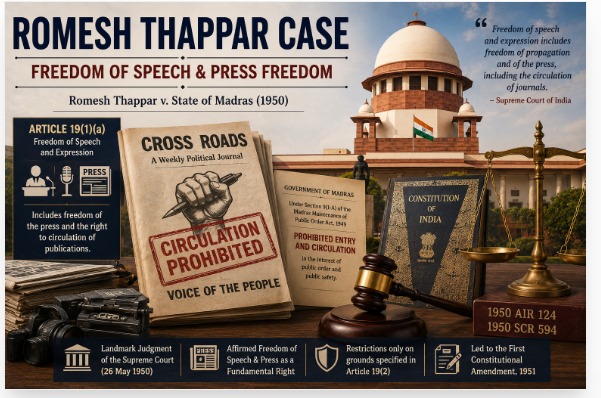
- Case Name: Romesh Thappar v. The State of Madras
- Court: Supreme Court of India
- Bench: 6-Judge Constitution Bench — Harilal Kania (C.J.), Saiyid Fazl Ali, M. Patanjali Sastri, M. C. Mahajan, B. K. Mukherjea, and S. R. Das, JJ.
- Date of Judgment: May 26, 1950
- Citation: 1950 AIR 124, 1950 SCR 594
Introduction
The judgment in the case of Romesh Thappar v. State of Madras (1950) represents one of the earliest and most significant rulings by the Supreme Court of India, coming in the wake of the Constitution’s passage in 1950.It laid down the framework for the interpretation of the right to freedom of speech and expression contained in the Constitution particularly Art 19(1)(a).
The Supreme Court held that the freedom of speech and expression includes freedom of propagation and of the press, including the circulation of journals. By this judgment, a state law restricting circulation of a political journal was declared as void on the ground that freedom of expression could not be curtailed in the name of public order unless it is specifically challenged as affecting security of the State. It led to the First Constitutional Amendment Act, 1951.
Facts of the Case
- The petitioner, Romesh Thappar, was a communist ideologue and journalist, and the printer, publisher, and editor of an English weekly journal, Cross Roads, circulated from Bombay. The journal regularly carried articles that were critical of the Union Government and the policy decisions of the state governments concerning the land reforms and the rights of citizens.
- In March 1950, the State Government of Madras, under the authority of section 9(1-A) of the Madras Maintenance of Public Order Act, 1949, issued a circular prohibiting the entry and circulation of Cross Roads in the State of Madras. The government has asserted its authority to take this action in the interest of “preventing or suppressing subversive processes” and “public order” and “public safety.”
- Romesh Thappar approached the Supreme Court directly under Article 32 of the Constitution by way of a writ petition challenging the impugned law on the ground that it was violating his fundamental rights under Article 19(1)(a) (Freedom of Speech and Expression) and Article 19(1)(g) (Freedom to practice any profession/trade).
- The State opposed maintainability of the petition on procedural ground that the petitioner should have approached high court under Article 226 before approaching this court under Article 32.
Issues before the court
1. Whether by virtue of Article 32 of the Constitution an aggrieved party is entitled to go directly to the Supreme Court which is not bound to decide any dispute unless the remedy sought is not available in the High Courts under Article 226 of the Constitution.
2. Whether the freedom of speech and expression under Article 19(1)(a) of the Constitution of India includes freedom of the press and the right to circulation of publications.
3. Whether the imposition of restriction on the freedom of publication by virtue of Section 9(1-A) of the Madras Maintenance of Public Order Act, 1949 was justified as a “reasonable restriction” under Article 19(2) in the original draft?
Petitioner’s Arguments
• Direct Access to Article 32:
The petitioner claimed that Article 32 is a fundamental right in itself,and so the Supreme Court is the ultimate authority for the enforcement of fundamental rights which cannot be pre-conditioned upon approaching the High Courts.
•Inclusion of Press Freedom:
It was argued that freedom of speech is meaningless without the freedom of dissemination and circulation. Banning circulation directly limits freedom of speech.
•Unconstitutional Restrictions: Counsel filed that the term “public order” was not enumerated among the grounds for restricting speech under the original Article 19(2), making any restriction on the broad grounds of public order unconstitutional.
Respondent’s arguments
•Procedural Hierarchy: The State contended that for the sake of order and hierarchy, the petitioner had to approach the Madras High Court under Article 226.
•Public Safety as Security: The State contended that “public safety” and “public order” were but different
ways of referring to the “security of the State,” which fell within the category of permissible restrictions under Article 19(2).
•State Necessity: The State contended that by reason of the general sovereignty, the maintenance of law and order in the State is a matter which justifies the censorship of any publications prejudicial to such interest.
Judgement
The court ruled in the favor of petitioner.
1. Maintenability under Article 32: A bare reading of Article 32 makes it amply clear that it confers a right upon any person to directly approach the Supreme Court for the enforcement of his or her fundamental rights.
2. Freedom of circulation: The petitioners’ right to freedom of speech and expression included the right to propagate their ideas by way of publications and the exercise of their freedom of circulation was therefore directly infringed.
3. Invalidity of Section 9(1-A): Section 9(1-A) of the Madras Maintenance of Public Order Act 1949 was therefore declared to be void by the Supreme Court as being in conflict with Article 19(1)(a) of the Constitution, under Article 13(1).
Reasoning of the Court
- Article 32 as a Constitutional Protector:
“The Court went to say that the Supreme Court is a Court of original jurisdiction in matters pertaining to the protection and restoration of Fundamental Rights, and that it was, therefore, a Court of first instance and that this Court could not refuse to entertain such a petition on the ground that the petitioner had not made an application to the High Court.”
- Circulation as the Vital Spark of Press Freedom:
“The freedom of the press, it was further said, being but a freedom of circulation includes the right of circulation of ideas; circulation is the vital spark and without it publication is but a meaningless act; consequently, a prohibition of circulation per se was an infringement of Article 19(1)(a).”
- Public Order and Security of the State Distinguished:
“Upon an analysis of the First Constitution of 1950, the Court concluded that ‘contempt of court, defamation, etc., and matters relating to the security of the State’, were amongst the grounds on which restriction on freedom of speech and expression could be imposed but that ‘public order’ was not the same thing as ‘security of the State.’ The Court also stated that laws which made restrictions on the grounds of ‘public order’ or ‘public safety’ wider than those specifically enumerated in Article 19(2) were “unconstitutional and void” because they went beyond the limitations specifically authorized by the Constitution.”
Significance of the Judgement
• Genesis of Press Freedom in India: Though the text of the Indian Constitution does not explicitly mention “freedom of the press”, Romesh Thappar laid down that it was implicitly covered under Article 19(1)(a).
• The First amendment to the constitution (1951): The very first ruling along with another case called Brij Bhushan v. State of Delhi prompted the government to act because they felt that they were not able to control public order. Thus, the parliament passed the constitution (first amendment) act, 1951 which added ‘public order’, ‘incitement to an offence,’ and ‘friendly relations with foreign States’ to the list of reasonable restrictions under article 19(2).
• Who enforced Article 32: In particular, Romesh Thappar’s judgment enforced Article 32 of the Indian Constitution, which justiciably empowered the Supreme Court to issue writs for the redress of any fundamental right violation.
Conclusion
The case of Romesh Thappar v. State of Madras (1950) is a significant one in the history of the Indian democratic setup. It is because of this judgment that the right to freedom of speech and the expression came to be related to the press and the circulation of ideas, and it became next to impossible to ban any publication by the government for questioning them.The judgment made a significant contribution to the development of a particular constitutional convention that the liberties established by the constitution are inalienable, and it is the duty of the state to protect them.
References
1. Romesh Thappar v. State of Madras, 1950 AIR 124; 1950 SCR 594.
2. Brij Bhushan v. State of Delhi, 1950 AIR 129.
3. Constitution of India, 1950 (Articles 13, 19, 32, and 226).
4. Constitution (First Amendment) Act, 1951.
5. Madras Maintenance of Public Order Act, 1949 (Section 9(1-A)).
