


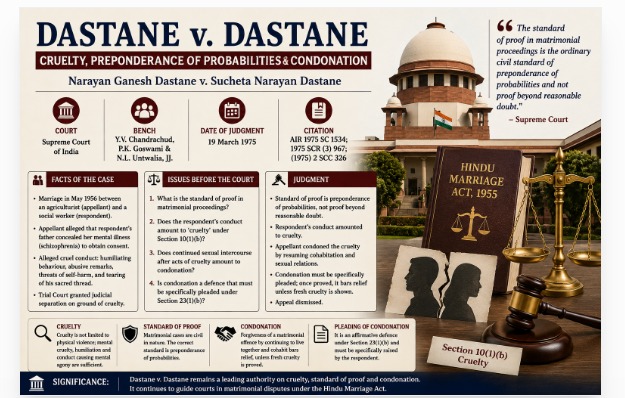
Case Details
| Case Name | Narayan Ganesh Dastane v. Sucheta Narayan Dastane |
| Court | Supreme Court of India |
| Bench | Y.V. Chandrachud, P.K. Goswami and N.L. Untwalia, JJ. (opinion authored by Chandrachud, J.) |
| Date of Judgment | 19 March 1975 |
| Citation | AIR 1975 SC 1534; 1975 SCR (3) 967; (1975) 2 SCC 326 |
Introduction
Dastane v. Dastane is one of the most frequently cited Supreme Court decisions on matrimonial law in India. Decided under the Hindu Marriage Act, 1955, before the Act recognised “irretrievable breakdown” as a ground for divorce, the case remains important for two reasons that go beyond its facts. First, it settled the standard of proof applicable in matrimonial litigation, rejecting the higher criminal standard of proof beyond reasonable doubt in favour of the ordinary civil standard of preponderance of probabilities. Second, it clarified the legal content of “cruelty” under Section 10(1)(b) of the Act and explained how the doctrine of condonation operates once cruelty is established. The judgment, authored by Chandrachud, J., continues to be relied upon in matrimonial disputes decided under the amended Section 13(1)(i-a) of the Act.
Facts of the Case
The appellant, Dr. Narayan Ganesh Dastane, held a postgraduate degree in agriculture from Poona University. The respondent, Sucheta, was a graduate of Delhi University who had also obtained a Master’s degree in Social Work. Their marriage was arranged by the respondent’s father in April 1956 and solemnised in May 1956. Before the marriage, the respondent’s father had written to the appellant’s family disclosing that she had suffered a severe attack of sunstroke and, later, cerebral malaria, which had temporarily affected her mental condition, and that she had since recovered.
After the marriage, relations between the couple deteriorated. The appellant later discovered, or claimed to have discovered, that the respondent had in fact been treated for schizophrenia at the Yeravada Mental Hospital, Pune, and alleged that her father had fraudulently concealed this fact to induce his consent to the marriage. He also alleged a persistent course of cruel conduct by the respondent during the marriage, including humiliating and insulting remarks made in front of others, threats to end her own life, and an incident in which she tore off his sacred thread in a fit of temper. Three daughters were born of the marriage.
The appellant instituted proceedings before the trial court, primarily seeking annulment of the marriage on the ground that his consent had been obtained by fraud under Section 12(1)(c) of the Act, and, in the alternative, judicial separation on the ground of cruelty under Section 10(1)(b). The trial court rejected the fraud allegation but held that the respondent had treated the appellant with cruelty and granted a decree of judicial separation. This finding was reversed in the first appeal, and the matter reached the High Court in second appeal, which restored the trial court’s finding that cruelty was proved, but denied relief on the ground that the appellant had condoned the cruelty by continuing to cohabit with, and have sexual intercourse with, the respondent after the acts complained of. The appellant then approached the Supreme Court under Article 136 of the Constitution.
Issues Before the Court
The Supreme Court framed four principal questions for determination for Dastane v. Dastane case:
first, whether the standard of proof required in matrimonial proceedings under the Hindu Marriage Act is proof beyond reasonable doubt, as in criminal cases, or the ordinary civil standard of preponderance of probabilities;
second, whether the conduct attributed to the respondent amounted to “cruelty” within the meaning of Section 10(1)(b) of the Act;
third, whether continued sexual intercourse after knowledge of the cruel acts amounted to condonation in law; and
fourth, whether condonation, as a matter of pleading and procedure, had to be specifically raised as a defence under Section 23(1)(b) before a court could act upon it.
Arguments of the Parties
On behalf of the appellant, it was argued that the respondent’s conduct through the marriage, taken cumulatively, established a clear pattern of cruelty. It was contended that she had persistently humiliated him, both in private and before third parties, had questioned his competence and status, had threatened self-harm to control and intimidate him, and had, on one occasion, torn off his sacred thread in his presence, an act said to carry particular significance given his religious sentiments. It was further argued that any resumption of cohabitation after such incidents did not, and should not, amount to condonation, since it occurred only in an attempt to preserve the marriage and did not signify forgiveness of the respondent’s conduct.
On behalf of the respondent, it was argued that the allegations of cruelty were exaggerated, inconsistent, and largely uncorroborated, and did not meet the threshold required to prove cruelty of a kind that would justify judicial separation. It was further argued, and this became central to the case, that even if some of the incidents were true, the appellant had continued to live with the respondent and had sexual relations with her well after the alleged acts, which in law amounted to condonation. Since there was no evidence of any fresh act of cruelty after the alleged condonation, the respondent contended that the condoned cruelty could not be revived to found a decree of judicial separation.
Judgment
The Supreme Court dismissed the appellant’s appeal. It held that the correct standard of proof in matrimonial cases under the Hindu Marriage Act is the ordinary civil standard of preponderance of probabilities, and not the criminal standard of proof beyond reasonable doubt. Applying this standard, the Court agreed with the concurrent findings below that the respondent’s conduct did amount to cruelty within the meaning of Section 10(1)(b). However, the Court also held that the appellant had, in law, condoned this cruelty by resuming cohabitation and continuing marital relations with the respondent with full knowledge of her conduct. Since condonation restores the offending spouse to the same position as before the matrimonial offence, subject to the implied condition that the misconduct will not be repeated, and since there was no evidence of any fresh cruelty after condonation, the appellant was not entitled to a decree of judicial separation. On the question of pleading, the Court held that although Section 23(1)(b) requires a court to be satisfied that there has been no condonation before granting relief, this is a statutory duty cast on the court itself and does not depend on the respondent having specifically pleaded condonation as a defence.
Reasoning of the Court
On the standard of proof, the Court reasoned that matrimonial proceedings are civil in nature and result in civil consequences, not penal ones, and there was no statutory basis for importing the higher criminal standard into them. It held that the correct test is whether the preponderance of probabilities establishes the alleged act, not whether every reasonable hypothesis of innocence has been excluded. At the same time, the Court cautioned that the degree of probability required should be commensurate with the seriousness of the allegation, so that grave charges such as adultery or cruelty must still be proved by evidence of a cogent and convincing character, even though the ultimate legal standard remains the civil one.
On cruelty, the Court declined to lay down a rigid or exhaustive definition, noting that the term is deliberately left undefined in the Act so that courts may assess conduct according to the particular facts, social background, and sensibilities of the parties before them. It held that cruelty consists of conduct of such a nature as to cause a reasonable apprehension in the mind of the petitioner that it would be harmful or injurious to continue living with the respondent. On the facts, the cumulative effect of the respondent’s conduct, particularly the persistent humiliation and the threats of self-harm, was found to satisfy this test, even though no single incident, viewed in isolation, might have sufficed.
On condonation, the Court explained that forgiveness of a matrimonial offence, followed by restoration of the offending spouse to their original position, constitutes condonation, and that sexual intercourse with knowledge of the misconduct is ordinarily strong evidence of such forgiveness. Condonation, the Court held, is always conditional: it operates on the implied condition that the offending spouse will not repeat the matrimonial misconduct, and revives if that condition is broken. Since the appellant could point to no evidence of cruelty committed after the period of condoned cohabitation, the original cause of action stood extinguished and could not be revived merely by the breakdown of the relationship at a later stage. The Court further reasoned that Section 23(1)(b) imposes an independent obligation on the court to satisfy itself on the question of condonation, which operates regardless of whether the respondent has raised it as a pleaded defence, since the provision is framed as a bar on the court granting relief rather than as a right vesting solely in the respondent.
Significance of the Judgment
Dastane v. Dastane remains a foundational authority on two distinct points of matrimonial law. Its clarification that the civil standard of preponderance of probabilities, rather than proof beyond reasonable doubt, governs matrimonial proceedings has been consistently followed in subsequent cases and has shaped the evidentiary approach of family courts across India. Its treatment of cruelty as a question of fact, to be assessed cumulatively and contextually rather than through a fixed definition, laid the groundwork for the more expansive understanding of mental cruelty developed in later decisions, including Samar Ghosh v. Jaya Ghosh. The judgment’s reasoning on condonation is also significant in practice, since it clarifies that a spouse who resumes cohabitation does not thereby forfeit the right to rely on earlier misconduct if that misconduct recurs, while equally making clear that condoned conduct cannot, without more, found a fresh claim for relief.
Conclusion
Dastane v. Dastane illustrates the Supreme Court’s effort to balance two competing concerns in matrimonial law: protecting spouses from genuinely injurious conduct, while not allowing every marital friction to be elevated into a ground for judicial separation or divorce. By fixing the standard of proof, giving content to the concept of cruelty without freezing it into a rigid formula, and explaining the conditional nature of condonation, the Court produced a framework that has outlasted the specific facts of the case. Its continuing relevance, five decades later, in disputes concerning mental cruelty and condonation confirms its place as a leading precedent in Indian family law.
References
- Narayan Ganesh Dastane v. Sucheta Narayan Dastane, AIR 1975 SC 1534.
- The Hindu Marriage Act, 1955, ss. 10, 12, 13, 23.
- Samar Ghosh v. Jaya Ghosh, (2007) 4 SCC 511.
- Paras Diwan, Law of Marriage and Divorce (6th edn., Universal Law Publishing).
