


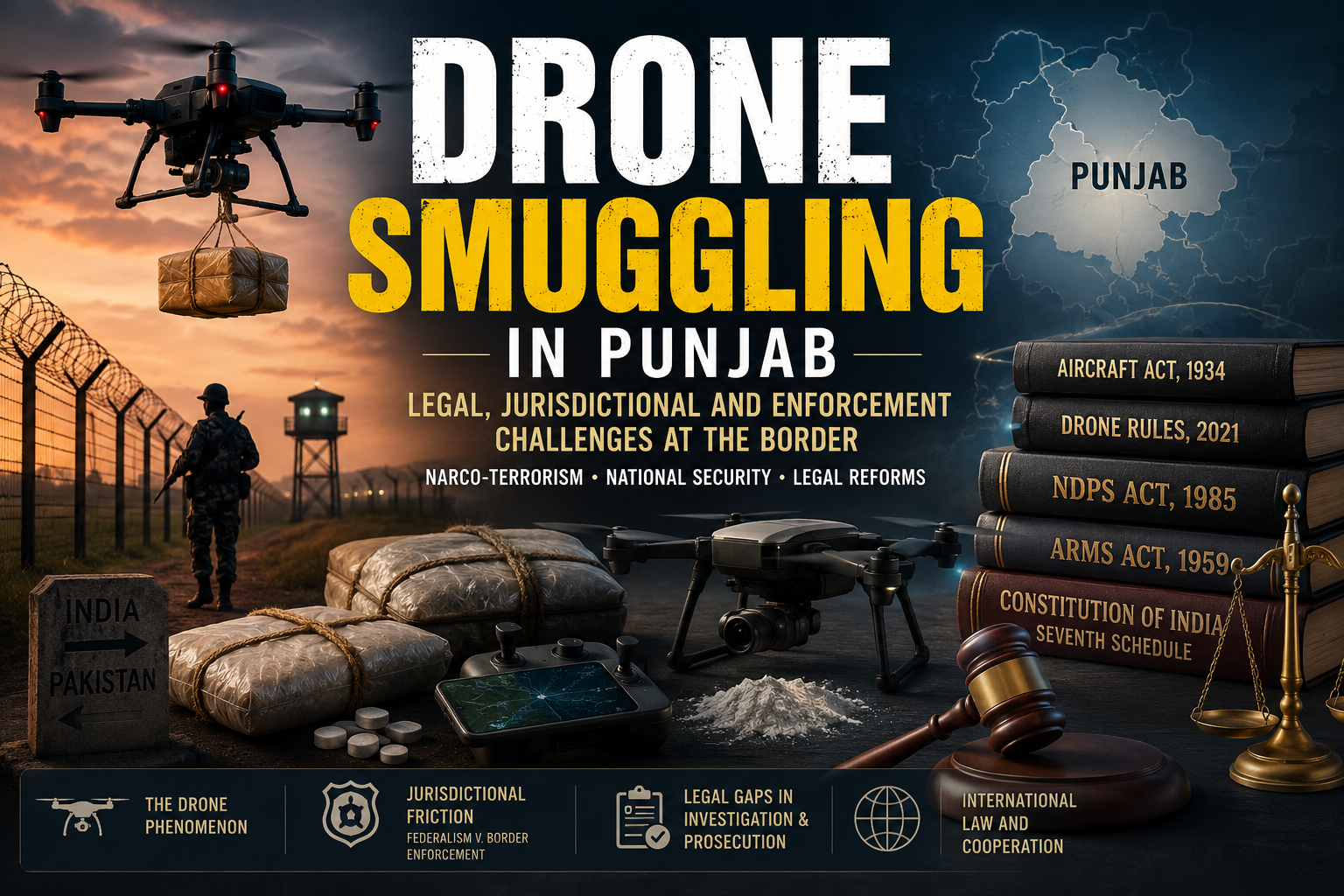
Introduction
Punjab province has a sensitive international border with Pakistan spanning 553 km. This border has turned from a security zone to a battleground, and a transit point for organized crimes. The challenge of patrolling this border is compounded by rivers, forests, and fogs that lie between the disputed Line of Control. While the fence along the border has played an effective role, the methods of smuggling has also evolved over time hence the need to develop new detection and apprehension approaches. National security has been compromised by human smuggling and narco-terrorism in Punjab province. The latter has become a serious challenge as heroin, narcoticsand advanced weaponry are being smuggled through the porous border to fund terror activities.This is undermining the country’s economy as heroin addiction has adverse economic impacts while fueling terrorism. The techniques and technology of smuggling has advanced but investigation and punishment processes are still lagging behind.
The Drone Phenomenon: Technological Progress and Statutory Vacuum Essay
The most significant change that has had an adverse impact on Punjab’s border security is the use of commercial and custom-built drones by smugglers. Such Unmanned Air Vehicles (UAVs) facilitate the dropping of weapons and narcotics by the smugglers deep into Indian territory – past the border fence and beyond the reach of conventional ground sensors.
When it comes to drone smuggling, India’s legal framework is in serious disarray:
- Aircraft Act, 1934: The very fact that India has been using this law to prosecute unauthorized drone flights highlights the inadequacy of the legal arsenal. The Aircraft Act only governs “aviation” in India, including regulations concerning “aircraft” and “air navigation.” It does not have penal provisions targeting hostile, unmanned flights violating the territorial airspace of the state.
- Drone Rules, 2021: The recent rules are primarily meant for commercial and hobbyist drone operations, and they have minimal punitive measures for unauthorized flights. The rules are largely compliance-oriented for registered drone operators. There are no specific rules for dealing with unauthorized UAV operations originating from outside India and intruding upon Indian airspace.
Therefore, authorities prosecuting drone smuggling cases rely on either the Narcotic Drugs and Psychotropic Substances Act, 1985 or the Arms Act, 1959 depending on what the drone was carrying. The NDPS Act and the Arms Act do a decent job when it comes to punishing the domestic recipients of the smuggled cargo. However, as far as prosecuting the actual unauthorized drone flight violating Indian airspace is concerned, the NDPS Act and the Arms Act are wholly inadequate. The fundamental problem is that there are no standard procedures for examining the digital evidence and extracting the flight data records from the drone’s onboard computer. It is challenging enough to obtain sufficient forensic evidence against the smuggler if the drone was flying on autopilot.
Jurisdictional Friction: Federalism vs. Border Enforcement
National security is a federal subject under the Union List of the Seventh Schedule of the Indian Constitution. By contrast, “Public Order” and “Police” are under the State List. This has resulted in severe jurisdictional friction over enforcing laws along the Punjab border.
The flashpoint was when the then ministry of home affairs notified an extension of the jurisdiction of the Border Security Force (BSF) from 15 km to 50 km inside the international border in Punjab. The reason was that drones were able to carry payloads of smuggled goods several kilometers beyond the fence. There was no doubt that the area under the aegis of the BSF had to be extended for them to be able to conduct effective surveillance and arrest operations. However, the extension soon led to serious constitutional and legal fallout.
- The fallout was because:
The extension of the jurisdiction of the BSF up to 50 km inside the international border was seen by the State Government of Punjab as a usurpation of the police powers vested in it under the Constitution – and they took the matter to the Supreme Court in the biggest constitutional tussle between the Union and the States in recent years;
While the BSF has been directed to take over the jurisdiction beyond 15 km along Punjab’s international borders, in reality it has neither machinery nor manpower to investigate or press charges. It has to handover any seized material and arrested persons to the Punjab Police who investigate and press charges in accordance with the law. Now if the jurisdiction of the BSF extends to 50 km inside the international border, who investigates and presses charges? The Punjab Police – since they have to investigate every complaint and conduct all preliminary inquiries in criminal cases.
The problem with this understanding – also brought out by the counsel for the Union in the Supreme Court – is that there will be utter confusion in enforcing the law if police jurisdictions are not clearly demarcated. If the BSF has extended jurisdiction up to 50 km, it includes several towns and a large number of densely populated areas. Which agency investigates and presses charges? Which one conducts surveillance and arrests? Since the BSF does not conduct investigations and press charges, it cannot be doing surveillance too.
It is clear that without clarity on police jurisdictions, smuggling activities will flourish. For example, if a person is arrested by the BSF personnel, how long can they detain him before handing him over to the Punjab Police? If the Police conduct raids without the knowledge of the BSF or the coordination with them, then the defence counsels will have a field day during bail applications and trials.
Evidentiary Hurdles and Judicial Interpretations
It is very difficult to secure convictions in cases of cross-border smuggling along the Punjab border in the Indian judicial system due to the complex nature of such cases. This is because in most instances, the actual masterminds of the crime are based outside of India, and hence beyond the jurisdiction of Indian courts. Only the local couriers or low-level participants in the crime, usually poor and addicted along the border are charged and brought to trial.
- The Standard of Proof under the NDPS Act:
The NDPS Act, particularly in provisions like Section 37, imposes a very heavy burden on granting bail in case of commercial quantities of contraband. It also overburdens the accused under sections 35 and 54 of the act by shifting the burden of proof over a culpable mental attitude and possession. On the flip side, the Supreme Court of India has time and again in various judgments highlighted that the higher the law, the higher is the standard of procedural propriety that is expected from the investigating agencies. The Indian courts have in various high-profile border smuggling cases acquitted the accused due to the lack of these standards being met by the investigative agencies.
Some of these issues in border smuggling cases of NDPS Act violations that keep surfacing in Indian judiciary include:
- Challenges under Section 42 and 50
Any failure by the Border Security Force and local police to follow due procedure while conducting a search, including informing the accused of their right to produce the search before a Gazetted Officer or Magistrate, results in the entire trial being vitiated.
Drones and the Conscious Possession Conundrum In cases where drones are used for dropping packets of heroin in agricultural fields overnight, the determination of conscious possession is very tough, especially if the owner of the land or a passer- by is arrested by the police in the proximity of the agricultural field where the packet was found. For conscious possession to be established, the prosecution will be required to present airtight circumstantial and electronic evidence.
- Section 25 of the Evidence Act
The Toofan Singh vs State of Tamil Nadu case determined that the central enforcement agencies’ members, like the BSF, are considered police officers under section 25 of the Evidence Act.Therefore, any confession made by an accused person to them will be deemed as invalid. As such, the prosecution will have to rely on physical and electronic evidence to convict the local courier in cases involving drones being used to smuggle arms or drugs from across the borders.
International Law and Bilateral Limitations
Cross-border smuggling in the Punjab region is a transnational crime that is addressed by international law, but the measures are local. The syndicates operating from the Pakistani side are under the protection of their state, and the international legal framework is irrelevant.
Although India and Pakistan are signatories to the UN Convention against Illicit Traffic in Narcotic Drugs and Psychotropic Substances of 1988, the bilateral nature of the problem does not allow for meaningful action on both sides. The legal tools, such as Mutual Legal Assistance Treaties or Interpol Red Notices, are ineffective when state structures turn a blind eye to the activities of narco- terrorist groups. Thus, India cannot prosecute the masterminds behind the Pakistani heroin flood into Punjab, and the problem is only addressed locally.
Conclusion
The nexus between drones, narco-terrorists, and the jurisdictional tug of war between the Center and the states poses a critical challenge to the national security of Punjab. If India wants to protect its borders and ensure that such a low conviction rate does not become an incentive for terrorists, then India needs to improve its legal system. Legalizing the drone problem, which is currently a non-issue, is the first step towards upgrading the legal system. For this, Parliament needs to formulate an anti-rogue drone and airspace security law that proscribes the unauthorized, weaponized, or smuggling use of UAVs. It also needs to define the evidential standards for digital data on each rogue drone.
Secondly, the federal tug of war needs to be resolved once and for all by forming a joint investigative agency for Punjab and the concerned agencies need to be directed to work in consonance. A Joint Border Investigative Command (JBIC) needs to be formed statutorily in Punjab. The BSF and the Punjab Police need to coordinate their investigative efforts and the border security operations of the BSF need to be made complementary to the investigative requirements of the Punjab Police.
The third step would be directing the lower courts to create technical wings that can expedite proceedings relating to border-related issues. Only then will the legal system catch up with technology and be able to plug the cracks in the border security mechanism of Punjab.
References
- Constitution of India, Seventh Schedule.
- Aircraft Act, 1934.
- Drone Rules, 2021.
- Narcotic Drugs and Psychotropic Substances Act, 1985.
- Arms Act, 1959.
- Indian Evidence Act, 1872.
- Border Security Force Act, 1968.
- Toofan Singh v. State of Tamil Nadu, (2021) 4 SCC 1.
- https://indiankanoon.org/doc/143202244/
- United Nations Convention Against Illicit Traffic in Narcotic Drugs and Psychotropic Substances, 1988.
- Ministry of Home Affairs, Government of India — notifications concerning BSF jurisdiction.
- https://lawarticle.in/drug-courts-in-india-a-missed-opportunity-for-rehabilitation/
- Directorate General of Civil Aviation (DGCA).
