


Introduction
Given the explosive spread of AI, machine learning, deep-fakes and generative models, technology and the law are at an unprecedented crossroads. Indian courts, alongside their international counterparts, are grappling with a complex new issue: Can a computer system participate in proceedings as a witness and how ought testimony based on artificially created evidence be considered by a court? Historically, the discipline of evidence was founded upon the sensory capacity, retention power and private knowledge of a human being.
At present, an AI device scans for surveillance, provides live-generated transcripts, weaves together artificial media, assesses risks of criminal recidivism or creates autonomous forensic reports.
However, as AI begins to transform from a passive tool wielded by human hands into an independent entity forming its own determinations, the Indian Evidence Act is expected to overcome some core structural issues relating to personhood, truthfulness, admissibility and constitutional rights.
The Legal Framework: Can AI Be a Witness Under Indian Law?
To see if it is permissible to stand an AI in the ‘witness box’ it is vital to analyze the legal concept of what constitutes ‘a witness’ and the statutory restriction of a ‘competent’ witness as regards the Indian law of evidence.
1. The Natural Person with Natural capacity
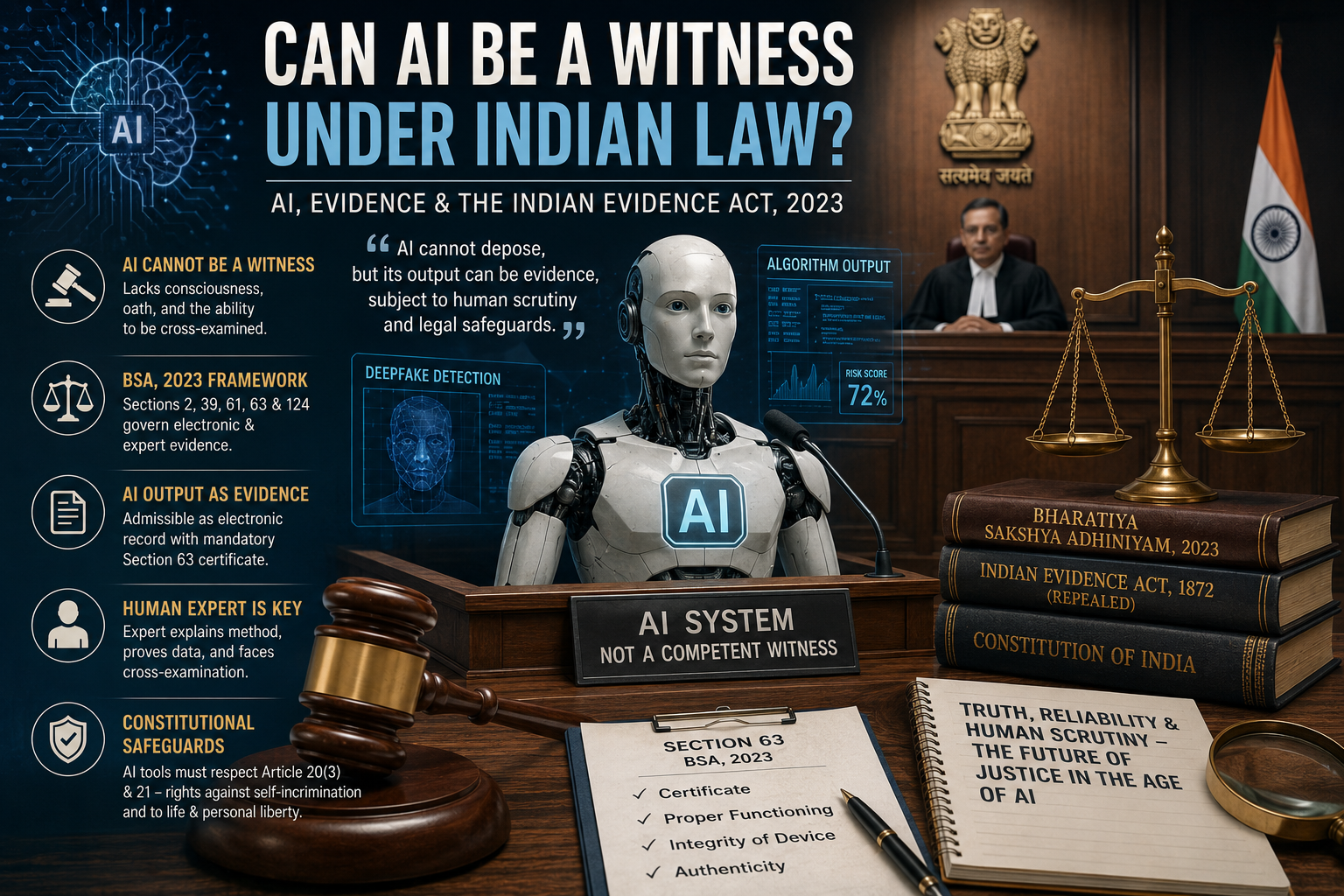
- As it is a universally recognized principle and as interpreted by the Indian laws, a witness means a human being who is in a position to understand a question, to perceive a fact with the senses, the nature of which is amenable to understanding and ability of judgment or is rationally able to articulate an answer.
- The competency of witness to give testimony is determined by the provision of the section 124 of the Bharatiya Sakshya Adhiniyam, 2023(BSA), which is the same as section 118 of Indian Evidence Act, 1872 (repealed legislation) and lays down that, “All persons shall be competent to testify unless the Court considers that such person is prevented from understanding the question, or from giving a rational answer, either because of youth or extreme old age, or disease, or any other cause of body or mind.”
- The language used in section 124 of the BSA, makes it clear that the question is concerned with biological being, or being in terms of legal personhood. In India, an AI cannot, as yet be swore, as there is no recognition for Artificial Intelligent Systems having a persona legally be it natural or legalisticjurist Person etc.
2. Hearsay Rule and the Right to Cross-Examination
- The right of the opposing party to cross-examine a witness with respect to his reliability, memory, bias, and honesty is a cornerstone of criminal and civil court proceedings. The Hearsay Rule; a human witness repeating statements made by another person out of court, fails for lack of the opportunity to cross-examine the person who made the statement, i.e., the original speaker. The output of an AI in the form of a factual finding or report, by no stretch of the imagination, can be treated as ‘testimony,’ since an AI algorithm can never be cross-examined under oath.
- The ‘Black Box’ Problem; a machine learning algorithm may be compared to an ‘operating system,’ wherein when given input, a particular outcome or ‘reasoning’ takes place inside the algorithm through a black-box mechanism.
- In the case of the deep neural networks, for instance, its underlying mathematical architecture and its weights are too complex, to enable its own creator to fully understand its reasoning, and in this situation an algorithm can never be cross-examined to explain its ‘thought process’ or ‘intent,’ or ‘ reliability’. Hence, Indian courts treat this output as a documentary or evidence of document, produced by a manual or electronic process rather than evidence given by a ‘witness.’
Admissibility of AI-Generated Evidence Under the Bharatiya Sakshya Adhiniyam, 2023 (BSA)
Though the AI can’t serve as witness, output of AI, i.e., forensic reports, automated matching of faces, output reports from predictive algorithm, synthetic media are widely tendered in court. These matters are adressed under the law for computer, mobile, and digital records in BSA.
- Digital Evidence and Primary/Secondary Proof
Under Section 2(1)(d) and Section 2(1)(e) of the BSA, 2023, Documents and Evidence can now includes electronically stored data,server logs, locational data, messages on data devices etc.
The BSA under Section 61 also reiterates that electronically produced records have the same legal effect as that produced by the paper mode.
However, according to Section 63 of the BSA (which is basically the renowned Section 65B of Indian Evidence Act, 1872), certain mandatory conditions are imposed for the admissibility of electronically produced evidence, in the case of an AI’s proof, to have validity a Mandatory Section 63(4) Certificate must be produced and signed by any officers or other persons in position of management and control of such device of computer or machine testifying that all such measures were in place to ensure the machine functioning without being improperly handled.
- The function of the Human Expert (section 39 of the BSA / section 45 of the IEA)
As the A.I itself cannot present themselves as a witnesses in court it falls upon the Human expert as the bridge between the algorithm to the court room. A forensic data analyst, software engineer or cyber specialist must perform the functions of a witness and attest in line with section 39 of the BSA (Evidence):
The Expert must provide evidence, explain method, prove the dataset, provide chain of evidence and finally provide the opportunity for such evidence to be tested by the defense team during cross examination. The Human experts’ opinion of the AI therefore comes under consideration by the court, and not the A.I.
The Dual Challenge: Generative AI, Deepfakes, and Hallucinations
With the advent of Generative AI there are two specific ‘evidentiary crises’ for Indian courts:
- The Deepfake Crisis: The Erasure of Authenticity
Generative AI technology can now produce highly realistic simulated audio, video and even written materials that would be difficult to differentiate from the original.
Traditionally, rules governing electronic evidence (such as Section 65B of the IEA or Section 63 of the BSA) have relied on a basic understanding that a digitally recorded output corresponds to a certain event that happened in the physical world. Now, a deepfake challenges this foundational premise since an AI system can synthesize convincing records of events that simply did not occur.
This leads to a shift for Indian courts, who must move from a system of mere certification (i.e., the process of simply proving that a computer was in working order) to one of detailed forensic validation of the media as being algorithmically untainted or manufactured.
2. AI Hallucinations and Reliability
Indian judges too have considered the dangers associated with AI hallucination – when LLMs make false claims or cite non-existent judgments with great certainty. In the case of Christian Louboutin SAS v. M/S The Shoe Boutique (2023), the Delhi High Court discussed the viability of using ChatGPT to conduct legal research or make findings on facts.
It was held by Justice Prathiba M.Singh that “intelligence and judicial determination can not be supplanted by artificial intelligence and… No fact-finding could be based, and decisions taken, based on the input received” because “the reliability of the input generated by artificial intelligence is still in the grey area.”
Judicial Precedents & Comparative Frameworks
Following human supremacy the courts of the Indian Higher Judiciary has carefully in its decisions embraced digital and technology-based tools:
1. Anvar P.V. V. P.K.Basheer (2014) & Arjun Panditrao Khotkar v. Kailash Gorantyal (2020)
The Supreme Court clearly ruled that procedural compliance towards introduction of electronic evidence in terms of the erstwhile Section 65B of the IEA (now Section 63 of the BSA) is a strict mandate; an electronic evidence cannot be brought in court merely through the deposition of a human witness who lacks the certificate requirement.
2. State (NCT of Delhi) v.Navjot Sandhu (2005)
Laid emphasis that the machine generates some output, and it is an onus on the human operator or the manipulator who manages the machine to satisfy the court with regard to the physical integrity of the machine.
3. Constitutional Limitations (Article 20(3) and Article 21)
Application of AI powered brain-mapping, prediction software, or lie detection software is in contravention to the constitutional right against self incrimination guaranteed to an individual under Article 20(3) of the Indian Constitution, as in Selvi v. State of Karnataka (2010).
Future Roadmap: How Indian Law Must Adapt
The reliance of law enforcement, financial auditing and forensics on machine-driven AI systems will compel Indian evidence law to move beyond existing frameworks by:
1. Parliamentary legislation recognizing machine-generated evidence:
Parliament needs to enact amendments to the BSA to recognize “Machine-Generated Records” and “Algorithmic Outputs” clearly distinguishing it from ordinary computer-stored human-created digital records.
2. AI Forensic Audits becoming more rigorous:
Courts would require a robust discovery process mandating the introduction of training data sets, source code, version of algorithm used, and error margin rate of submitted AI data.
3. Rebuttable presumption:
Creating an additional layer of scrutiny for audio/video digital evidence where a plausible claim is made regarding AI synthesis or deep-fake of the data and thus rendering it void automatically on being proved false with burden on the introducer.
Conclusion
AI can neither be called a witness under Indian law since the AI is not an individual capable of legally swearing the oath, can’t experience the facts through direct sensory consciousness and cannot be constitutionally cross-examined; rather, an AI output is documented or electronic evidence under the BSA 2023 since it can only make it to an Indian courtroom after passing the mandatory filter of human scrutiny-a report or analysis produced by the AI would require strict procedural certification under Section 63 of the BSA and would need to be backed up by corroborative testimony of a human expert witness under Section 39. AI’s future in Indian litigation will consist of it being a device of proof, with truth itself resting in human testimony.
References
- Bharatiya Sakshya Adhiniyam, 2023: S 2(1)(d), 2(1)(e), 39, 61, 63, & 124.
- Indian Evidence Act, 1872 (Repealed): S 3, 45, 65B, & 118.
- Documentary Evidence – BSA – LawArticle
- Constitution of India: art 20(3), & 21.
- Selvi v. State of Karnataka, (2010) 7 SCC 1.
- Selvi & Ors vs State Of Karnataka & Anr on 5 May, 2010
- Anvar P.V. v. P.K. Basheer, (2014) 10 SCC 473.
- Anvar P.V vs P.K.Basheer & Ors on 18 September, 2014
- Arjun Panditrao Khotkar v. Kailash Gorantyal, (2020) 7 SCC 1.
- Christian Louboutin SAS v. M/S The Shoe Boutique & Ors., CS(COMM) 583/2023.
- https://indiankanoon.org/doc/128131570/
