


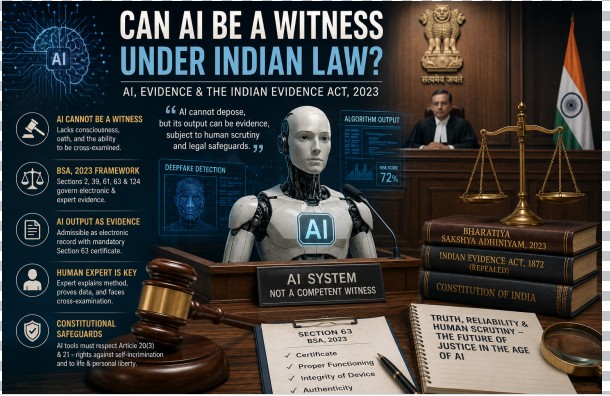
An algorithm cannot act as a standalone independent witness or provide self-verifying evidence in Indian courts because the legal system mandates human accountability and transparent verification. AI-generated evidence in Indian courts raises new questions about admissibility, authenticity and the role of human witnesses.
The Legal Framework in India
- Bharatiya Sakshya Adhiniyam (BSA), 2023: This law replaces the old Indian Evidence Act. It expands the definition of “documents” to include digital and electronic records under Section 2(d).
- Electronic Records Admissibility: AI-generated outputs are treated as electronic records under Sections 60 and 63 of the BSA.
- Mandatory Certificates: Just like older digital records, AI outputs require proper certification under Section 63 of the BSA to prove authenticity.
Abstract
The rapid deployment of generative artificial intelligence, synthetic media, automated forensic systems and machine-learning tools has altered the evidentiary landscape before Indian courts. Audio, video, images, transcripts, facial-recognition outputs, predictive classifications and digitally reconstructed material may now be generated or materially altered by algorithmic systems. This development raises a foundational question — whether an algorithm may be treated as a witness.
Under the present statutory framework, the answer is in the negative. An algorithm is not a witness in the legal sense because it lacks legal personality, testimonial competence, consciousness, the capacity to understand questions, and the ability to provide rational answers under examination and cross-examination. Nevertheless, an algorithmically generated output may, in appropriate circumstances, be tendered as an electronic or digital record under the Bharatiya Sakshya Adhiniyam, 2023. Its admissibility, however, does not establish its authenticity, reliability or probative force.
The central legal distinction is therefore between the algorithm as a source of information and the human witness or technical custodian who explains the system, its operation, its data inputs, its safeguards and the conditions under which the output was produced.
Indian courts should not confer testimonial status upon an algorithm. They should instead require a layered proof structure consisting of statutory compliance, provenance evidence, technical validation, disclosure of material limitations and meaningful adversarial testing.
This article contends that the Bharatiya Sakshya Adhiniyam, 2023 provides a workable foundation for the reception of AI-related material, but does not yet prescribe a complete evidentiary framework for synthetic content, opaque models, probabilistic outputs or generative systems. Judicial development of principled safeguards is therefore necessary, particularly in criminal proceedings governed by the Bharatiya Nagarik Suraksha Sanhita, 2023 and offences under the Bharatiya Nyaya Sanhita, 2023.
Preliminary statutory position
The statutory vocabulary requires immediate clarification. The Indian Penal Code, 1860 has been replaced, for offences committed under the new regime, by the Bharatiya Nyaya Sanhita, 2023.
The Code of Criminal Procedure, 1973 has been replaced by the Bharatiya Nagarik Suraksha Sanhita, 2023, and the Indian Evidence Act, 1872 has been replaced by the Bharatiya Sakshya Adhiniyam, 2023. These enactments came into force on 1 July 2024, subject to the notifications issued by the Central Government.
Accordingly, the expression “AI-generated evidence” should ordinarily be analysed under the BSA rather than under the repealed Indian Evidence Act. Earlier decisions concerning Sections 65A and 65B of the Indian Evidence Act remain highly persuasive where the language and structure of the corresponding BSA provisions substantially preserve the former evidentiary principles.
The principal provisions are as follows.
| Legal issue | Relevant provision |
| Ø Legal status of electronic or digital records | Sections 61 and 62, BSA |
| Ø Admissibility of computer output | Section 63, BSA |
| Ø Certificate accompanying electronic records | Section 63(4), BSA |
| Ø Direct oral evidence | Section 55, BSA |
| Ø Competency of witnesses | Section 124, BSA |
| Ø Proof of electronic signatures and digital signatures | Sections 66 and 73, BSA |
| Ø Presumptions concerning electronic records | Sections 81, 85, 86, 87, 90 and 93, BSA |
| Ø Audio-video recording during search and seizure | Section 105, BNSS |
| Ø Electronic mode of proceedings | Section 530, BNSS |
Section 63 of the BSA provides that information contained in an electronic record, including information printed, stored, recorded, copied or otherwise produced through a computer or communication device, may be treated as a document and admitted without production of the original if the statutory conditions are satisfied.
Those conditions relate principally to regular use of the relevant device, ordinary-course input, proper operation and reproduction or derivation of the information from material fed into the system.
The provision also requires a certificate identifying the electronic record, describing the manner of production, identifying relevant devices and addressing the statutory conditions. This requirement is particularly significant in AI-related proceedings because the evidentiary question is not merely whether a file exists, but whether the file is traceable to a known system, known data, known process and demonstrably reliable chain of custody.
- The conceptual error in calling an algorithm a witness
The expression “algorithm as a witness” is rhetorically attractive but legally imprecise.
Calling an algorithm a legal witness is a conceptual error because software lacks consciousness, moral agency, and the ability to take a legal oath or face cross-examination.
An algorithm is a mathematical tool that processes data. A witness is a person who perceives a real-world event and testifies about it under oath.
Section 124 of the BSA provides that all persons are competent to testify unless they are incapable of understanding questions or giving rational answers for reasons recognised by law. The statutory conception of a witness therefore presupposes a person capable of responding to questions, being examined and, where necessary, being cross-examined.
Section 55 further requires oral evidence to be direct. Where the evidence concerns a fact capable of being seen, heard or otherwise perceived, the testimony must ordinarily proceed from a witness who personally perceived that fact.
An algorithm does not satisfy this model. It does not perceive a fact in the juridical sense. It processes inputs according to programmed or trained parameters and produces an output. It does not possess personal knowledge, form a belief, understand the oath or affirmation, respond rationally to cross-examination or assume legal responsibility for the truthfulness of its statement.
Consequently, an algorithm cannot be treated as a witness under Section 124 of the BSA. It may generate information, classify information or transform information, but it cannot testify.
The appropriate legal characterization is that an AI output is potentially one of the following.
- First, it may constitute an electronic or digital record.
- Secondly, it may constitute the output of a technical or scientific process requiring proof through a competent human witness.
- Thirdly, it may form part of an expert opinion, provided that a qualified expert explains the system, the methodology, the relevant data and the limits of the conclusion.
- Fourthly, it may be merely an investigative lead with no independent evidentiary value unless the underlying facts are proved through admissible evidence.
This distinction is essential. The presence of an automated label such as “face match,” “high probability,” “synthetic voice” or “AI-generated” does not convert the output into proof of the fact asserted.
AI-assisted evidence and AI-generated evidence must be distinguished
The law should distinguish between AI-assisted evidence and AI-generated evidence.
Defining the Two Types
- AI-assisted evidence: A human creates the work, and artificial intelligence only helps with basic tasks. Examples include fixing grammar, organizing files, or searching a database.
- AI-generated evidence: An artificial intelligence tool creates the text, image, or audio completely on its own based on a prompt, with little or no direct human input during creation.
- AI-assisted evidence
AI-assisted evidence is material originally produced by a human or physical event but processed, enhanced or analyzed through an algorithm. Examples include the following.
- Enhancement of a CCTV frame
- Restoration of an indistinct audio recording
- Automated transcription of a recorded conversation
- Facial comparison between an image and a reference database
- Detection of alterations in a document
- Pattern analysis of call-detail records
- Extraction of metadata from a seized device
In these situations, the underlying evidence may remain a human-created or event-generated record. The algorithm assists in interpretation or presentation. The prosecution or party must nevertheless prove that the enhancement did not introduce material distortion and that the output remains faithful to the original record.
2. AI-generated evidence
AI-generated evidence is content created, reconstructed or materially transformed by an artificial intelligence system. Examples include the following.
- A synthetic video depicting a person performing an act that never occurred
- A cloned voice recording
- An artificially generated photograph
- A reconstructed conversation
- A machine-generated document or message
- A video in which the face or voice of a person is superimposed on another body or recording
- A generated image purporting to show a crime scene
Such material does not ordinarily prove the occurrence of the depicted event. At most, it may prove that the file existed, that it was generated by a particular system, or that it was transmitted or stored by a particular person. Its content requires independent corroboration.
This distinction reflects a broader evidentiary principle. The fact that a computer produced a file does not establish that the factual proposition represented by the file is true.
Admissibility is distinct from authenticity and probative value
Indian evidence law recognizes three analytically separate inquiries.
First — admissibility
The court must determine whether the material falls within a recognized category of evidence and whether the statutory conditions for its reception have been fulfilled. In the case of electronic records, Section 63 of the BSA and the accompanying certificate are central.
Secondly — authenticity
The court must determine whether the material is what the party represents it to be. This inquiry includes the identity of the source, the device or platform used, the date of creation, the integrity of the file, the possibility of alteration and the preservation of the chain of custody.
Thirdly — evidentiary weight
Even if the material is admissible and authentic, the court must decide what weight it deserves. An authentic AI-generated image may still have negligible probative value if it does not establish the truth of the event depicted. Conversely, an AI-assisted forensic output may carry substantial weight if the underlying data, methodology and validation process are satisfactorily established.
The Supreme Court’s jurisprudence under the former Section 65B of the Indian Evidence Act remains instructive. In Anvar P.V. v. P.K. Basheer, the Court treated the statutory certificate requirement as integral to the admissibility of secondary electronic evidence.
In Arjun Panditrao Khotkar v. Kailash Kushanrao Gorantyal, the Court reaffirmed the mandatory character of the certificate requirement, while recognizing that the person issuing the certificate need not necessarily be the original creator of the electronic record.
The Court has also recognized that an original electronic record may be proved differently from a copy or computer output. Where the original device itself is produced and properly identified, the certificate requirement may not operate in the same manner as it does for secondary computer output.
This distinction has direct relevance to AI systems. A party tendering an original model-generated file, the originating device, the application logs and the associated system data is in a substantially stronger evidentiary position than a party tendering an unexplained screenshot or downloaded copy.
The certificate under Section 63 must be interpreted substantively
A formal certificate alone should not be treated as conclusive proof of reliability.
Section 63(4) requires the certificate to identify the electronic record, describe the manner of production, provide relevant particulars of the device and address the statutory conditions concerning regular use, ordinary-course input and proper operation. For ordinary electronic records, this structure may be sufficient to establish the reliability of the computer output. AI-generated material, however, introduces additional questions that the statutory language does not expressly answer.
A proper AI-related certificate should ideally disclose the following.
- The identity and version of the AI system
- The date and time of generation
- The identity of the person who operated or instructed the system
- The input material, including prompts, source files and reference datasets
- Whether the system altered, enhanced, reconstructed or generated the material
- The relevant software, model and configuration settings
- Whether the system had access to external databases or online services
- The existence of logs, audit trails, hashes and metadata
- The safeguards adopted against unauthorized alteration
- Known error rates, limitations or instances of system failure
- The identity and competence of the person responsible for preserving and explaining the record
A certificate that merely states that “the file was generated by a computer” would not adequately address the distinctive risks associated with probabilistic or generative systems. It may satisfy the form of Section 63 while failing to establish the evidentiary reliability of the substantive output.
The Supreme Court has emphasized that the purpose of electronic-record safeguards is to protect source and authenticity because electronic material is susceptible to tampering, alteration, excision and manipulation.
In AI cases, the concern extends beyond conventional tampering. The system may produce a file without malicious alteration, yet the output may still be inaccurate because of hallucination, biased training data, erroneous classification, prompt sensitivity or model drift.
Human testimony remains indispensable
Although an algorithm cannot be a witness, a human witness may testify regarding the algorithm.
The relevant witness may be a system administrator, forensic examiner, data custodian, software engineer, laboratory officer, digital investigator or other person occupying a responsible position in relation to the operation of the system. The witness need not always be the programmer.
The important question is whether the witness possesses sufficient knowledge of the system and the relevant record to explain its provenance, operation and integrity.
The witness should be capable of addressing the following matters.
- How the data was acquired
- Whether the original data was preserved
- How the system processed the data
- Whether the process was automated or human-directed
- What variables or assumptions affected the output
- Whether the system was functioning properly
- Whether the result can be independently reproduced
- Whether the output has a quantified error rate
- Whether alternative explanations were tested
- Whether the system’s conclusion is categorical or probabilistic
The witness does not testify that the algorithm is infallible. The witness explains the conditions under which the output was created and the limits within which it may responsibly be interpreted.
Cross-examination should therefore focus not only on the final output but also on the complete technological chain. A party should be permitted to challenge the training data, source data, model architecture, threshold settings, validation methodology, false-positive rate, false-negative rate and any human intervention in the process.
Expert opinion and algorithmic opacity
AI-generated material may be introduced through expert opinion, but the mere use of sophisticated technology does not automatically satisfy the requirements of expert evidence.
An expert must establish a recognized field of knowledge, demonstrate familiarity with the relevant methodology and explain why the method is reliable in the particular case. The expert should not merely repeat the output generated by a proprietary software system.
The problem becomes more acute where the algorithm is a “black box” and the party tendering the evidence refuses to disclose the model, relevant data, performance statistics or material parameters on the ground of trade secrecy.
Trade secrecy cannot, by itself, defeat the accused’s right to a fair trial under Article 21 of the Constitution. If the prosecution seeks to rely upon an opaque system in a manner that materially affects guilt, identity, intention or sentencing, the defence must receive adequate information to test the reliability of the result.
A court should be slow to rely upon an algorithmic output where the opposing party cannot meaningfully examine the method by which the output was produced. Procedural fairness requires more than the assertion that a computer system generated the conclusion.
BNSS implications for investigation and trial
The BNSS expressly integrates audio-video and electronic processes into criminal procedure. Section 105 requires the process of search and seizure, including the preparation and signing of the seizure list, to be recorded through audio-video electronic means and forwarded to the competent magistrate without undue delay.
This provision may create valuable contemporaneous evidence concerning the legality and integrity of a search. It may also generate new disputes concerning whether the recording itself was complete, continuous, properly preserved and free from post-production manipulation.
The investigating agency should therefore preserve the original recording, the device on which it was captured, the relevant metadata, the hash value and a documented chain of custody. An AI-generated summary of the search cannot replace the original recording or the testimony of the officers and witnesses who participated in the process.
The BNSS also enables proceedings to be conducted in electronic mode. This facilitates access and efficiency but does not dilute the requirements of natural justice, confrontation, cross-examination or proof beyond reasonable doubt.
In criminal proceedings, the use of AI-generated material must be evaluated against the presumption of innocence and the prosecution’s obligation to establish every essential ingredient of the alleged offence under the applicable provision of the BNS or any special penal statute. An unreliable algorithmic output cannot discharge that burden merely because it appears technologically sophisticated.
The recent judicial warning against unverified AI material
The Supreme Court’s recent decision in *Pooja Ramesh Singh v. Jammu and Kashmir Bank Ltd.*, 2026 INSC 668, concerned AI-generated and hallucinated case law rather than physical or digital evidence. Nevertheless, the decision offers an important institutional principle.
The Court adopted a zero-tolerance approach towards reliance upon fabricated or unverified AI-generated legal material and held that a decision founded upon hallucinated authority cannot be sustained in law.
The reasoning has wider relevance. AI output must not be treated as reliable merely because it is presented in a coherent, authoritative or technically impressive form. Verification must precede reliance.
The analogy must, however, be applied cautiously. The decision does not establish a general rule that all AI-assisted material is inadmissible. Rather, it reinforces the proposition that the court must retain control over the evidentiary and adjudicatory process and must not delegate legal judgment to an unverified machine output.
- Proposed judicial test for AI-generated material
Indian courts may adopt a structured admissibility and weight test comprising the following inquiries.
- Classification
The court should determine whether the material is an original electronic record, secondary computer output, AI-assisted analysis, AI-generated content, expert opinion or merely an investigative lead.
- Relevance
The party must identify the precise fact in issue or relevant fact which the material is tendered to establish. General assertions that the material is “important,” “accurate” or “technology-based” should not suffice.
- Provenance
The party must establish the origin of the file, the identity of the generating or processing system, the person who operated it and the circumstances in which it was preserved.
- Statutory compliance
The requirements of Section 63 of the BSA, including certification where applicable, must be satisfied.
- Integrity
The court should examine hashes, metadata, audit logs, device history and chain-of-custody records, together with any evidence of alteration or compression.
- Methodological reliability
The court should determine whether the system functioned properly, whether the process was reproducible and whether the output is supported by accepted scientific or technical methodology.
- Explainability and disclosure
The opposing party must receive sufficient information to challenge the output meaningfully. Absolute secrecy concerning the system’s operation should ordinarily weigh against reliance upon the material.
- Corroboration
Where the material is probabilistic, synthetic or susceptible to manipulation, the court should seek independent corroboration. AI output should not ordinarily be the sole basis for conviction where its reliability cannot be independently tested.
- Constitutional compatibility
The court must ensure that reliance upon the material does not undermine fair trial rights, equality of arms, the presumption of innocence, the right to cross-examination or the requirement of proof beyond reasonable doubt.
Evidentiary value in different contexts
The probative value of AI-generated material will vary according to its function.
A system that merely transcribes an authenticated recording may have substantial utility, although the original audio should remain the primary reference point.
A facial-recognition output may assist investigation but should not, without more, conclusively establish identity. Recognition systems can generate false positives, particularly where image quality, lighting, ethnicity, age or database composition affects performance.
A synthetic video may be relevant to establish fabrication, fraud, intimidation or the dissemination of false material. It cannot ordinarily establish the truth of the event depicted.
An AI-generated voice recording may be relevant to show that a person’s voice was imitated or that a deception was attempted. Voice similarity, without proof of provenance and independent corroboration, should not be treated as proof that the person uttered the words.
An AI-assisted forensic reconstruction may be useful where the underlying data is preserved, the methodology is disclosed and an expert can explain the assumptions. Its conclusions should nevertheless be expressed in terms of probability or confidence rather than artificial certainty.
Assertions requiring stronger statutory or case-law support
The following propositions should not be presented in a legal submission without specific authority or evidentiary foundation.
“AI evidence is inherently unreliable”
This is too broad. The reliability of the material depends upon the type of AI system, the nature of the output, the source data, the validation process and the purpose for which the material is tendered.
“AI-generated content is inadmissible in Indian courts”
This proposition is also overbroad. The BSA does not create a blanket exclusion against material merely because an algorithm generated it. The relevant inquiry concerns relevance, authenticity, statutory compliance and probative value.
“The Section 63 certificate proves the truth of AI-generated content”
A certificate may establish statutory conditions concerning the production of computer output. It does not necessarily prove the truth of the factual proposition represented by the output.
“The algorithm can be cross-examined through its developer”
This formulation is legally inaccurate. A developer may testify concerning the design or operation of the system, but cannot provide personal testimony on behalf of the algorithm concerning the truth of every output.
“AI detection software conclusively identifies deepfakes”
This assertion requires empirical validation, error-rate evidence and expert testimony. A detection score is ordinarily an opinion or probabilistic output rather than conclusive proof.
“The use of AI violates the accused’s right to a fair trial”
The constitutional objection depends upon the manner of use. AI may assist investigation or adjudication without violating Article 21, provided that the defence receives sufficient disclosure and a meaningful opportunity to challenge the material.
Conclusion
The Indian legal system should reject the metaphor of the algorithm as a witness. Under the BSA, a witness is a competent person capable of understanding questions and providing rational answers. An algorithm cannot perform that juridical function.
The correct approach is to treat AI output as a potentially admissible electronic or digital record whose reliability must be established through human testimony, statutory certification, technical provenance, forensic integrity and adversarial scrutiny. The court must separately determine whether the material is authentic and what evidentiary weight, if any, it deserves.
The BSA supplies the foundational mechanism for admitting electronic material, but its existing language was not designed specifically for generative AI, synthetic media, opaque machine-learning systems or probabilistic forensic classifications. Courts should therefore develop a technology-sensitive but rights-preserving framework.
The governing principle should be stated in precise terms.
- An algorithm may generate an evidentiary record, assist an expert or identify an investigative lead, but it cannot itself testify. Its output is not self-proving. The legal responsibility for explaining, authenticating and defending that output remains with a human witness and ultimately with the party tendering it.
- In criminal proceedings, particularly those involving serious offences under the BNS, no person should be convicted solely upon the basis of an unexplained or untested algorithmic conclusion. Technological sophistication cannot substitute for proof. The decisive question remains whether the material has been demonstrated to be relevant, authentic, reliable and sufficient to satisfy the standard of proof required by law.
