


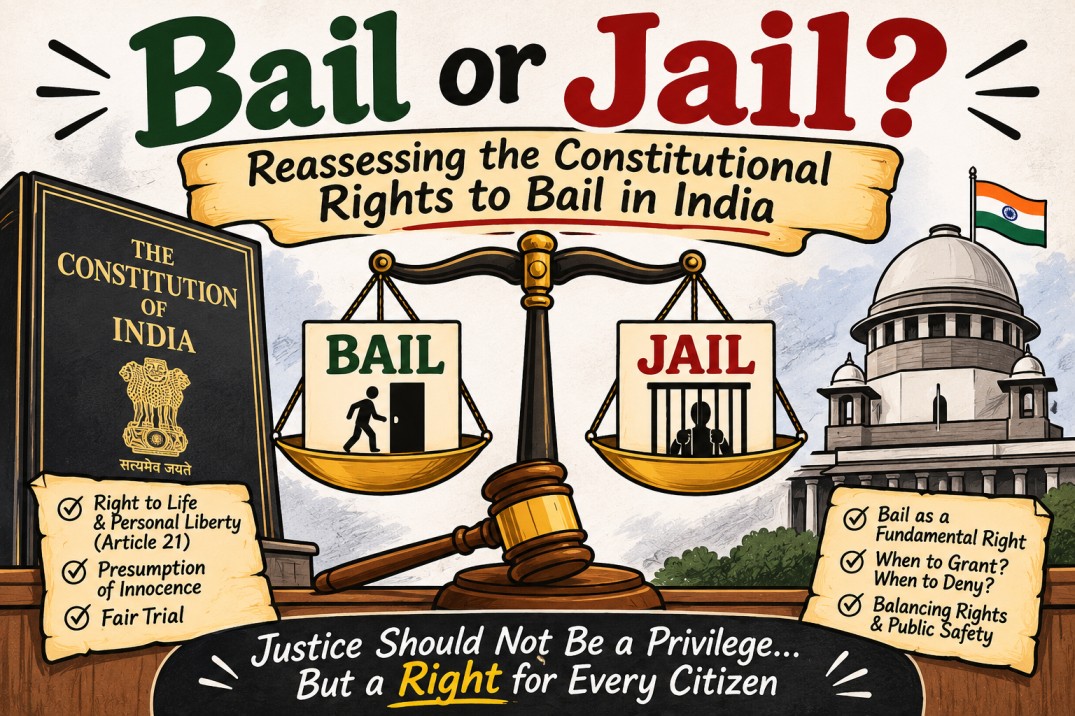
Introduction
Liberty is a
fundamental principle enshrined in the Preamble to the Indian Constitution,
protecting individual freedom and limiting arbitrary state action. Article 21 protects the right to life and personal liberty, ensuring no one is
deprived of it except according to the procedure established by law.[1]
However, this constitutional guarantee becomes particularly significant when an individual is accused of an offence but remains in custody awaiting trial. This raises a greater question further as to how long an individual can be restricted of their liberty before their guilt has been established?
Bail is an
important safeguard against unnecessary deprivation of liberty. It is a
mechanism for securing the release of an accused person charged with an offence,
ensuring their further appearance before the court during the trial and their
compliance with the court’s jurisdiction. The
principle ‘bail is the rule and jail is the exception’ reflects the perception
that an accused should not normally be made to undergo prolonged imprisonment
before establishment of guilt. Therefore, the grant of bail is not merely a procedural consideration but also a significant element for protection of constitutional liberty.
Despite the established principle, the practical implementation of bail in India continues to raise noteworthy concerns. Obstacles such as prolonged pre-trial detention, delays in judicial proceedings, and economic inequalities block access to bail. Further, situations where individuals remain in custody for prolonged periods without being convicted of the allegations against them raise concerns about the effectiveness of constitutional safeguards and the extent to which the criminal justice system balances individual liberty with the interests of justice.
This article
examines the constitutional foundations of bail in India, judicial
interpretations of personal liberty and necessary reforms to bridge the gap
between legal principle and the existing conditions.
Constitutional
Foundations of Bail
Though there is no particular provision for the
right to bail in the Indian Constitution, Article 21 is closely connected to it
as it protects personal liberty. The presumption of innocence is yet another
foundational principle of criminal justice and is intrinsically linked to
Article 21. An individual is presumed innocent even after trial has commenced until
guilt is proven. When detention is unnecessarily stretched or becomes
disproportionate, it raises concerns about pretrial detention. Article 21 also
guarantees the right to a speedy trial, which strengthens the compelling
constitutional case for prioritising bail. Without a speedy trial, the accused
faces restriction on their liberty before guilt is proven in court. Therefore,
the grounds for prolonged incarceration must be assessed in light of the
progress of the trial and the individual circumstances of the accused. Further,
securing bail is not an automatic process; the court considers relevant factors
like the nature of the allegations, the likelihood of the accused absconding or
the possibility of tampering with the evidence.
Judicial
Interpretation of Bail in India
The constitutional doctrine ‘bail is the rule and
jail is the exception’ was famously drawn by Justice V. R. Krishna Iyer in State
of Rajasthan v. Balchand [[2](1977),
where the respondent was convicted by the trial court under Section 452 of the
Indian Penal Code (IPC), 1860[3], for
house trespass after preparation of hurt, assault and wrongful restraint and
Section 323 IPC [4]
for voluntarily causing hurt. Further, upon conviction, Balchand filed an
appeal before the Hon’ble High Court, which granted him bail. Later, the State
of Rajasthan challenged the order in the Supreme Court, arguing that once the accused
has been convicted, bail should not be granted so liberally, as the protection
of individual liberty must be balanced against the broader interests of society
in such circumstances. However, during the delivery of judgment, Justice Iyer emphasized that mere conviction by the trial court cannot negate the granting of bail
during the pendency of an appeal, especially when the sentence is not of a
severe nature.[5] Similarly, in Gurbaksh Singh Sibbia v. State of Punjab [6],
the Court contended that the scope of Section 438 CrPC should not be restricted
by any unnecessary constraints, as this would undermine the purpose of
safeguarding individuals against unjustified arrest. Recently, in Satender Kumar Antil v. CBI,[7] the Supreme Court addressed the
concerns related to unnecessary arrests and the implementation of bail
principles. It highlighted the need for greater consistency in the
administration of bail.
Considered collectively, these decisions define that
bail jurisprudence must balance the requirements of criminal investigations
with the constitutional obligation to protect personal liberty.
Practical Application of Bail
Despite judicial recognition of personal liberty,
several difficulties continue to affect access to bail. Some of the challenges
are as follows-
Firstly, the prolonged undertrial incarceration.
Individuals are kept in prison for extended periods while their cases are
awaiting trial. Such detention affects family responsibilities, financial
stability, employment and the ability to prepare a defense. When a trial is
substantially delayed, prolonged incarceration raises concerns about the proportionality and necessity of detention.
Secondly, to grant bail, certain conditions are
imposed by the courts, but the individuals affected by economic inequality may
be unable to secure release because they may not be able to satisfy the
conditions imposed. Financial difficulties in arranging sureties can
disproportionately affect economically disadvantaged individuals. After all,
the practical enjoyment of liberty may depend partly on a person’s financial
conditions.
Lastly, stringent statutory provisions create
additional challenges; laws like the Unlawful Activities (Prevention) Act[8] and the
Prevention of Money Laundering Act[9] impose
specific restrictions on the grant of bail. Although these legal provisions
address concerns associated with specific offences, their enforcement must be
assessed in light of constitutional safeguards when the trial is unlikely to be
completed within a reasonable time.
These challenges reflect a difference between the
formal recognition of liberty and the ability of individuals to exercise that
liberty in practice.
Suggestions for
Reforms
(i) Investigating
agencies should comply with the safeguards that govern arrest and avoid
unnecessary detention
(ii) The principles
established in Satender Kumar Antil should be implemented consistently.
(iii)Bail conditions
should be proportionate and responsive to the financial conditions of the
accused, subject to the requirements of law and the interest of justice.
(iv)Courts should
strengthen the case management mechanism and prioritize matters involving
prolonged undertrial incarceration.
(v)Judicial
authorities should pay particular attention to prolonged detention in cases
involving stringent statutory restrictions.
Conclusion
The constitutional protection of
personal liberty requires more than merely acknowledging fundamental rights. A
criminal justice system is required which is backed by valid reasons for
prolonged detention, where trials are completed in a reasonable timeframe, and
procedural obstacles do not hinder an individual’s ability to obtain bail. The
Supreme Court has consistently highlighted the need to maintain a balance
between individual freedom and the legitimate aims of criminal justice. In
finality, the constitutional importance of bail lies in maintaining a clear
distinction between an accusation and a finding of guilt. The principle ‘bail
is the rule, jail is the exception’ must serve as an effective safeguard
against unnecessary and continued detention, while enabling courts to consider
genuine threats to their administration of justice.
However, the effectiveness of constitutional principles depends largely on their practical implementation. Despite progressive judicial decisions, prolonged pre-trial incarceration, delays in the disposal of bail applications and restrictive statutory provisions continue to create obstacles within the criminal justice system. The mere availability of a legal remedy does not guarantee its accessibility, particularly to those individuals who lack adequate financial resources or legal assistance. Thus, bail should not remain a tool accessible only to those who possess the means to navigate the judicial processes.
Furthermore, grant or denial of bail must be determined through a clear assessment of the circumstances of each case. While factors such as the possibility of absconding, tampering with evidence, intimidation of witnesses and the seriousness of the alleged offence may legitimately influence judicial discretion, detention should not be an automatic consequence of an accusation of an offence. Even in cases involving stringent statutory authority restrictions, the constitutional implications of prolonged pre-trial custody must receive appropriate judicial consideration.
A constitutional democracy is measured not merely by its ability to punish those found guilty, but also by its ability to protect the rights of those whose guilt has yet to be established.
