


Introduction
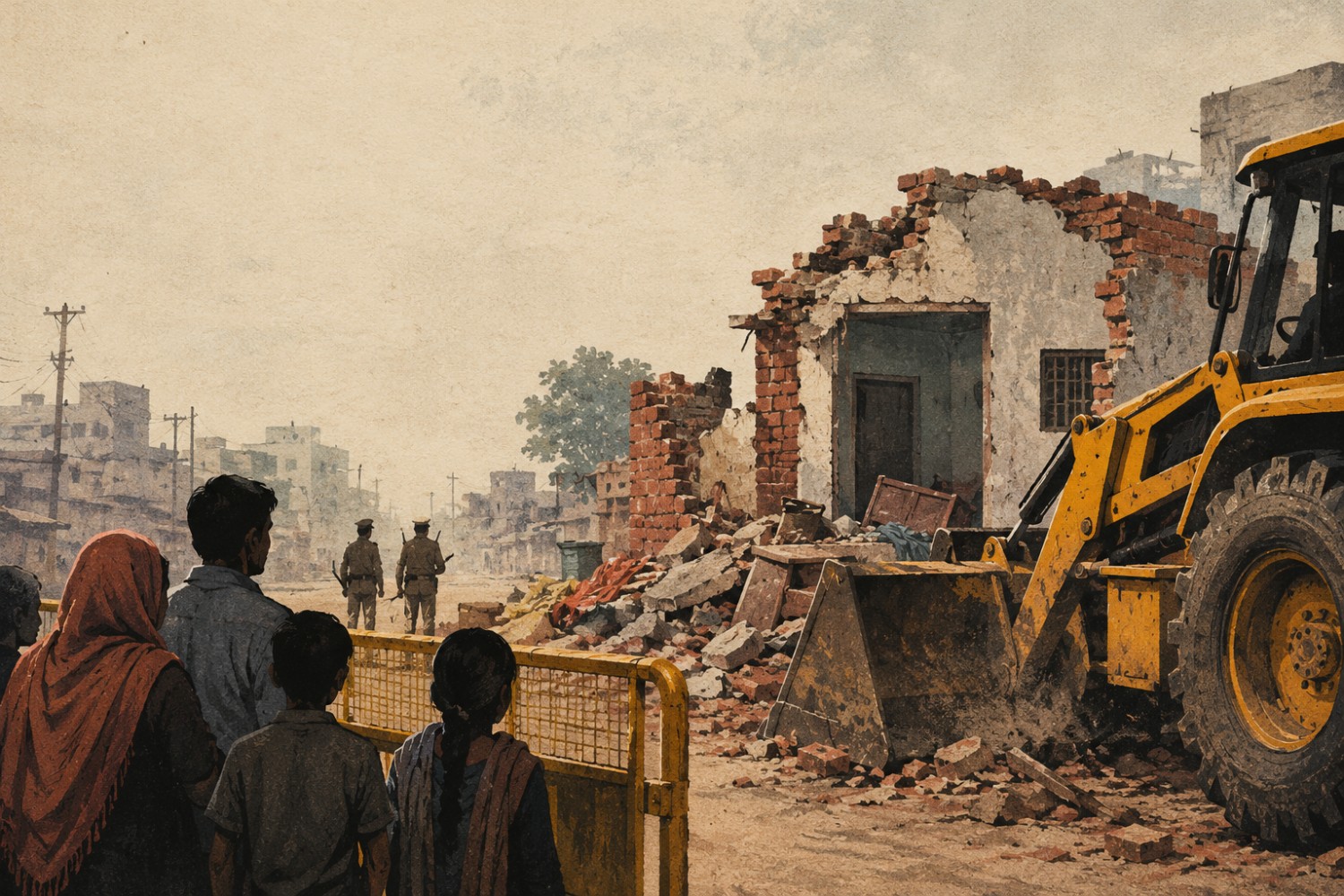
Imagine coming home and finding a demolition notice pasted on your front door.
Your family has lived in that house for years, but now municipal officers are
at your doorstep because one of your relatives has been named in a criminal
case.
no court has convicted the accused, yet your house is marked for
demolition.
The first question is whether the building violates planning laws. The deeper
question is constitutional: is the government enforcing municipal law, or is it
using that power to punish someone without a trial?
This question is at the centre of the debate on “bulldozer justice”
in India. Demolition of unauthorised construction is a legitimate exercise of
municipal powers. But when such demolition follows immediately after an arrest,
FIR or public controversy, the circumstances demand scrutiny. A statutory power
meant to regulate land use cannot be turned into an alternative mode of
criminal punishment.
The Supreme Court addressed this problem in In Re: Directions in the Matter of
Demolition of Structures [1]. The Court held that the executive cannot assume
the role of the judiciary by demolishing the property of a person accused of an
offence. It laid down pan-India safeguards, including prior show-cause notice,
opportunity of hearing, a reasoned order and time to challenge the decision
before demolition.
The constitutional debate became more significant in Zulfiquar Haider v. State
of U.P., where the Court condemned illegal demolition of residential houses in
Prayagraj and directed the Prayagraj Development Authority to pay costs of Rs.
10 lakh in each. The judgment made it clear that procedural safeguards are not
mere formalities and their violation can attract financial liability for
authorities.
This article argues that the validity of a demolition must be judged on three
tests: whether the authority had lawful power, whether it exercised that power
for a legitimate purpose, and whether the procedure followed protected the
rights of affected persons. Articles 14, 21 and 300A provide the main
constitutional framework for this assessment. Read together, they show that the
State can regulate property, but cannot act arbitrarily, cannot disregard human
dignity, and cannot bypass the criminal justice system.
The Constitutional Framework: Articles 14, 21, 300A
Article 300A: Property Cannot Be Taken Without Authority of Law
Article 300A says that no person shall be deprived of his property save by
authority of law. It was inserted by the Constitution (Forty-Fourth Amendment)
Act, 1978. Property is no longer a fundamental right under Article 19(1)(f),
but it continues as a constitutional right.
This provision is crucial in demolition cases because the State must show the
law under which it is depriving a person of property. Administrative
convenience, political pressure or a criminal allegation against a person
cannot by itself be authority of law.
In K.T. Plantation Pvt. Ltd. v. State of Karnataka[1], the Supreme Court held
that Article 300A imposes meaningful restrictions on State action and that any
compulsory deprivation must satisfy constitutional requirements, including
public purpose in cases of acquisition.
Similarly, in Vidya Devi v. State of Himachal Pradesh[2], the Court held that the
State cannot forcibly take private land without following due process of law.
The State cannot ignore procedure only because it finds such acquisition
desirable.
These principles are relevant for demolition, but a distinction must be kept in
mind. Demolition of an unauthorised structure is not the same as compulsory
acquisition of land. Article 300A does not give protection to illegal
construction. Even then, where the State demolishes a structure, it must act
under the applicable statute, follow procedural safeguards and remain within
its legal limits.
Hence, the constitutional question is not whether the owner has an absolute
right to retain every construction. The question is whether the authority has
lawfully proved the violation and acted strictly in accordance with the
governing legal framework.
Article 14: Prohibition of Arbitrary and Selective
Enforcement
Article 14 guarantees equality before the law and equal protection of the laws.
In bulldozer justice cases, its importance goes beyond the formal validity of a
demolition order.
A municipal authority may have statutory power to demolish illegal
construction, but it may exercise that power unconstitutionally by targeting
some individuals selectively while ignoring similar violations by others.
For example, if two buildings in the same locality have materially similar
violations, and the authority initiates action against one owner immediately
after an FIR against his family member, while leaving other similar structures
untouched without any justifiable reason, such difference in treatment calls
for explanation.
Selective enforcement alone does not automatically prove unconstitutional
discrimination. Authorities may legitimately prioritise cases based on safety
risks, gravity of violation or other relevant factors. However, unexplained
differential treatment can be evidence of arbitrariness or improper purpose.
In E.P. Royappa v. State of Tamil Nadu[3], the Supreme Court linked
arbitrariness with violation of Article 14. This principle allows courts to
closely examine executive action which appears to be guided by considerations
unrelated to the object of the statute.
The demolition judgment of 2024 also identified selective targeting as a
relevant factor when courts examine allegations that demolition is punitive in
nature[4].
Thus, Article 14 strengthens constitutional analysis in two ways. First, it
requires the State to act on relevant legal criteria, not personal or political
considerations. Second, it enables courts to examine whether an otherwise
lawful power conceals an arbitrary or retaliatory purpose.
Article 21: Shelter, Dignity and
Consequences of Demolition
Article 21 protects life and personal liberty. Judicial interpretation has made
it clear that the right to life includes more than mere physical survival; it
includes conditions necessary for a dignified life.
In Olga Tellis v. Bombay Municipal Corporation[5], the Supreme Court
recognised the link between livelihood and the right to life. The judgment did
not create an absolute right to occupy public land, but emphasised that
eviction affecting livelihood must follow lawful procedure.
In Chameli Singh v. State of U.P.[6], the Court held that
shelter is an important component of dignified life under Article 21.
These decisions show why demolition of a family home needs special care. A
house provides shelter, security and stability for children, the elderly and
other dependents. Its destruction may also disrupt education, employment and
access to essential services.
Even then, the right to shelter does not prohibit every lawful demolition or
eviction. The constitutional requirement is that authorities must act legally
and fairly, with due regard to the consequences of their decisions.
The relationship between Articles 14, 21 and 300A is therefore complementary.
Article 300A requires lawful authority, Article 14 restrains arbitrariness, and
Article 21 protects dignity and human interests affected by State action.
Uttar Pradesh’s Statutory
Framework: Regulation or Retaliation?
The Source of Power
The power to demolish flows from Section 27 of the U.P. Urban Planning and
Development Act, 1973. The provision empowers the Vice-Chairman or the
competent officer of the Development Authority to direct removal of development
which is undertaken in contravention of the Master Plan or is without
permission, approval or sanction as required under the Act.[7]
This is a statutory power. It is not an executive prerogative. It must be
traced to the Act, and exercised within the four corners of the Act.
Inbuilt Safeguards – Not Empty Formalities
The Legislature itself did not leave Section 27 as an unanalysed discretion.
The Section mandates:
(a) Show-cause notice specifying the violation;
(b) Reasonable opportunity to the affected person to respond; and
(c) A reasoned order dealing with the response.
Further, Section 27(2) provides a statutory appeal. The existence of these
safeguards is itself a legislative indication that demolition is an extreme
step.
In practice before this Hon’ble Court and other Development Authorities, it is
seen that notices are often vague – “unauthorised construction”
without specifying what is unauthorised, to what extent, and under which
provision of the Master Plan/bye-laws. Such a notice vitiates the entire
proceeding as it denies a meaningful right to defend.
What Courts Expect – Three Core Tests
From a practitioner’s standpoint, courts examine Section 27 action on three
touchstones:
1. Identification of Violation. The Authority must place on record the precise
nature of the deviation – whether it is excess FAR, setback violation, or
construction without sanction. A bald assertion is insufficient.
2. Meaningful Hearing. Opportunity to show cause must be real, not illusory.
Service of notice, time to file reply with documents, and personal hearing
where requested are essential.
3. Consideration of Alternatives. Where the Act / Regulations permit
compounding, regularisation or removal of only the offending portion, the
Authority must apply its mind to the same. Automatic resort to complete
demolition shows non-application of mind.
The Supreme Court’s pan-India directions in In Re: Demolition of Structures[8] have now supplemented
Section 27. The Court has mandated 15 days’ notice, personal hearing, reasoned
order, and videography of demolition. These directions are binding under
Article 142 and Article 144 of the Constitution.
The Real Issue – Existence vs. Exercise
A building may be in violation. That gives power to act. But it does not give
licence to use that power as a penal measure for an unrelated criminal case.
Conversely, mere timing – that notice was issued soon after an FIR – does not
by itself prove mala fide. But timing coupled with selective pick-and-choose,
undue haste, departure from procedure, or public statements by officials
linking demolition with crime, becomes relevant material for the Court to
examine the true purpose.[9]
In short, Section 27 answers whether the Authority can demolish. Articles 14,
21 and 300A answer how and for what purpose that power can be exercised.
The Supreme Court’s 2024
Judgment: Establishing Procedural Safeguards
In Re: Directions in the Matter of Demolition of Structures.[10], decided on 13th
November, 2024.
The Bench comprising Justice B.R. Gavai and Justice K.V. Viswanathan considered with a recurring pattern – demolition
action following close on the heels of a criminal incident.
The question was not whether unauthorised construction can be demolished. The
question was whether the State can don the robe of the Judge, convict by media
trial, and punish by bulldozer.
The Court answered in the negative. It reaffirmed the cardinal principles –
rule of law, separation of powers, audi alteram partem, and right to shelter
under Article 21.
Binding Directions – What Every Development Authority Must
Now Follow
The judgment does not create a new statute, but lays down mandatory pan-India
procedure under Article 142. Any demolition falling within the scope of the
judgment must comply with the following; else it is non est:
(a) Prior Show-Cause Notice: Notice under applicable municipal law, or a minimum of 15 days’ clear time as per para 30 of the judgment, whichever is longer. No
back-dated notice.
(b) Mode of Service and Intimation: Proper service upon the owner/occupier,
affixation with videography if the person is not available, and intimation to the District
Collector / District Magistrate by email. The purpose is to create an
independent record.
(c) Personal Hearing: Opportunity of hearing to the notice, to be documented in
writing. This is not a formality. The Authority must show that it heard the
person.
(d) Reasoned Order: The final order must deal with objections, specify the exact
violation with reference to the Master Plan / bye-laws, and give reasons why
demolition is the only option, if other options like compounding exist.
(e) Breathing Time to Challenge: 15 days from order to actual demolition, to
enable the person to avail appellate remedy under Section 27(2) or to approach
the Court. Except where the structure is about to collapse, or there is a Court
order.
(f) Videography and Panchama: Entire demolition proceedings to be video-graphied.
Demolition report and list of officials present to be maintained.
Consequence of Violation
The Court has not left directions as mere advisories. Paras 35-37 of the
judgment provide:
(i) Contempt under the Contempt of Courts Act;
(ii) Personal liability for restitution and costs upon erring officers; and
(iii) Direction to reconstruct at State cost in appropriate cases.
This is significant for practitioners. In Zulfiquar Haider, the Court has
already imposed Rs. 10 lakhs cost per case on Prayagraj Development Authority
for violation of procedure.
What the Judgment Does NOT Do
The Court clarified that it does not protect encroachments on public land,
footpaths, railway lines, water bodies, and cases where there is a direct order
of demolition by a Constitutional Court. But exceptions are to be strictly
construed. The Authority must still prove that the case falls within the exception.
The Real Ratio – Procedure is Substance
The heart of the judgment, with respect, is paragraph 28 – procedural
compliance cannot be reduced to paper compliance. A notice issued only to tick
the box, without giving a meaningful opportunity, is fraud on the safeguards.
In other words, the State cannot first decide to demolish and then create a file
to justify it. The decision must follow the file, not the other way around.
WHERE THE LAW STANDS TODAY
Zulfiquar Haider v. State of U.P.[11] – Costs Follow Illegality
On 01.04.2025, the Hon’ble Supreme Court decided Zulfiquar Haider v. State of
U.P. Five houses were demolished by the Prayagraj Development Authority.
The Court, in unequivocal terms, held the demolitions to be illegal and
high-handed. The Court did not stop at declaration. It directed payment of Rs.
10 lakhs as costs in each of the five appeals, payable by the Authority.
Two points for practice:
1. Liberty is given to affected parties to pursue their remedy for title and
for compensation/damages for illegal demolition in appropriate proceedings.
Costs of Rs. 10 lakhs are not compensation for property loss. It is a punitive
cost for breach of due process. Compensation has to be claimed separately by
leading evidence.
2. The judgment sends a message to authorities: a file will not save you if
procedure is violated. Personal liability will follow.
Faimuddeen v. State of U.P. (Writ-C No. 2229 of 2026) – The Split Verdict
This case requires careful handling. Misreading this judgment is easy.
On 20.07.2026, the Division Bench of the Allahabad High Court delivered a split
verdict.
Opinion of Hon’ble Mr Justice Atul
Sreedharan: Supported a 2-year restraint on the demolition of the dwelling of
an accused after registration of an FIR, subject to exceptions noted in his
opinion. The idea was to break the immediate nexus between accusation and
bulldozer.
Opinion of Hon’ble Mr Justice Siddharth
Nandan: Disagreed. Held that additional blanket restraint beyond Supreme Court
directions in _In Re: Demolition_ cannot be created, as it would amount to
judicial legislation inconsistent with the statutory scheme of the U.P. Act,
1973.
Both Hon’ble Judges concurred on principle – demolition cannot be used as
punishment for crime. The difference was on remedy – whether the court can
impose a time-bound moratorium.
The matter is now referred to the third Judge. Therefore, as on date, the
2-year moratorium is not binding law. It is the opinion of one Hon’ble Judge in
a split verdict. It cannot be cited as ratio of the High Court.
What Should Be The Way Forward?
Where a demonstrated pattern of retaliatory demolition exists, courts must remain open to moulding effective remedies under Article 226 of the Constitution. However, such remedies must be evidence-based, tailored to the facts of each case and consistent with the Supreme Court’s framework in In Re: Directions in the Matter of Demolition of Structures
(a) Evidence-based, not blanket;
(b) Tailored, so that genuinely dangerous/public safety violations are not
protected; and
(c) Consistent with the Supreme Court’s framework in 2024 INSC 866, not in
conflict with it.
The middle path is not unqualified immunity for the accused, nor unbridled
power for the Authority. It is strict, verifiable compliance with procedure,
with cost and contempt as real deterrents.
If an Authority demolishes within weeks of an FIR, selectively, without proper
notice, the court must draw an adverse inference on purpose, unless the Authority
rebuts with cogent material. That, respectfully, is the correct reading of
Articles 14, 21 and 300A together.
International Human
Rights: The Right to Housing and Effective Remedies
The constitutional debate has an international dimension which can be used as
interpretive aid, not as a directly enforceable right. Article 11(1) of the
International Covenant on Economic, Social and Cultural Rights (ICESCR), 1966,
recognises the right of everyone to an adequate standard of living, including
adequate housing.[12] India acceded to the
Covenant on 10th April, 1979.
The argument is not that ICESCR creates an independent cause of action before the
High Court. The argument is that where Articles 21 and 300A are ambiguous on the
scope of protection, the Court may look at international commitments to inform
interpretation – as held by the Supreme Court in CERC v. Union of India and Vishaka
v. State of Rajasthan.[13]
In General Comment No. 7 (1997) on the right to adequate housing: forced
evictions, the UN Committee on Economic, Social and Cultural Rights (CESCR)
laid down minimum procedural protections:[14]
(a) Reasonable notice;
(b) Genuine consultation with affected persons;
(c) Access to legal remedies; and
(d) Provision of compensation for property loss.
The Committee also observed that eviction should not result in rendering
individuals homeless or vulnerable to further violations. Where persons are
unable to provide for themselves, the State must take all appropriate measures
within maximum available resources to ensure alternative accommodation.
Relevance of International Human Rights Standards Before Indian Courts
This international material cannot mean that every demolition is prohibited,
nor does it decide domestic title disputes. It provides a framework to test
whether procedure respects human dignity and is not arbitrary.
For Indian constitutional analysis, it reinforces two points:
1. A house is not a mere economic asset. Its demolition impacts Article 21 rights
– family, education of children, livelihood, dignity – as held in Olga Tellis[15] and Chameli Singh[16].
2. Remedy must be effective, not illusory. A remedy that is available only
after the structure is razed to the ground, without a realistic prospect of
restitution or compensation, is no remedy in law. This is precisely what the Hon’ble
Supreme Court sought to address in In Re: Demolition by mandating 15 days’
breathing time.
Therefore, the Indian constitutional framework – Articles 14, 21, 300A – must
be interpreted with due regard to India’s international commitments under
Article 51(c), while keeping in view the distinct status of domestic
constitutional provisions.
Compensation,
Accountability and Remedies for Affected Persons
A constitutional safeguard without practical enforcement is a
mere parchment promise. From a practical legal standpoint, affected persons must understand the remedies available both before demolition and after an unlawful demolition has taken place.
BEFORE DEMOLITION – PRESERVE, APPEAL, STAY
Step 1: Preserve Paper Trail. Client must immediately preserve:
(i) Show-cause notice and demolition order;
(ii) Proof of service – postal receipt, affixation photos, if any;
(iii) Title documents, sanctioned map, tax receipts, electricity bills;
(iv) All correspondence/representation filed before Authority;
(v) Photos/videos of structure as on date.
This becomes record before the Court.
Step 2: Avail Statutory Remedy. Section 27(2) of the U.P. Act, 1973 provides for
an appeal against the order under Section 27(1) to the Chairman, with
prescribed limitation.[17] Ordinarily, a writ under
Article 226 should be filed after availing or alongside the statutory appeal,
explaining urgency. High Court will not entertain if the appeal remedy is
bypassed without reason, but where demolition is imminent, the Court can
entertain a writ directly- the Whirlpool Corporation [18]principle.
Step 3: Seek Stay. The most important practical step is an application for stay
/ interim protection. Supreme Court in In Re: Demolition[19] mandates 15 days gap from
final order to actual demolition precisely for this purpose – to enable party
to obtain stay. If the Authority violates this, it is contempt.
Step 4: Writ under Article 226. Where constitutional rights under Articles 14,
21, 300A are threatened, or there is an allegation of mala fide / retaliatory
action, the High Court under Article 226 is the proper forum. Grounds:
violation of natural justice, non-application of mind, selective targeting,
breach of Supreme Court binding directions under Article 141.
AFTER UNLAWFUL DEMOLITION – DECLARATION, COSTS, COMPENSATION
Where demolition is already executed, relief is not rendered infructuous. The
following remedies survive:
(a) Declaration that demolition was unlawful;
(b) Compensation for loss caused by illegal State action – public law remedy
under Article 226 as per Nilabati Behera[20] and Rudul Sah[21]
(c) Costs upon the Authority – as awarded in Zulfiquar Haider[22] – Rs. 10 lakhs per case;
(d) Restitution/reconstruction at State cost – contemplated in In Re: Demolition
directions;
(e) Direction for disciplinary/departmental action against erring officials.
In Zulfiquar Haider, the Hon’ble Supreme Court expressly left appellants free
to pursue compensation claims.[23] This establishes that the
conclusion of demolition does not extinguish a separate claim for damages.
But compensation is not automatic. The claimant must prove title / lawful
possession, extent of loss, and nexus with illegal action. It must be
adjudicated by a competent forum – either the High Court in writ if facts are undisputed,
or a civil suit/claim commissioner if disputed questions of fact arise.
Why Accountability Must Go Beyond Money
Financial relief is necessary but not sufficient. If an officer knows that the maximum
consequence is that the Authority will pay compensation from the public
exchequer, there is no personal deterrence.
Therefore, accountability must extend to:
(i) Personal liability and recovery from erring officer – as indicated in In
Re: Demolition and Zulfiquar Haider;
(ii) Departmental proceedings for misconduct;
(iii) Contempt proceedings for violation of Supreme Court directions;
(iv) Mandatory preservation of records – notices, orders, inspection notes,
photographs, videography, list of officers who authorised and executed
demolition.
A transparent mechanism would require the Authority to place on record:
Legal basis with reference to Master Plan/by-law provision;
Names of officers who passed the order and who supervised demolition;
Checklist of compliance with In Re: Demolition safeguards;
Reasons for departure from ordinary
practice, if any.
A Practical Framework for
Constitutional Review
The following table summarises how the principal constitutional concerns
can be examined in an individual demolition case.
|
Legal question |
Relevant constitutional or legal principle |
Evidence requiring examination |
|
Does the |
Article 300A, |
Statutory
|
|
Has the |
Legality |
Inspection |
|
Was the |
Audi alteram |
Show-cause |
|
Was the |
Article |
E.P. Royappa, |
|
Was |
Separation |
Timing –
|
|
Were less |
Proportionality, |
Whether |
|
Is an |
Article |
Urgency, extent of loss, status of construction, violation |
Timeline of Important
Judicial Developments
|
Date |
Judicial development |
Constitutional significance |
|
1985 |
Olga |
Linked the right |
|
1996 |
Chameli |
Recognised |
|
2011 |
K.T. |
Laid down |
|
2020 |
Vidya |
Reaffirmed |
|
6 |
In Re: |
The |
|
13 |
In Re: |
Locus classicus on bulldozer justice |
|
1 April |
Zulfiquar |
Condemned
|
|
20 July |
Faimuddeen |
Split verdict |
CONCLUSION: FROM POWER TO DEMOLISH TO DUTY TO JUSTIFY
The constitutional problem of bulldozer justice cannot be resolved by choosing
between two extremes – on one side, unrestricted power of the State to demolish;
on the other side, complete immunity for unauthorised construction. Both
positions ignore the central requirement of the rule of law: the State must
justify its coercive action on three touchstones – lawful authority, legitimate
purpose, fair procedure.
Three Constitutional Pillars
(i) Article 300A requires that the State acts only under authority of law. No
person shall be deprived of property save by authority of law – and law here
means valid law, interpreted strictly, exercised by competent authority.
(ii) Article 14 prohibits arbitrary or discriminatory exercise of public power.
Pick-and-choose demolition, demolition of only one community or only after FIR,
is anathema to Article 14.
(iii) Article 21 requires attention to human consequences. A house is not
bricks and mortar. It is shelter, dignity, education of children, security of
family. Its destruction must be a last resort, after hearing, with reasons.
Together, Articles 300A, 14 and 21 constitute meaningful limits on demolition
power.
The next step is not more law, but better enforcement:
(a) Transparent records – notices, orders, inspection notes, photographs, video
to be preserved and produced before the Court;
(b) Effective hearing – not an empty formality but a meaningful opportunity to
show cause;
(c) Independent review – appellate forum to function before demolition, not
after;
(d) Appropriate compensation – public law damages for illegal State action; and
(e) Personal accountability – recovery from and disciplinary action against
officials who knowingly disregard binding safeguards.
Public authorities should also be required to publish quarterly data on demolition proceedings, number of notices, number executed, locality-wise, so civil society and courts can examine patterns of selective enforcement.
Ultimately, the constitutional legitimacy of demolition does not depend on whether the
State can point to some provision in some Act. It depends on whether the Authority
has exercised that power in a lawful, non-arbitrary, proportionate and
defensible manner.
A bulldozer may be a legitimate instrument of urban regulation – to clear a public
street, drain, or park. It cannot become a substitute for a criminal trial. It
cannot punish an entire family for one member’s alleged act. It cannot
place executive discretion above the Constitution. From power to demolish to
duty to justify – that is the journey that Articles 14, 21 and 300A demand.
[1]
(2011) 9 SCC 1
[2]
(2020) 11 SCC 474
[3]
(1974) 4 SCC 3
[4]
2024 INSC 857.
[5]
(1985) 3 SCC 545
[6]
(1996) 2 SCC 549
[7]
The U.P. Urban Planning and Development Act, 1973, S 27(1).
[8]
2024 INSC 857, para 30-35.
[9]
Zulfiquar Haider v. State of U.P., Civil Appeals arising out of SLP (C) Nos.
14615-14619/2024.
[10]
2024 INSC 866 (decided on 13.11.2024).
[11]
2025 INSC 480 ; 5 S.C.R. 205 ; 2025 LiveLaw (SC) 421 ; 2025 Supreme (SC) 625
[12]
International Covenant on Economic, Social and Cultural Rights, 1966, Art.
11(1), 993 U.N.T.S. 3
[13]
1997) 6 SCC 241
[14]
UN CESCR, General Comment No. 7: The Right to Adequate Housing (Art. 11.1):
Forced Evictions, UN Doc. E/1998/22 (20 May 1997).
[15]
(1985) 3 SCC 545.
[16]
(1996) 2 SCC 549
[17]
U.P. Urban Planning and Development Act, 1973, S 27(2)
[18]
Whirlpool Corporation v. Registrar of Trade Marks_, (1998) 8 SCC 1.
[19]
In Re: Directions in the Matter of Demolition of Structures_, 2024 INSC 866,
para 30-32
[20]
(1993) 2 SCC 746
[21]
(1983) 4 SCC 141
[22]
2025 INSC 480
[23]
Ibid., para 16
