

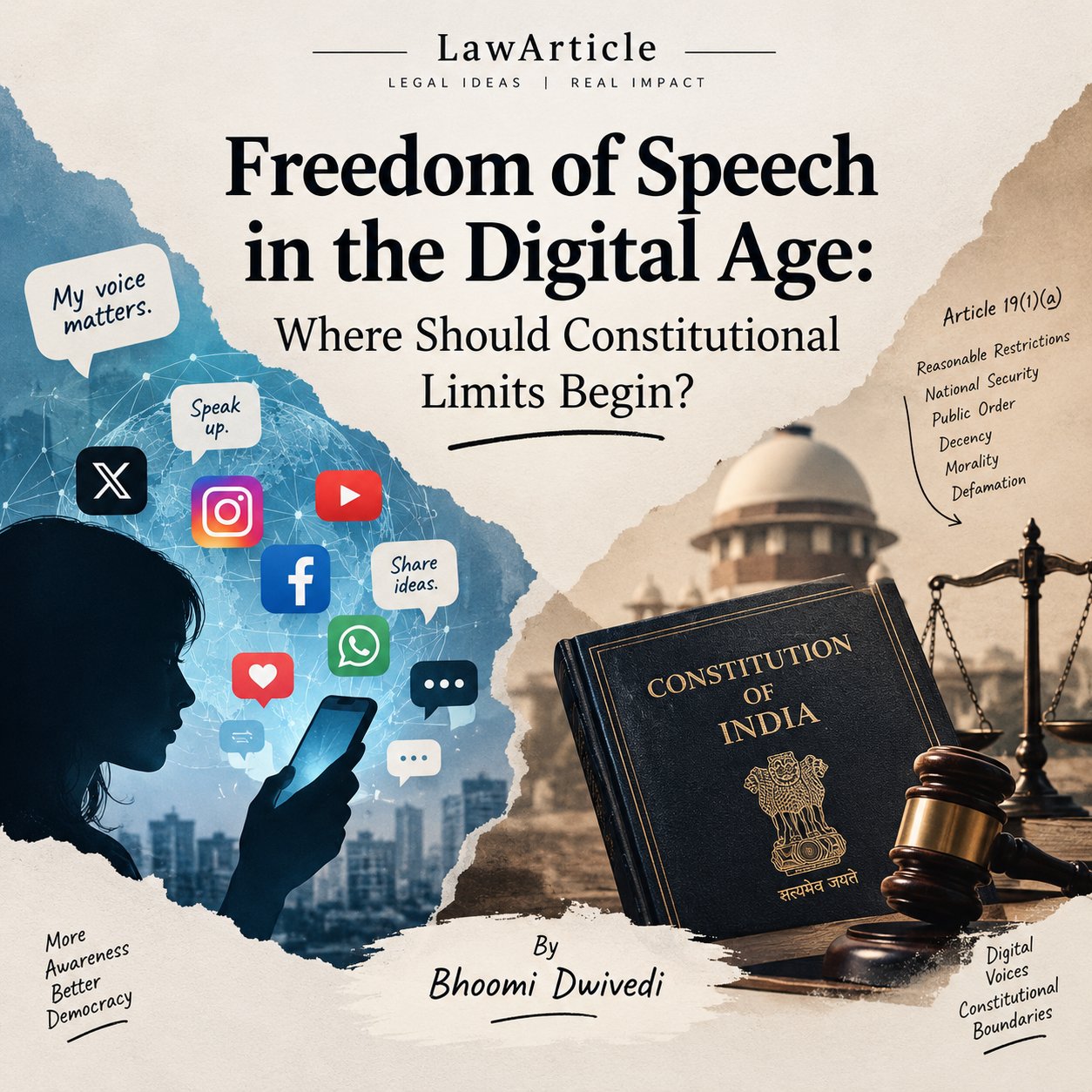
Freedom of Speech in the Digital Age: Where Should Constitutional Limits Begin?
1.Introduction
Today, we are living in such an era where a single post or video made on social media reaches from nowhere to everywhere overnight. In such times, we can say today that digital platforms have not only democratized information, but have also turned every individual into a thinker and a writer.
the definition of freedom of speech in the digital age has completely changed. In earlier times, the medium for conveying one’s thoughts to everyone used to be newspapers and stages, but today is the age of the internet and social media, where anyone can very easily deliver anything to anyone, anywhere.
Today, we are standing in the biggest digital age—an era where every second, millions of thoughts, debates, trolling, and news collide with each other. The freedom of speech that the internet has given us has given people the power to raise their voices, but this very freedom In this era, a new empire of trolls hiding behind fake news, hate speech, and keyboards has also risen. In such a situation, it becomes very important to raise the question—where does responsibility start for freedom of speech in the digital age, and how much should it be?
Freedom of speech gives people the freedom to express their views. If it is being misused, then the question arises—where should the constitutional limits of freedom of speech begin?
2. Constitutional Protection of Freedom of Speech in India
* Article 19(1)(a) of the Indian Constitution grants citizens freedom of speech and expression.
* This is a Fundamental Right; it is the backbone of India’s democratic system. Whether it is the power of the press, voices rising on social media, or a citizen’s protest, this right gives us the power to freely express our thoughts, but this freedom is not unlimited. Along with it come responsibilities and the country security of the country, which are equally important. Let us understand in detail what constitutional protection is granted to freedom of speech in India and what its limits are.
1. Article 19(1)(a)
* According to this article, every citizen in India has the right to express their thoughts, opinions, and speech, and to write and express themselves through newspapers and social media.
2. Digital Age Importance
* The internet has provided ordinary citizens with a platform to share their opinions, raise social issues, and discuss government policies.
3. Limitations
* This freedom is not absolute. Article 19(2) of the Constitution places “Reasonable Restrictions” on this freedom. This means that freedom of speech in India is not absolute; certain legal boundaries have been set to maintain the security of the country and social harmony.
3.Reasonable Restrictions under Article 19(2)
Article 19(1)(a) provides freedom of speech and expression, but this does not mean that any person can say anything without any responsibility. In the digital age, a post or video can spread very quickly and sometimes affect public order, reputation, or national security.
Therefore, Article 19(2) of the Constitution allows reasonable restrictions on certain specific grounds.
1. Public Order
Speech that can disturb public peace and order.
2. Defamation
Harming the reputation of any individual.
3. Security of the State
Speech that threatens the security of the State.
4 – Incitement to an Offence
Inciting someone to commit an offence.
5. Sovereignty and Integrity of India
Protection of the sovereignty and integrity of the country.
6. Contempt of Court
Violating the dignity or authority of the Court.
7. Decency or Morality
Content that goes against the standards of decency and morality.
8. Friendly Relations with Foreign States
Protecting friendly relations with foreign countries.
4. Freedom of Speech in the Digital Age: Challenges
Internet and social media have democratized information by giving ordinary citizens a platform.
However, along with this, several challenges have also emerged that have completely changed the definition of free speech.
1. Fake News and Misinformation
The rapid spread of false information and fake news on social media.
2. Hate Speech and Online Harassment
Abusive content on online platforms and targeted harassment of individuals.
3. Censorship and Freedom of Expression
Sometimes, removing content or imposing online restrictions can also affect genuine opinions.
5. Landmark Judicial Decisions
1. Shreya Singhal v. Union of India (2015)
Citation: (2015) 5 SCC 1; AIR 2015 SC 1523.
In this case, the Supreme Court of India declared Section 66A of the IT Act, 2000 unconstitutional because it violated freedom of speech and expression.
2. Anuradha Bhasin v. Union of India (2020)
Citation: (2020) 3 SCC 637; AIR 2020 SC 1308.
The Supreme Court laid down important principles regarding internet restrictions and clarified that speech and expression through the internet enjoy constitutional protection. It is also important that internet suspension orders are published and made subject to judicial review.
6. Finding the Right Balance
In the digital age, it is important to maintain a balance between freedom of speech and the responsibility to use it properly. Every citizen should have the right to express their opinions, even when those opinions are different from others. However, this freedom should not be used to spread fake news, threaten others, or encourage violence.
The government should make sure that any restriction on online speech is reasonable and follows the Constitution. People should not be prevented from expressing genuine opinions only because someone disagrees with them. Social media platforms also have a responsibility to deal with harmful content while respecting the freedom of their users.
At the same time, citizens should verify information before sharing it and avoid posting content that may harm the reputation or safety of others. Awareness about constitutional rights and responsibilities can help people use digital platforms in a better way.
Therefore, the solution is not to restrict freedom of speech completely, but to prevent its misuse through lawful and reasonable measures. A healthy democracy needs both freedom and responsibility.
7. Conclusion
Freedom of speech and expression is an important part of democracy. In the digital age, social media and the internet have made it easier for people to express their opinions and share information. However, fake news, hate speech and online harassment have also created serious challenges.
Article 19(1)(a) of the Indian Constitution protects freedom of speech, while Article 19(2) allows reasonable restrictions in certain situations. In Shreya Singhal v. Union of India (2015), the Supreme Court protected online freedom of expression by striking down Section 66A of the IT Act. Similarly, in Anuradha Bhasin v. Union of India (2020), the Court explained important principles regarding internet restrictions.
In my opinion, the main challenge is to maintain a balance between freedom of speech and the protection of society. People should be free to express their views, but they should also use social media responsibly. Constitutional limits should begin when speech falls within the grounds specified under Article 19(2), not merely because an opinion is unpopular or critical. Therefore, protecting freedom of speech while preventing its misuse is essential for a healthy democracy.
