


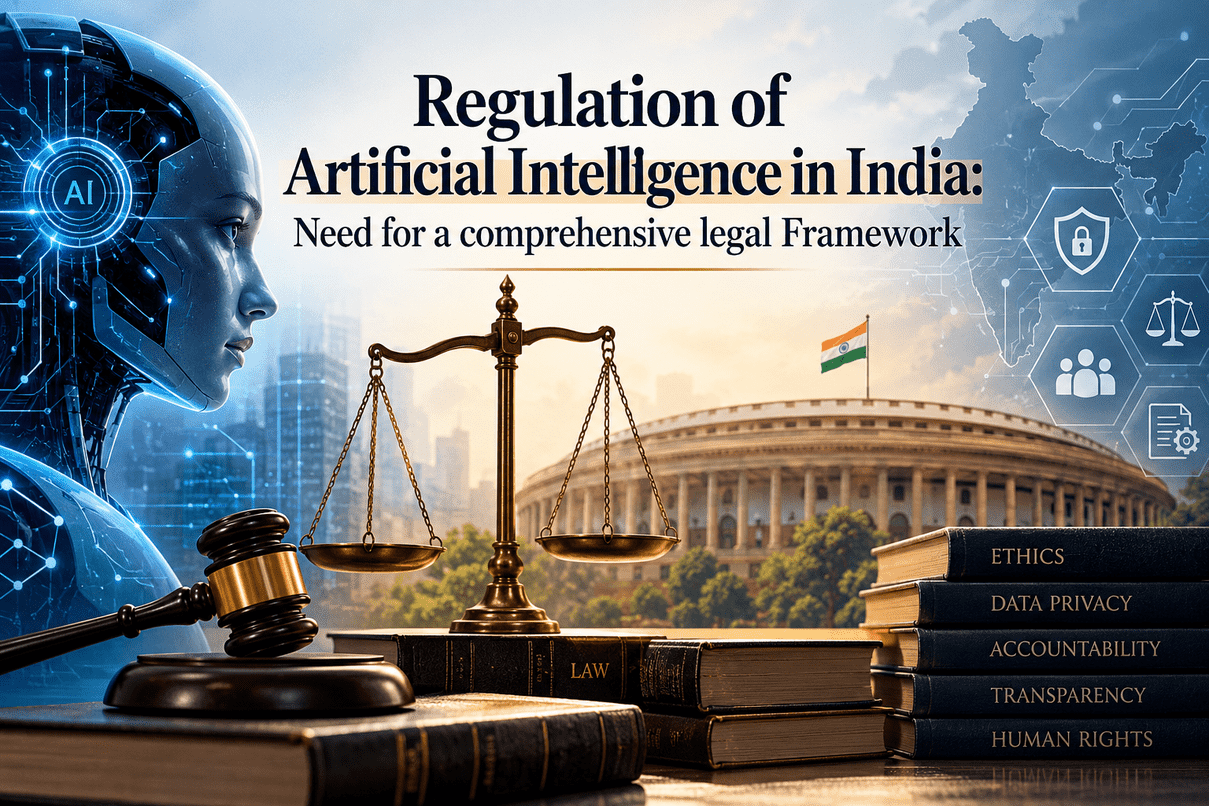
Abstract
Artificial
Intelligence (AI) has emerged as a transformative technology with applications
in healthcare, schooling, banking, governance, cybersecurity and financial
services. While AI promotes innovation, efficiency and monetary boom, it also
increases serious worries regarding privateness, algorithmic discrimination,
misinformation, deepfakes, intellectual assets rights and accountability. India
has followed a technology-oriented approach to AI governance, relying on
current law, policy initiatives and sector-specific policies. The India AI
Governance Guidelines, launched in November 2025, offer a framework for
responsible, secure and inclusive AI adoption. However, coverage pointers alone
won’t properly resolve complicated questions regarding liability, transparency,
automated decision-making and treatment for people harmed by means of AI
systems. This article examines India’s present prison framework, identifies
sizable regulatory gaps and recommends a balanced, risk-based and
rights-oriented approach. It argues that India needs a coherent felony
framework that protects fundamental rights even as encouraging technological
improvement and ensuring that AI stays accountable to society.
Introduction
Artificial
Intelligence (AI) is not simply a technological innovation; it has emerged as a
powerful force able to influence human choices, shaping public opinion and
transforming the relationship between people, agencies and the State. From
AI-powered healthcare and automated recruitment to facial recognition, deepfakes
and predictive policing, its applications are increasing unexpectedly. However, at
the back of these technological improvements lies a good-sized legal query: Who
should be held responsible when synthetic intelligence causes damage to a man
or woman or society?
The
growing use of AI raises serious concerns regarding privacy, information
safety, freedom of expression, intellectual property, discrimination and
duty. Generative AI can produce practical but deceptive records, whilst
algorithmic systems may additionally reproduce social and financial
inequalities embedded in their training records. In India, where virtual
adoption is increasing throughout a populace of vast diversity, those demanding
situations require specific attention.
India
presently regulates numerous aspects of AI through existing rules and coverage
projects. Nevertheless, the absence of a committed, comprehensive AI statute creates
uncertainty regarding liability, transparency, algorithmic fairness and
treatment for affected people. Therefore, India wishes a balanced legal
framework that encourages technological innovation while ensuring constitutional
safety, accountable improvement and effective accountability.
Existing Legal Framework Governing
AI in India
India
does not presently have a single complete law solely regulating
artificial intelligence. Instead, AI-related matters are governed by several
current legal guidelines.
Information Technology Act, 2000:
Sections 43A, 66C, 66D, 66E and 72 provide applicable protections and address
certain forms of laptop-associated misconduct, identity theft, online impersonation, privacy violations and disclosure of information.
Digital Personal Data Protection
Act, 2023: Establishes obligations regarding the processing of
virtual private facts, which includes consent and responsibilities of Data
Fiduciaries. These provisions are relevant when AI systems collect or manner
non-public information.
Consumer Protection Act, 2019: May
offer remedies towards deceptive advertisements, unfair exchange practices and
faulty services involving AI-based products.
Copyright Act, 1957:
Raises critical questions regarding the usage of copyrighted works for AI
schooling and ownership of AI-generated outputs.
Constitution of India: Articles
14, 19 and 21 offer constitutional safeguards concerning equality, freedom of
expression and private liberty, privacy and dignity.
Although
these legal guidelines deal with numerous AI-related harms, they were not originally designed to alter self-sustaining and generative AI systems.
Consequently, uncertainty remains regarding responsibility amongst AI builders,
carrier companies, platform operators and customers.
Recent AI-Related Legal
Developments in India (2025–2026)
IndiaAI Mission, 2025
The
Government’s IndiaAI Mission seeks to strengthen domestic AI infrastructure,
offer a right of entry to computing centres, sell indigenous AI models and
encourage responsible AI development. It recognises the importance of creating
AI accessible even as developing appropriate safeguards.
IT Rules Amendment, 2026
On
10 February 2026, the Government amended the Information Technology
(Intermediary Guidelines and Digital Media Ethics Code) Rules, 2021,
introducing provisions addressing synthetically generated statistics. The
amendments enhance platform duties regarding illegal AI-generated content,
including deceptive fabrications, impersonation and content material harmful to
children. They additionally require labelling and traceable metadata for
permissible artificial content material. The amendments came into force on
20 February 2026.
India AI Governance Guidelines,
2026
On
15 February 2026, the Government launched the India AI Governance Guidelines.
The framework is primarily based on seven guiding ideas, including consideration,
human-first improvement, equity, accountability, transparency and safety. It
recommends establishing an AI Governance Group, a Technology and Policy Expert
Committee and an AI Safety Institute. It additionally proposes threat
assessment, regulatory sandboxes, incident reporting and progressive coordination among regulators.
Judicial and Copyright
Developments, 2025–2026
In
Narendra Kumar Goswami v. Union of India
(2025), the Supreme Court declined to entertain a PIL in search of a
court-monitored framework for regulating AI-generated deepfakes and directed
the petitioner towards the Delhi High Court, in which associated issues were being
taken into consideration.
In
ANI Media Pvt. Ltd. V. OpenAI OpCo LLC
(2026), the Delhi High Court dismissed ANI’s application for an intervening
time injunction regarding the alleged use of copyrighted information cloth for
AI schooling. The court cases raise essential questions concerning copyright
infringement, honest dealing, and territorial jurisdiction and using included
fabric in generative AI structures.
These
trends show that India is gradually transferring from trendy digital regulation
closer to greater unique AI governance.
Judicial Approach and Relevant
Supreme Court Judgments
Although
the Supreme Court of India has no longer yet established a complete AI-specific
constitutional doctrine, several landmark judgments offer the inspiration for
regulating AI continuously with essential rights.
Justice K.S. Puttaswamy v. Union of
India (2017) 10 SCC 1
The
Supreme Court regarded privacy as an essential proper beneath Article 21. This
judgment is mainly relevant to AI structures involving facial recognition,
biometric identification, behavioral tracking and big-scale personal-facts
processing. It establishes that technological advancement cannot override man
or woman privacy and dignity.
Shreya Singhal v. Union of India
(2015) five SCC 1
The
Supreme Court struck down Section 66A of the Information Technology Act, 2000,
for violating Article 19(1) (a). The judgment is applicable to AI-generated
misinformation and online content material regulation due to the fact
regulations on digital expression ought to fulfill constitutional standards and
cannot be arbitrary.
Anuradha Bhasin v. Union of India
(2020) 3 SCC 637
The
Supreme Court emphasized that restrictions affecting internet get admission to
need to fulfill constitutional necessities of necessity and proportionality.
This precept is applicable whilst governments use AI-primarily based
surveillance, computerized tracking or era-driven restrictions affecting civil
liberties.
E.P. Royappa v. State of Tamil Nadu
(1974) 4 SCC 3
The
Supreme Court explained the relationship between arbitrariness and equality
beneath Article 14. This principle can guide judicial scrutiny of algorithmic
decisions that unfairly downside individuals in recruitment, lending, education
or public administration.
Collectively,
these selections establish that AI governance should stay regular with privateness,
equality, dignity and freedom of expression.
International Comparison: India,
European Union and USA
Different
jurisdictions have adopted different approaches to AI regulation.
European Union:
The EU AI Act (Regulation (EU) 2024/1689) adopts a risk-based approach. It
prohibits certain unacceptable-risk AI practices and imposes specific
requirements on high-risk AI systems. Its implementation is progressive: major
provisions become applicable from 2 August 2026, with further obligations
scheduled for later dates.
United States:
The USA follows a more decentralized and zone-specific version, counting on
current laws, enterprise enforcement and voluntary technical standards along
with the NIST AI Risk Management Framework. Executive Order 14365 of December
2025 sought a extra uniform federal coverage framework and addressed conflicts
with certain nation AI legal guidelines. Executive Order 14409 of June 2026
similarly emphasized advanced AI innovation and safety.
India:
India has followed a comparatively bendy technique, looking for to inspire
innovation whilst relying on current law and rising governance suggestions.
However, India could benefit from combining the EU’s enforceable safeguards
with the United States technical risk-management approach, adapted to Indian
constitutional and social conditions.
Practical Case Studies: AI,
Deepfakes and Algorithmic Discrimination
The
following examples reveal how AI-related risks can create sensible legal
demanding situations.
A. Deepfake misuse and persona
rights – Ankur Warikoo case (2025)
In
Ankur Warikoo v. John Doe & Ors., CS(COMM) 370/2025, the Delhi High
Court considered the unauthorized exploitation of personality and publicity
rights, together with thru AI-generated content. The case illustrates how
artificial media can misuse an individual’s identification, popularity, picture
and voice. It highlights the want for effective legal treatments in opposition
to AI-generated impersonation.
B. AI-generated impersonation –
Varun Dhawan case (2026)
In
May 2026, the Delhi High Court granted meantime safety to actor Varun Dhawan
towards unauthorized exploitation of his name, picture, voice and likeness via
AI, deepfakes and other technologies. The order demonstrates the importance of
shielding persona rights in opposition to misleading artificial content.
C. Algorithmic discrimination –
COMPAS case, USA
In
State v. Loomis, 881 N.W.2nd 749 (Wis. 2016), the Wisconsin Supreme Court
considered the use of the COMPAS algorithm in crook sentencing. The device
assessed the hazard of reoffending. The case raised worries approximately
transparency, proprietary algorithms and the opportunity of biased computerized
risk checks. It demonstrates why consequential selections need to not rely
totally on systems whose reasoning cannot be meaningfully tested.
Recommendations for a Comprehensive
AI Regulatory Framework
India
must introduce a complete and generation-impartial AI regulatory framework
incorporating the subsequent measures:
1. Risk-based category:
AI structures should be classified into unacceptable-risk, high-danger,
constrained-chance and minimum-threat categories. High-chance applications in
healthcare, recruitment, banking, training and criminal justice ought to face
stricter obligations.
2. Algorithmic transparency:
Developers and deployer ought to divulge while individuals are interacting with
AI and offer comprehensible causes for vast computerized decisions.
3. Clear liability provisions:
The law ought to outline the respective obligations of AI builders, providers, deployer
and users. Victims need to have on hand treatments and appropriate compensation
mechanisms.
4. Data safety and privateness:
AI builders have to observe relevant records protection necessities, make
certain lawful processing and enforce safeguards against unauthorized
collection and misuse of private data.
5. Protection in opposition to
deepfakes: Platforms have to implement powerful content
material labelling, provenance mechanisms, rapid complaint handling and
techniques for disposing of illegal impersonation and manipulated content
material.
6. Independent regulatory authority:
A specialised AI regulatory group must coordinate with MeitY, the Data
Protection Board, CERT-In and sectoral regulators. It have to have appropriate
technical knowledge, investigative powers and enforcement potential.
7. Mandatory algorithmic audits:
High-danger AI systems need to undergo unbiased audits to observe accuracy,
discrimination, safety, reliability and compliance with constitutional
concepts.
8. Human oversight and criticism
redressal: Individuals ought to have the
possibility to challenge consequential AI-generated selections and gain
significant human evaluation.
9. Protection of highbrow assets:
Clear legislative steering must deal with the use of copyrighted cloth for AI
schooling, licensing, attribution and ownership of AI-generated works.
10. Regulatory sandboxes and AI
literacy: Controlled checking out environments must inspire
innovation, at the same time as public consciousness programmes need to educate
residents, college students, corporations and authorities officials’ approximately
accountable AI use.
Conclusion
Artificial
Intelligence provides India with an awesome possibility and a good-sized constitutional assignment. While AI can boost economic development, public
management and technological innovation, its misuse can threaten privacy,
equality, dignity, intellectual property and democratic values.
The
tendencies of 2025–2026, in particular the IT Rules amendments and India AI
Governance Guidelines, constitute critical steps closer to accountable AI
governance. Nevertheless, policy guidelines and present digital legal
guidelines alone may not properly deal with emerging issues concerning
algorithmic discrimination, deepfakes, liability and autonomous
decision-making.
India
therefore needs a complete, threat-primarily based and rights-oriented AI
regulatory framework supported via impartial oversight, transparent algorithms,
human responsibility and effective remedies. The objective should now not be to
limit innovation but to ensure that technological development stays consistent with constitutional morality and the rule of law.
