


Case Details
Case Name: Pooja Ramesh Singh v. Jammu and Kashmir Bank Ltd. & Anr.
Court: Supreme Court of India
Bench: Justice Pamidighantam Sri Narasimha and Justice Alok Aradhe
Date of Judgment: 2 July 2026
Citation: 2026 INSC 668
Case Number: Civil Appeal No. 11950 of 2025
Introduction
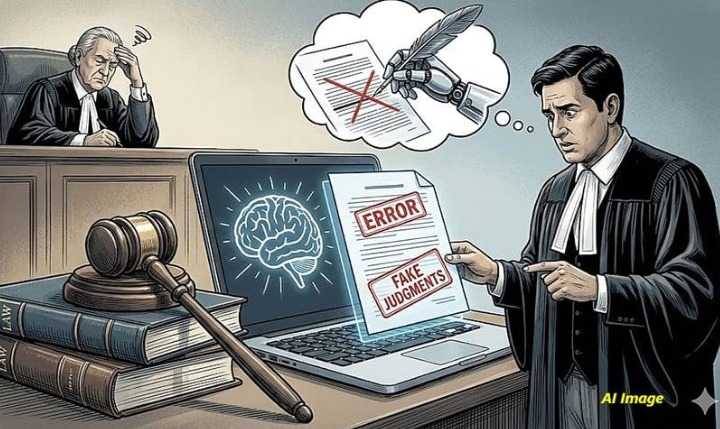
AI hallucinations in courts have emerged as a serious challenge to judicial accuracy and legal accountability, as highlighted by the Supreme Court in the Pooja Ramesh Singh Case. The rapid advancement of Artificial Intelligence (AI) has transformed almost every profession, including the legal sector. AI-powered legal research tools have improved efficiency by enabling lawyers and judges to access legal information quickly. However, these technologies also pose significant risks, particularly when AI generates inaccurate or fabricated legal authorities, commonly referred to as “AI hallucinations.” The Supreme Court of India’s judgment in Pooja Ramesh Singh v. Jammu and Kashmir Bank Ltd. (2026 INSC 668) is the first comprehensive judicial pronouncement in India addressing the dangers of relying upon AI-generated fake precedents during adjudication. The Court emphasized that although AI may assist legal professionals, judicial reasoning and decision-making must always remain under meaningful human supervision. This decision establishes an important precedent by reinforcing judicial accountability, preserving the integrity of legal proceedings and promoting the responsible and ethical use of AI within the Indian justice system.
Facts Of The Case
The present appeal arose from insolvency proceedings initiated under Section 7 of the Insolvency and Bankruptcy Code, 2016 (IBC) against Essel Infra projects Ltd. (EIL), the corporate guarantor of Pan India Utilities Distribution Company Ltd. (PIUDCL). PIUDCL had availed financial assistance from Jammu and Kashmir Bank Ltd., while EIL executed a corporate guarantee to secure the repayment of the loan. Subsequently, PIUDCL defaulted in repayment and its loan accounts were classified as Non-Performing Assets (NPAs). Consequently, the Bank initiated insolvency proceedings before the National Company Law Tribunal (NCLT).
On 28 August 2024, the NCLT admitted the application under Section 7 of the IBC, appointed an Interim Resolution Professional and declared a moratorium under Section 14 of the Code. Aggrieved by this order, Pooja Ramesh Singh, a suspended director of EIL, preferred an appeal before the National Company Law Appellate Tribunal (NCLAT). The appellant argued that the liabilities of EIL had been transferred pursuant to a scheme of demerger and amalgamation and that a renewed sanction letter executed in 2017 omitted any reference to the corporate guarantee, thereby implying that the guarantee had ceased to exist. The NCLAT dismissed the appeal, affirming the findings of the NCLT. While doing so, both tribunals relied upon several judicial precedents to support their conclusions regarding the continuing liability of the corporate guarantor. However, before the Supreme Court, the appellant’s senior counsel submitted that many of the judgments cited by the NCLT were either entirely non-existent or contained AI-generated paragraphs falsely attributed to genuine decisions. Upon independent verification, the Supreme Court found that several citations were fabricated, several paragraphs did not exist in the reported judgments and some case citations themselves were fictitious. The Court observed that reliance on such AI-generated hallucinated material seriously undermined the integrity of the judicial process and rendered the decisions legally unsustainable.
Issues Before The Court
The AI Hallucinations in Courts highlighted in this case raised serious concerns regarding the accuracy, authenticity, and verification of legal precedents. The Supreme Court considered the following principal issues:
- Whether judgments of the NCLT and NCLAT could be sustained when they relied upon fake, non-existent, or AI-generated hallucinated judicial precedents.
- Whether the use of fabricated AI-generated case law violates the integrity and credibility of the judicial decision-making process.
- Whether Artificial Intelligence may be used in legal research and adjudication without adequate human verification and supervision.
- Whether judicial authorities and legal practitioners should be subjected to accountability for relying upon AI-generated hallucinated material in judicial proceedings.
The Court also considered the broader issue of balancing technological advancement with judicial responsibility, ensuring that AI remains only an assistive tool and never replaces independent judicial reasoning.
Arguments Of the Appellant
The appellant, represented by senior counsel, challenged the orders of the NCLT and the NCLAT primarily on the ground that both forums had relied upon non-existent and AI-generated judicial precedents while deciding the case. It was submitted that several case citations referred to in the NCLT’s judgment were either fictitious or contained paragraphs that could not be traced to the original reported judgments. The appellant highlighted the serious concerns arising from AI Hallucinations in Courts, particularly where fabricated authorities are relied upon without proper verification. On the merits of the dispute, it was further contended that the liabilities of the corporate guarantor had been transferred pursuant to a scheme of demerger and amalgamation. The appellant also argued that the renewed sanction letter dated 18 November 2017 did not refer to the corporate guarantee, indicating that the guarantee had been relinquished.
Arguments Of The Respondent
The respondents opposed the appeal and defended the insolvency proceedings on merits. However, they filed an affidavit stating that the alleged precedents relied upon by the NCLT had not been cited by their counsel during the proceedings. According to the respondents, those judgments had been relied upon by the adjudicating authority through its own research. While disputing the appellant’s contentions on the merits of the insolvency dispute, the respondents maintained that the existence of debt and default justified the initiation of proceedings under Section 7 of the Insolvency and Bankruptcy Code.
Judgment
The Supreme Court allowed the appeal and set aside the judgments of both the National Company Law Tribunal (NCLT) and the National Company Law Appellate Tribunal (NCLAT). In addressing AI Hallucinations in Courts, the Court held that judicial decisions founded upon fake, fabricated or AI-generated hallucinated precedents are legally unsustainable and cannot be permitted to stand. It observed that the integrity of adjudication is compromised when courts rely upon authorities that do not exist in law. The Court restored the Section 7 application to the file of the NCLT for fresh adjudication on its own merits, without relying upon fabricated precedents. It clarified that it had expressed no opinion on the substantive merits of the insolvency dispute and that the adjudicating authority must independently determine the matter in accordance with law. The Court further directed the NCLT to dispose of the application expeditiously, preferably within two weeks, and ordered the parties to maintain status quo until the disposal of the proceedings.
Reasoning Of The Court
The Supreme Court emphasized that Artificial Intelligence has immense potential to improve efficiency within the legal profession by assisting in research, drafting and case management. Nevertheless, the Court cautioned that AI cannot replace independent human reasoning, particularly in judicial decision-making. The Bench observed that while technology has always supported the administration of justice, AI differs fundamentally because it is capable of generating reasoning and content that may appear authentic despite being entirely false. Therefore, judicial officers and legal practitioners must exercise the highest degree of caution while using AI-generated outputs.
The Court explained that one of the most significant risks associated with AI is its tendency to generate hallucinations, namely fabricated judgments, fictitious legal principles, and false quotations that appear genuine. Such hallucinated material, if relied upon in judicial proceedings, threatens the rule of law because courts derive their authority from authentic legal precedents. The Court compared the spread of AI-generated fake precedents to the release of methyl isocyanate, describing it as “invisible, insidious, and catastrophic” for the justice delivery system.
Recognising the seriousness of the issue, the Supreme Court adopted a zero-tolerance approach. It declared that any judgment based upon fake or hallucinated AI-generated precedents is “no decision in the eyes of law” and must be set aside irrespective of whether such material substantially influenced the outcome. The Court further held that advocates have a professional duty to verify every authority cited before a court, and judges are equally responsible for ensuring that the precedents relied upon are genuine. Human verification remains indispensable even where AI tools are used during legal research.
The Court also directed the Bar Council of India to constitute a committee to formulate appropriate professional guidelines and disciplinary measures governing the use of AI by advocates. While encouraging the responsible use of AI as an assistive technology, the Court unequivocally reaffirmed that adjudication must remain under complete human control and that technological advancement cannot come at the cost of judicial integrity, accountability, or public confidence in the justice system.
Significance Of The Judgment
The decision in Pooja Ramesh Singh v. Jammu and Kashmir Bank Ltd., marks a significant milestone in the evolution of Indian jurisprudence concerning Artificial Intelligence and the administration of justice. It is among the first decisions of the Supreme Court to comprehensively address the legal and ethical implications of AI-generated content in judicial proceedings, particularly the risks associated with AI Hallucinations in Courts. By declaring that judgments based on fake or hallucinated AI-generated precedents are legally unsustainable, the Court reaffirmed that the legitimacy of judicial decisions depends upon authentic legal sources and independent judicial reasoning. The judgment also strengthens professional responsibility within the legal profession. It imposes a duty upon advocates to verify every authority cited before a court and reminds judges of their obligation to independently scrutinize legal precedents before relying upon them. Further, the direction issued to the Bar Council of India to frame guidelines and disciplinary measures for the responsible use of AI is a progressive step towards regulating emerging technologies within legal practice.
More importantly, the decision establishes that Artificial Intelligence is only an assistive tool and can never substitute human judgment in adjudication. The ruling is likely to influence future judicial policies, legal education and professional ethics by promoting responsible technological innovation while preserving public confidence in the justice delivery system. Consequently, this judgment will serve as an important precedent for courts, tribunals, advocates and policymakers dealing with AI-assisted legal processes.
Conclusion
The judgment in Pooja Ramesh Singh v. Jammu and Kashmir Bank Ltd. is a landmark decision that addresses one of the most pressing challenges posed by Artificial Intelligence in the legal profession. While recognising the transformative potential of AI in improving efficiency and access to legal information, the Supreme Court unequivocally held that technology cannot replace human reasoning or judicial responsibility. The judgment highlights the serious risks of AI Hallucinations in Courts, particularly when fabricated precedents are relied upon without proper verification. By adopting a zero-tolerance approach towards fabricated AI-generated precedents and restoring the matter for fresh adjudication, the Court protected the integrity, credibility and fairness of the judicial process.
The judgment serves as a timely reminder that innovation must always operate within the framework of the rule of law. It lays the foundation for the ethical and accountable use of Artificial Intelligence in India’s justice system while ensuring that the final responsibility for adjudication always remains with human judges.
References
- Pooja Ramesh Singh v. Jammu and Kashmir Bank Ltd. & Anr., 2026 INSC 668, Supreme Court of India.
- The Insolvency and Bankruptcy Code, 2016.
- Bar Council of India Act, 1961 (for professional regulation context).
