


Case Details
|
Case Name |
Tapas Mazumdar v. Kolkata Municipal Corporation & Ors. |
|
Court |
High Court at Calcutta (Writ Jurisdiction, Original Side) |
|
Bench |
Justice Raja Basu Chowdhury |
|
Date of Judgment |
30 July 2026 |
|
Citation / Case No. |
WPA 11266 of 2026 |
Introduction
Unauthorised construction is a familiar villain in Kolkata’s municipal law, but the Calcutta High Court’s ruling in Tapas Mazumdar v. Kolkata Municipal Corporation & Ors. turns that story around: here, it was the enforcement action itself that ended up punishing an innocent, law-abiding flat owner. When the Kolkata Municipal Corporation (KMC) moved to demolish an illegally built upper floor of a residential building, its officers ended up tearing into the roof of a flat that was perfectly legal, owned by a man who had bought it on the strength of a sanctioned plan and had it duly mutated in his name. Justice Raja Basu Chowdhury’s order is a sharp reminder that even when a civic body is acting against a genuine wrong, it cannot let carelessness become the instrument of someone else’s loss.
Facts of the Case
The petitioner, Tapas Mazumdar, had purchased a fourth-floor flat in a residential building at Ananda Palit Road, Kolkata. He claimed to have bought the flat after being shown the building’s sanctioned plan, which permitted construction up to the fourth floor (a ‘G+4’ structure), and to have subsequently obtained mutation of the flat in KMC’s own records. His case was that the building’s developer, described in the proceedings as M/s. Star Construction, had gone on to raise unauthorised construction on the fifth and sixth floors, well beyond what the sanctioned plan allowed.
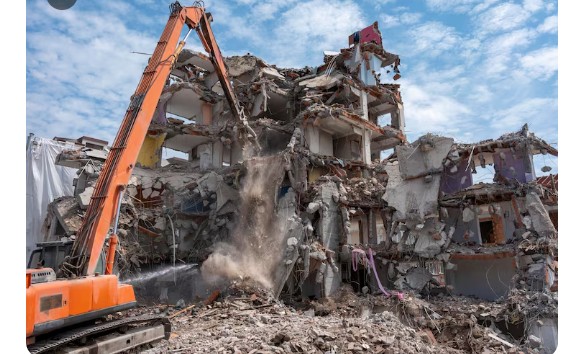
Acting on a complaint received from the Entally Police Station about this unauthorised construction, KMC carried out an inspection and found construction on the fifth and sixth floors for which no sanctioned plan could be produced. It accordingly initiated stop-work and demolition proceedings under the Kolkata Municipal Corporation Act, 1980. During the demolition drive that followed, however, the roof of the petitioner’s own fourth-floor flat, part of the legally sanctioned structure, was also damaged and torn down. The petitioner then approached the High Court, and pursuant to an earlier direction of the Court, KMC filed a report explaining its version of events. The Corporation stated that a sanctioned G+4 building plan did in fact exist, but that it had expired in 2014, and that this sanctioned plan had not been brought to the notice of the Executive Engineer who passed the demolition order.
Issues Before the Court
The dispute raised two connected questions for the Court’s consideration. First, was the demolition of the petitioner’s sanctioned fourth-floor flat lawful, given that it formed part of a structure for which a building plan had once been sanctioned, and given that the officer who ordered the demolition had not consulted the Corporation’s own records before acting? Second, could KMC be permitted to justify the demolition after the fact by raising, through affidavits filed in the writ proceedings, reasons such as the expiry of the sanctioned plan in 2014, when those reasons did not appear anywhere in the original demolition order itself?
Arguments of the Parties
The petitioner’s case rested on the simple fact that he had acted in good faith throughout: he had verified the sanctioned plan before purchasing his flat, had it mutated in the municipal records in his own name, and had done nothing to attract any enforcement action against himself. He argued that the damage to his roof was the direct result of the Corporation’s own carelessness in failing to check whether the floor being targeted for demolition was, in fact, part of a legally sanctioned structure, and sought both restoration of the damaged portion and compensation for the loss caused to him.
The Kolkata Municipal Corporation, for its part, did not dispute that the demolition had damaged the petitioner’s flat, but sought to justify its action on the ground that the building’s sanctioned plan, though it had once existed, had expired back in 2014. On this basis, KMC argued that construction on the fifth floor, and by extension the demolition carried out there, was justified regardless of any earlier sanction. The Corporation also explained that this information about the sanctioned but expired plan had not been placed before the Executive Engineer at the time the demolition order was passed, since it came to light only after the petitioner raised his complaint.
Judgment
The Calcutta High Court ruled in favour of the petitioner on the question of the Corporation’s liability for the manner in which the demolition was carried out. The Court rejected KMC’s attempt to defend the demolition order by relying on the 2014 expiry of the sanctioned plan, a fact that had not featured in the order itself, and held that the Executive Engineer had failed to discharge the basic duty of verifying municipal records before authorising the demolition. Describing the Corporation’s conduct as reflecting a ‘most reckless manner’ of functioning, the Court directed KMC to restore the damaged roof of the petitioner’s flat within eight weeks, with the Executive Engineer required to certify that the restoration had been completed. On the question of monetary compensation for the loss suffered, the Court declined to decide the claim within writ proceedings but granted the petitioner liberty to pursue that relief before the appropriate forum.
Reasoning of the Court
At the core of the Court’s reasoning was a straightforward but important administrative law principle: a public authority cannot defend its own order by inventing new justifications for it after the event, particularly through affidavits filed once litigation has already begun. The demolition order that KMC’s Executive Engineer had actually passed made no mention of the sanctioned plan or its expiry in 2014; it simply reflected an inspection that found construction without any visible sanction. It was only later, once the petitioner brought the matter to court, that KMC discovered and disclosed that a sanctioned plan had existed at all. The Court found it telling, and troubling, that an officer empowered to order the demolition of a structure had not thought to check his own department’s records before doing so, and had then sought to excuse this by saying that no one had specifically drawn the sanctioned plan to his attention.
The Court was firm that this was not an adequate defence for a body exercising coercive statutory power capable of destroying part of a citizen’s home. It observed that it was utterly shocking for an officer who had passed a demolition order without consulting his own records to later shelter behind the claim that the information simply had not been brought to him. This reasoning placed the burden squarely on the municipal authority itself to be diligent before wielding its demolition powers, rather than on an innocent third party like the petitioner to somehow intervene and correct the Corporation’s own oversight. Since the demolition order, as actually passed, never turned on whether the sanctioned plan had lapsed, the Court held that KMC could not retroactively supply that reasoning to save an order that was, on its face, the product of an incomplete inquiry.
Significance of the Judgment
The judgment fits into a broader and increasingly urgent conversation in West Bengal about how municipal bodies exercise their demolition powers against unauthorised construction. Kolkata has, in recent years, seen tragic consequences flow from both extremes of this problem, from fatal building collapses linked to unchecked illegal construction on one hand, to demolition drives that move too quickly and too carelessly on the other. Around the same period as this ruling, the Calcutta High Court also held, in a separate matter, that municipal authorities cannot curtail a citizen’s statutory right of appeal against a demolition order by compressing the time available to exercise that remedy. Read together, these decisions signal that the Court expects civic bodies to combine firmness against genuine violations with procedural care, particularly record verification and respect for statutory safeguards, before coercive demolition machinery is set in motion.
For ordinary flat buyers, the case is also a useful illustration of a specific and often overlooked risk: that even a fully compliant purchase, backed by a sanctioned plan and proper mutation, may not fully insulate an owner from the fallout of a neighbour’s or developer’s unauthorised construction if the enforcing authority does not exercise due diligence. By holding the Corporation to a standard of basic record verification and denying it the ability to patch up a defective order with fresh, litigation-stage justifications, the Court has reinforced that administrative accountability does not evaporate simply because the underlying target of enforcement, unauthorised construction, deserved to be checked.
Conclusion
Tapas Mazumdar v. Kolkata Municipal Corporation & Ors. is a modest-sounding dispute over a damaged rooftop that carries a larger lesson about the discipline expected of municipal enforcement. The Calcutta High Court made clear that the power to demolish is not a power to be exercised carelessly, and that an authority cannot rely on facts it never considered at the time of passing its order to justify that order later in court. By directing restoration of the petitioner’s roof within a firm timeline while leaving the door open for him to separately claim damages, the judgment strikes a balance between prompt relief and full accountability, and stands as a caution to municipal officers that record-checking is not an optional courtesy but a basic legal duty.
References
1. “‘Utterly Shocking’: Calcutta High Court Raps KMC Officer For Demolition Order Passed Without Checking Records”, LiveLaw, 31 July 2026.
2. “Calcutta HC Pulls Up KMC Officer Over Demolition Order Passed Without Checking Records; Directs Restoration Of Damaged Roof”, Free Press Journal, 1 August 2026.
3. “Calcutta High Court Orders KMC to Restore Flat Roof After Reckless Demolition Error Occurred”, Supreme Today AI, 31 July 2026.
4. “Calcutta High Court Weekly Round-Up: 27th July To 2nd August, 2026”, LiveLaw.
5. “Calcutta High Court Monthly Digest: July 2026”, LiveLaw.
6. Kolkata Municipal Corporation Act, 1980.
