


Case Details
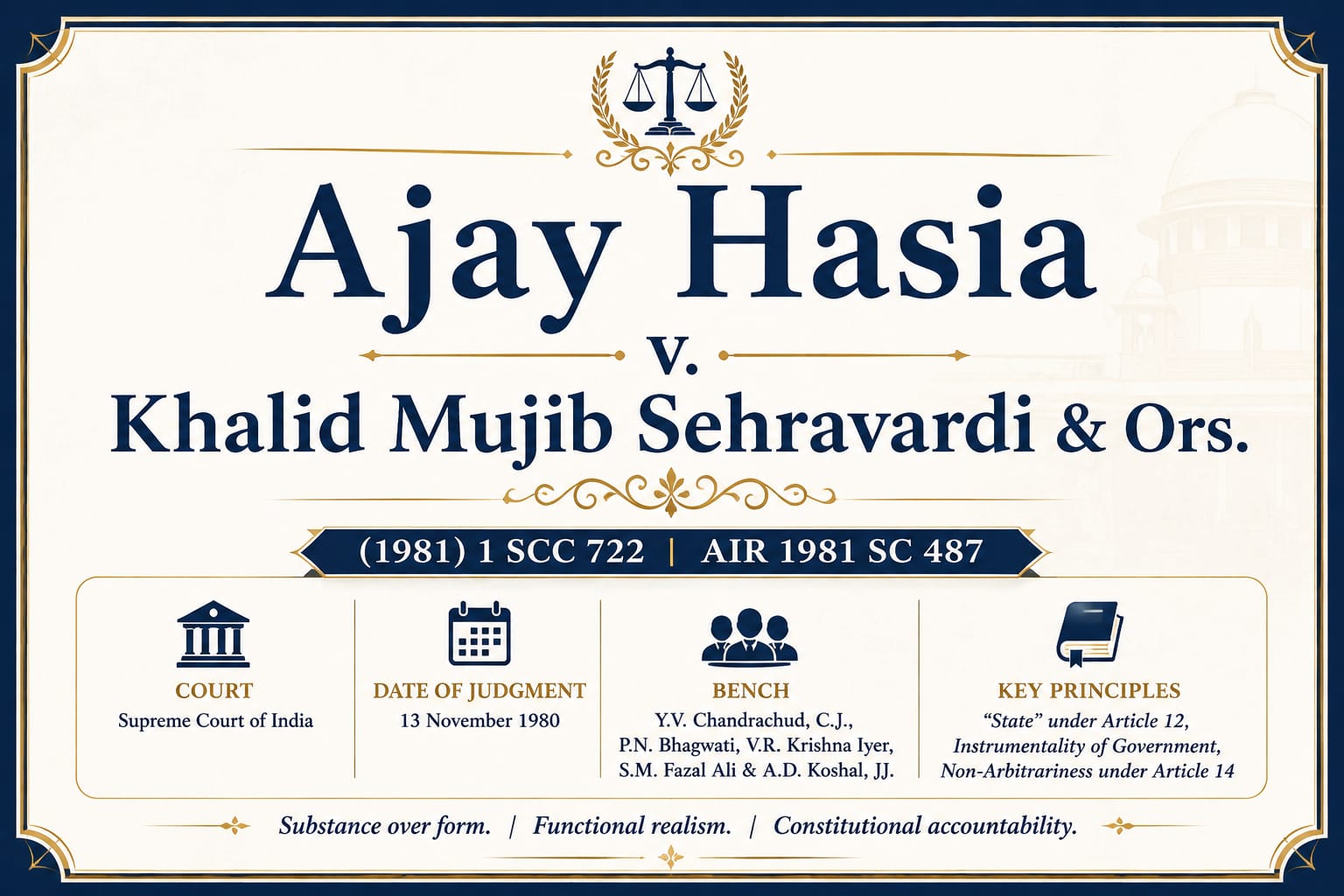
Case Name: Ajay Hasia v. Khalid Mujib Sehravardi & Ors.
Citation: (1981) 1 SCC 722; AIR 1981 SC 487
Court: Supreme Court of India
Date of Judgment: 13 November 1980
Bench: Y.V. Chandrachud, C.J., P.N. Bhagwati, V.R. Krishna Iyer, S.M. Fazal Ali and A.D. Koshal, JJ.
Introduction
The expression “State” under Article 12 of the Constitution of India is central to the enforcement of Fundamental Rights. Article 12 includes the Government and Parliament of India, State Governments and Legislatures, local authorities, and “other authorities” within its constitutional framework. The difficulty, however, arises when governmental functions are performed not directly by a government department but through a corporation, company or society having a separate legal personality.
The Supreme Court’s decision in Ajay Hasia v. Khalid Mujib Sehravardi is a landmark authority on this issue. The Court held that the formal legal status of an organisation cannot determine whether it is “State” under Article 12. What matters is the substance of governmental control and the real character of the body. Thus, even a society registered under a Societies Registration Act may fall within Article 12 if it functions as an instrumentality or agency of the Government.
The decision is particularly significant because it strengthened the constitutional guarantee against indirect State action and established a structured set of factors for determining whether an apparently autonomous body is, in reality, an extension of governmental authority.
Facts of the Case
The case arose from the admission process of the Regional Engineering College, Srinagar, which was managed by a society registered under the Jammu and Kashmir Registration of Societies Act, 1898. The college conducted admissions for the academic session 1979–80 through an entrance examination and viva voce.
A significant controversy arose because one-third of the total marks were allocated to the oral interview. The interview process was also extremely brief, with interviews generally lasting only two or three minutes. Questions were allegedly asked regarding matters such as the candidates’ parentage and residence rather than their suitability for engineering education.
The petitioners challenged the admission process principally on the ground that the allocation of such a substantial percentage of marks to viva voce was arbitrary and violated Article 14, which guarantees equality before law and equal protection of laws.
An important preliminary question was whether the Regional Engineering College society could be considered “State” under Article 12. If it was State, its admission process would be subject to the constitutional requirement of non-arbitrariness under Article 14.
Issues Before the Supreme Court
The principal issues were:
- Whether the Regional Engineering College society was an “authority” and therefore “State” within Article 12 of the Constitution.
- Whether the Government’s control over the society was sufficient to make it an instrumentality or agency of the Government.
- Whether allocating 33⅓% of the total marks to viva voce was arbitrary and violative of Article 14.
- Whether the selection procedure based upon a short and largely irrelevant interview was constitutionally valid.
Judgment and Ratio Decidendi
The Supreme Court dismissed the petitions but made important constitutional observations and laid down principles that became foundational to Article 12 jurisprudence.
- The College Society was “State” under Article 12
The Court examined the Memorandum of Association and Rules of the society and found extensive governmental involvement.
The society’s composition was dominated by representatives appointed by the Central Government and various State Governments. Its finances were substantially provided by the Central and Jammu & Kashmir Governments. Government approval was required for important financial and administrative matters, including certain rules and disposal of immovable property. The Board of Governors was also substantially controlled by government nominees.
On this basis, the Court concluded that the society was effectively an instrumentality or agency of the Government and therefore constituted an “authority” under Article 12.
The judgment emphasised that the Court must look beyond the formal legal personality of the organisation. In substance, the society was functioning as an extension of governmental authority.
- The “Functional Realism” Approach
One of the most important contributions of the judgment was the Court’s rejection of a purely formal approach to Article 12.
The Court held that constitutional interpretation should focus upon “functional realism” rather than “facial cosmetics.” The fact that an organisation is incorporated as a company or registered as a society does not automatically place it outside Article 12.
This principle was necessary because the modern welfare State performs numerous economic, educational, commercial and social functions through corporations and other legal entities. If such entities were automatically excluded from constitutional scrutiny merely because of their legal form, the Government could potentially avoid Fundamental Rights obligations by transferring governmental functions to separate corporate bodies.[7]
The Court therefore treated the corporate personality as a possible legal veil that cannot be permitted to defeat constitutional rights when the Government remains the real power behind the entity.
- The Six-Factor Test
The Court derived six relevant factors from R.D. Shetty v. International Airport Authority of India for determining whether a corporation or other body is an instrumentality or agency of the Government.
1. Government Ownership: If the entire share capital of the corporation is held by the Government, this strongly indicates that the body is an instrumentality or agency of Government.
2. Financial Assistance: Where the Government provides financial assistance sufficient to meet almost the entire expenditure of the organisation, it indicates a strong governmental character.
3. State-Conferred or State-Protected Monopoly: A monopoly status granted or protected by the State is another relevant factor because it may demonstrate substantial governmental involvement.
4. Deep and Pervasive State Control: Extensive governmental control over the organisation’s administration and functioning is one of the most significant indicators of governmental agency.
5. Public Importance and Governmental Functions: Where the functions performed by the organisation are of public importance and closely connected with governmental functions, this supports the conclusion that the organisation is an instrumentality of the State.
6. Transfer of a Government Department: If a government department is transferred to the corporation, this constitutes a strong indication that the corporation is effectively acting as an agency of the Government.
Importantly, the Court clarified that these factors were not conclusive or rigid tests. They were merely relevant indicia that had to be assessed carefully in the circumstances of each case.
- Form Versus Substance
The central constitutional philosophy of the case is that substance must prevail over form.
The Court observed that it is immaterial whether a body is created directly by statute, under a statute, incorporated as a government company, or registered as a society. The real inquiry is not “how the juristic person is born” but “why it has been brought into existence.”
This principle is highly significant in contemporary administrative law because governmental functions are increasingly performed through autonomous institutions, public sector undertakings, regulatory bodies, societies and government-controlled companies.
The judgment consequently prevents the Government from escaping constitutional accountability through organisational restructuring.
- Article 14 and the Doctrine of Non-Arbitrariness
After determining that the society was State under Article 12, the Court examined the admission procedure under Article 14.
The Court reiterated the constitutional principle that arbitrariness is inconsistent with equality. Article 14 is not confined merely to cases involving formal classification. State action must also satisfy the requirement of reasonableness and non-arbitrariness.
The Court recognised that an entrance examination could be a legitimate method of assessing comparative merit. However, the Court was critical of excessive dependence upon viva voce because an oral interview is inherently subjective and capable of manipulation.
The Court therefore held that allocation of 33⅓% of the total marks to viva voce was arbitrary and unreasonable. In the circumstances prevailing at that time, allocation of more than 15% of the total marks to oral interview would be arbitrary.
The Court also found that the extremely short interviews and irrelevant questions further undermined the fairness of the selection process.
Critical Analysis
The judgment deserves considerable appreciation for strengthening the constitutional control of governmental action.
First, it prevents the circumvention of Fundamental Rights. Without this approach, the Government could simply create a society or company and transfer governmental functions to it, thereby arguing that the resulting entity was a private body.
Secondly, the judgment reflects the realities of the modern welfare State. Government today does not function exclusively through traditional departments. Education, transport, infrastructure, finance, healthcare and other public services may be administered through corporations and autonomous bodies. A constitutional definition of State based exclusively on formal legal status would therefore be inadequate.
Thirdly, the decision promotes administrative accountability. Once a body is regarded as State under Article 12, its actions become subject to constitutional limitations, particularly Articles 14, 19 and 21.
However, the six-factor test has also attracted criticism. If applied mechanically, it could bring numerous autonomous organisations within Article 12 merely because they receive government funding or are subject to some regulatory supervision. The Court itself recognised this danger by stating that the meaning of “other authorities” should not be stretched to include every autonomous body having some nexus with Government.
Thus, the test must be applied cumulatively rather than mechanically.
Subsequent Development of the Law
The principles of Ajay Hasia were subsequently clarified by the Supreme Court in Pradeep Kumar Biswas v. Indian Institute of Chemical Biology. A seven-judge Bench explained that the Ajay Hasia factors are not rigid conditions. The ultimate question is whether, considering the cumulative circumstances, the body is financially, functionally and administratively dominated by or under the control of Government, and whether such control is deep and pervasive.
The distinction between genuine governmental control and ordinary regulatory control is therefore crucial. Mere licensing, supervision or regulation of a private body does not automatically make it “State.”
The decision was also considered in Zee Telefilms Ltd. v. Union of India, where the Supreme Court examined whether the Board of Control for Cricket in India (BCCI) was “State” under Article 12. The Court ultimately held that BCCI did not satisfy the Article 12 test, demonstrating that public importance alone is insufficient to establish State status.
More recently, courts have continued to rely upon Ajay Hasia while emphasising that the six factors must be assessed in combination and according to the actual degree of governmental domination.
Thus, Ajay Hasia remains a foundational authority, but its test has evolved into a more nuanced cumulative-control test.
Critical Evaluation
From a constitutional perspective, the decision represents a progressive interpretation of Article 12. It recognises that Fundamental Rights would lose much of their effectiveness if the Government could evade constitutional limitations simply by acting through separate legal entities.
At the same time, the judgment correctly avoids treating every government-linked organisation as “State.” The requirement of deep and pervasive governmental control prevents the doctrine from becoming excessively broad.
The most enduring contribution of the judgment is therefore not merely the six-factor test but its constitutional methodology: courts must identify the real source of power and examine the actual relationship between Government and the concerned body.
The case also connects Article 12 with Article 14. Once an entity is identified as State, its discretion cannot be exercised arbitrarily. This ensures that constitutional equality follows governmental power irrespective of the institutional form through which that power is exercised.
Conclusion
Ajay Hasia v. Khalid Mujib Sehravardi occupies a pivotal position in Indian constitutional and administrative law. The judgment transformed the understanding of “State” under Article 12 from a largely formal concept into a substantive and functional inquiry.
Its most important message is that constitutional obligations cannot be avoided by changing the legal form of governmental activity. Whether the entity is a statutory corporation, government company or registered society, the decisive question is whether it functions as an instrumentality or agency of Government.
The six-factor framework introduced by the judgment subsequently became an important foundation for the development of Article 12 jurisprudence. Although later cases, particularly Pradeep Kumar Biswas, clarified that the factors are not rigid or conclusive, the fundamental principle of Ajay Hasia remains intact: constitutional rights must follow governmental power, not merely governmental form.
The decision therefore represents an important step towards ensuring that the Fundamental Rights guaranteed by the Constitution remain effective in a changing administrative State.
References
- Ajay Hasia v. Khalid Mujib Sehravardi, (1981) 1 SCC 722; AIR 1981 SC 487.
- https://indiankanoon.org/doc/1186368/
- Indian Constitution, art 12, 14, 19 & 21.
- R.D. Shetty v. International Airport Authority of India, (1979) 3 SCC 489; see also Ajay Hasia, (1981) 1 SCC 722.
- https://indiankanoon.org/doc/1281050/
- Pradeep Kumar Biswas v. Indian Institute of Chemical Biology (2002) 5 SCC 111.
- https://indiankanoon.org/doc/471272/
- E.P. Royappa v. State of Tamil Nadu, (1974) 4 SCC 3; Maneka Gandhi v. Union of India, (1978) 1 SCC 248; Ajay Hasia, (1981) 1 SCC 722.
- Zee Telefilms Ltd. v. Union of India (2005), Zee Telefilms Ltd. v. Union of India (2005) 4 SCC 649 – iPleaders
