


INTRODUCTION:
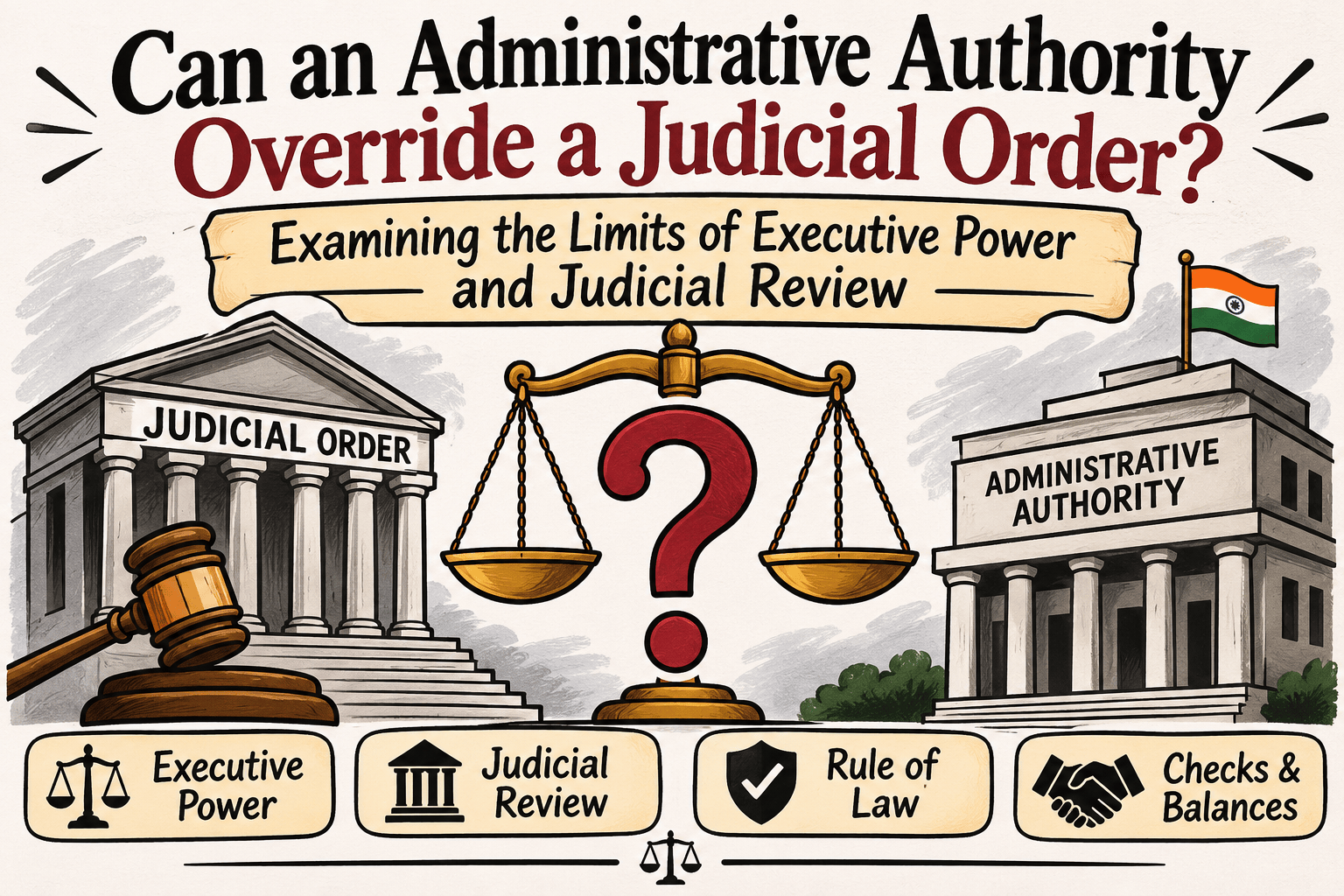
When a court decides a dispute against the government, the matter does not necessarily end with the pronouncement of judgment. An administrative authority may delay compliance, interpret the order narrowly, or take steps that frustrate its practical effect. In other circumstances, the government may seek legislative or ordinance-based intervention to alter the legal position on which the judgment was founded. These responses raise a fundamental question of constitutional governance: can the executive, or an authority acting under it, override a judicial order?
The answer depends on what is meant by the term “override”. An administrative authority cannot disregard a binding judicial order merely because it disagrees with the outcome. It must comply with the order or pursue an appropriate legal remedy. The legislature, however, occupies a distinct constitutional position. It may, within the limits of its legislative competence, change the law on which a judicial decision rests. What it cannot do is simply declare a judicial determination ineffective, as that would amount to an impermissible exercise of judicial power.
The distinction is therefore between disobedience to a judicial order and a lawful alteration of the legal framework underlying it. While the former undermines the authority of courts, the latter may constitute a legitimate exercise of legislative power, provided constitutional limitations are respected.
This article examines the constitutional boundaries governing executive compliance, legislative intervention and the exercise of contempt jurisdiction. It argues that the executive remains bound by judicial orders until they are stayed, modified or set aside; that the legislature may correct the legal basis of a judgment but cannot directly nullify the judicial determination; and that courts must enforce their orders through contempt jurisdiction without exceeding its statutory and doctrinal limits.
The discussion draws upon NHPC Ltd. v. State of Himachal Pradesh (2023), Celir LLP v. Sumati Prasad Bafna (2024) and Chaduranga Kanthraj Urs v. P. Ravi Kumar (2024), alongside established authorities on validating legislation, ordinances and wilful disobedience.
2. Constitutional Framework
The rule of law requires public power to be exercised within legally prescribed limits. Administrative authorities derive their powers from the Constitution and statutes and cannot independently determine that a binding judicial decision need not be followed. Courts, in turn, exercise judicial power to determine the legality and constitutional validity of executive action, while the legislature performs its law-making function subject to constitutional constraints.
The Constitution of India reflects this institutional arrangement. Articles 32 and 226 empower the Supreme Court and High Courts to issue writs for the enforcement of fundamental rights and, in the case of High Courts, for other legal purposes. Article 142 empowers the Supreme Court to pass such orders as are necessary to do complete justice in a matter before it. Article 141 makes the law declared by the Supreme Court binding on all courts, while Article 144 requires all civil and judicial authorities to act in aid of the Supreme Court.
Articles 129 and 215 recognise the contempt jurisdiction of the Supreme Court and High Courts respectively, which is regulated by the Contempt of Courts Act, 1971.
These provisions perform distinct functions. Article 141 concerns the precedential authority of the law declared by the Supreme Court, whereas Article 144 imposes an obligation upon civil and judicial authorities to act in aid of the Court. The obligation to comply with a particular judicial order also arises from the order itself and the legal relationship between the parties.
The constitutional principle of separation of powers, recognised as part of the basic structure of the Constitution, further explains why no organ of the State may assume the functions of another. In Indira Nehru Gandhi v. Raj Narain (1975), the Supreme Court invalidated a constitutional amendment that sought to exclude the adjudication of a particular election dispute from judicial determination, thereby reaffirming the constitutional limits on legislative interference with judicial power.
The term “override” may therefore describe three distinct situations:
-
Direct non-compliance: An authority fails to obey a binding judicial direction.
-
Circumvention: Conduct is undertaken to frustrate the practical effect of a judgment or pending judicial proceedings.
-
Legislative intervention: A law or ordinance is enacted to alter the legal basis of a judicial decision.
Each raises a different constitutional question and must be examined independently.
3. Can the Executive Override a Court Order?
3.1 Non-compliance and the Duty to Seek a Remedy
An administrative authority cannot substitute its own assessment for a binding judicial determination merely because it considers the decision erroneous. If the authority believes that the order is legally incorrect, it must pursue an appropriate remedy, such as an appeal, review, or application for clarification or modification. A curative petition may be available in narrowly defined circumstances.
Until the order is stayed, modified or set aside, its operative directions must be obeyed.
This obligation is not merely procedural. If the government were free to decide which judicial orders it would follow, judicial determinations would cease to possess binding authority and would become little more than recommendations.
The principle assumes particular importance where public authorities are concerned, as they possess the administrative machinery necessary to give effect to judicial directions. Their failure to comply may directly affect the enforcement of legal rights and undermine public confidence in the administration of justice.
3.2 Circumvention of Judicial Proceedings
The Supreme Court’s decision in Celir LLP v. Sumati Prasad Bafna illustrates the concern surrounding conduct that frustrates judicial proceedings.
The dispute arose from the sale of secured property under the SARFAESI framework. While proceedings were pending, the borrower transferred the property to third parties. In the contempt proceedings that followed, the Supreme Court examined whether conduct undermining the effect of judicial proceedings could attract contempt even in the absence of a straightforward breach of an express prohibitory direction. The Court also considered the transfer in the context of the doctrine of lis pendens and the parties’ subsequent conduct.
The decision demonstrates that contempt jurisdiction is not necessarily confined to the literal violation of an express direction. Conduct that undermines the integrity or effectiveness of judicial proceedings may also become relevant.
However, the decision must not be interpreted to mean that every transaction undertaken before the conclusion of litigation constitutes contempt. The legal consequences depend upon the circumstances, the nature of the proceedings, and the effect of the conduct in question.
Further, Celir LLP concerned private parties. Its relevance to executive action is therefore analogical, arising from the broader principle that parties cannot deliberately frustrate the administration of justice.
Where the State itself seeks to circumvent a judicial determination through legislative action, the constitutional position is more directly illustrated by Cauvery Water Disputes Tribunal, In re (1993) and State of Tamil Nadu v. State of Kerala (2014), discussed below.
3.3 Disagreement Is Not Defiance
The distinction between disagreement and wilful disobedience is essential to the exercise of contempt jurisdiction.
In Chaduranga Kanthraj Urs v. P. Ravi Kumar (2024), the Supreme Court emphasised that civil contempt requires wilful disobedience. Such disobedience must be conscious, deliberate and intentional. Accidental, bona fide or involuntary non-compliance, as well as genuine impossibility of compliance, does not necessarily constitute contempt.
Similarly, where an order reasonably admits of more than one interpretation and the conduct is not contumacious, contempt proceedings may not be maintainable. The position is also reflected in Ram Kishan v. Tarun Bajaj (2014).
The distinction is therefore between a legitimate challenge to a judicial decision and deliberate defiance of its authority. The executive may question an order through lawful procedures, but it cannot ignore the order or use administrative discretion to defeat its operative effect.
4. The Legislative Route and Its Constitutional Limits
4.1 The Principle of Legislative Correction
Unlike the executive, the legislature may, in appropriate circumstances, respond to an adverse judicial decision by changing the law on which it rests. This power, however, is subject to constitutional limitations.
The settled principle was articulated in Shri Prithvi Cotton Mills Ltd. v. Broach Borough Municipality (1969). The Supreme Court held that a validating law cannot simply declare a judicial decision invalid. Instead, the legislature must remove the defect identified by the Court so that the judgment could no longer have been rendered on the altered legal basis.
The distinction was reaffirmed in Indian Aluminium Co. v. State of Kerala (1996). The legislature cannot sit in appeal over a judicial decision, but it may validly remove the legal basis of that decision, including through retrospective legislation, provided it possesses the requisite legislative competence and complies with constitutional limitations, including fundamental rights.
The constitutional validity of legislative intervention therefore depends not merely upon its form but upon its substance. The legislature must genuinely alter the legal framework rather than merely declare that a judicial determination shall no longer operate.
4.2 NHPC Ltd. v. State of Himachal Pradesh (2023)
The Supreme Court applied these principles in NHPC Ltd. v. State of Himachal Pradesh (2023).
The dispute concerned the liability of NHPC and other entities to passenger tax under the Himachal Pradesh Passengers and Goods Taxation Act, 1955. The High Court had held that the relevant provisions did not impose the tax in the circumstances before it.
The State subsequently enacted the Amendment and Validation Act of 1997, which amended the statutory framework, expanded relevant definitions and introduced provisions with retrospective effect.
The Supreme Court upheld the legislative response, holding that the State Legislature had validly removed the basis of the earlier judgment.
The decision illustrates the constitutional distinction between reversing a judicial determination and changing the legal foundation on which it rests. A legislature cannot declare that a judgment is wrong or that it shall cease to bind the parties. It may, however, enact a law within its competence that cures the defect identified by the Court.
Thus, the validity of legislative intervention depends upon whether it genuinely alters the law or merely seeks to deny the authority of the judicial determination.
4.3 When Legislative Intervention Goes Too Far
The distinction between legislative correction and judicial nullification is substantive rather than formal. A law does not become constitutionally valid merely because it is described as an amendment or validating legislation.
If legislation merely declares past acts valid without removing the defect identified by the Court, it may amount to an impermissible attempt to nullify the judicial decision.
Two decisions illustrate this limitation.
In State of Tamil Nadu v. State of Kerala (2014), the Supreme Court examined a Kerala amendment concerning the Mullaperiyar dam. The legislative measure sought, in substance, to undo the Court’s earlier determination without validly changing the legal basis on which it rested. The amendment was struck down.
Similarly, in Cauvery Water Disputes Tribunal, In re (1993), a Karnataka ordinance seeking to neutralise an interim order of the Cauvery Water Disputes Tribunal was held to be beyond the permissible limits of legislative power.
The contrast with NHPC is significant. In NHPC, the legislature altered the substantive legal framework. In the Cauvery and Mullaperiyar matters, the impugned measures were found to impermissibly interfere with binding judicial determinations.
The central question is therefore not whether the legislature has acted after a judgment, but whether it has validly changed the law or merely attempted to deny the judgment’s authority.
4.4 Ordinances and the Limits of Executive-Legislative Power
Ordinances promulgated under Articles 123 and 213 of the Constitution possess the force of law, but remain subject to constitutional limitations and judicial review.
The Karnataka ordinance considered in Cauvery Water Disputes Tribunal, In re demonstrates that an ordinance cannot be used to accomplish what the legislature itself could not constitutionally do.
The Supreme Court has also addressed the constitutional impropriety of repeated re-promulgation of ordinances without placing them before the legislature. In Krishna Kumar Singh v. State of Bihar (2017), the Court held that re-promulgation may amount to a fraud on the Constitution.
The constitutional consequences are therefore clear: an ordinance intended to respond to an adverse judicial decision must be examined according to its substance and effect. If it validly changes the law, it may withstand judicial scrutiny. If it merely neutralises a judicial determination without removing the underlying legal defect, it cannot be sustained.
5. Limits of Judicial Review and Contempt Jurisdiction
5.1 The Statutory Framework
The obligation to comply with judicial orders does not mean that contempt jurisdiction is unlimited.
Section 2(b) of the Contempt of Courts Act, 1971 defines civil contempt as the wilful disobedience of a judgment, decree, direction, order, writ or other process of a court, or the wilful breach of an undertaking given to a court.
Section 12 prescribes punishment for contempt, including simple imprisonment for a term which may extend to six months, a fine which may extend to two thousand rupees, or both. The provision also permits discharge or remission of punishment upon a bona fide apology, subject to the Court’s satisfaction.
Section 20 bars the initiation of contempt proceedings after the expiry of one year from the date on which the alleged contempt is committed.
Contempt jurisdiction exists to protect the administration of justice. It is not a general mechanism for supervising administrative decisions or a substitute for the ordinary processes of execution.
5.2 Wilfulness, Ambiguity and Impossibility
In Chaduranga Kanthraj Urs v. P. Ravi Kumar, the Supreme Court emphasised that contempt requires wilful disobedience.
A genuine inability to comply, an accidental lapse, or a bona fide interpretation of an ambiguous order may not satisfy this requirement. Where a direction is unclear, seeking clarification may be more appropriate than imposing punishment.
The requirement of wilfulness ensures that contempt jurisdiction is exercised in a manner consistent with fairness and the rule of law. It prevents the mere existence of non-compliance from automatically resulting in penal consequences.
This distinction is particularly relevant to administrative authorities, which may face practical difficulties in implementing judicial directions. Such difficulties do not authorise disregard of the order, but they may be relevant in determining whether the non-compliance was wilful.
5.3 Staying Within the Scope of the Original Order
A court exercising contempt jurisdiction must also remain within the scope of the original judicial order.
In Prithawi Nath Ram v. State of Jharkhand (2004), the Supreme Court held that a contempt court cannot add to or travel beyond the original order, or decide a fresh dispute outside its terms.
The contempt court must determine whether the directions actually issued were wilfully disobeyed. It cannot use contempt proceedings to expand the original judgment or impose obligations that were never contained in it.
This limitation is essential to maintaining the constitutional balance. While courts possess the authority to enforce their orders, contempt jurisdiction cannot become an instrument of general control over government policy or administrative functioning.
6.Assessment
The constitutional framework governing executive compliance, legislative intervention and contempt jurisdiction is sound in principle, but its application raises important questions.
First, the distinction between removing the legal basis of a judgment and impermissibly nullifying it is often difficult to apply. A legislature that retrospectively amends a statute to neutralise a particular judicial decision will ordinarily contend that it is exercising its law-making power. Courts must therefore examine the substance and effect of the legislation rather than merely accept its stated purpose.
The contrast between NHPC Ltd. v. State of Himachal Pradesh and State of Tamil Nadu v. State of Kerala illustrates the difficulty. In one case, the legislative response was upheld because it validly altered the legal framework. In the other, the intervention was rejected because it impermissibly interfered with the judicial determination.
Second, contempt proceedings against government officials carry institutional consequences. The repeated summoning of senior officers and the threat of personal liability may encourage compliance, but they may also raise concerns about judicial overreach and administrative functioning. Contempt should therefore be reserved for wilful defiance rather than treated as the first response to every instance of delay.
Third, compliance cannot be examined without considering the legitimate remedies available to the government. Governments may have valid reasons to seek review, clarification, modification or additional time to comply with a judicial direction. The law accommodates such circumstances through established legal procedures and the requirement of wilfulness.
A constitutional system that punishes every instance of non-compliance irrespective of its cause would risk confusing obedience with the rule of law. At the same time, allowing public authorities to disregard binding orders on the basis of their own assessment would undermine judicial authority.
The challenge lies in preserving both principles: ensuring that judicial orders are respected while preventing contempt jurisdiction from exceeding its legitimate constitutional purpose.
7. Conclusion
An administrative authority cannot override a binding judicial order merely because it disagrees with the decision. It must comply unless the order is stayed, modified or set aside. If the authority considers the judgment legally incorrect, it must pursue the remedies provided by law rather than disregard the judicial determination.
The legislature occupies a different constitutional position. It may, within its legislative competence, alter the legal basis of a judgment. As Prithvi Cotton Mills, Indian Aluminium and NHPC demonstrate, a valid legislative response must remove the defect identified by the Court. Cauvery Water Disputes Tribunal, In re and State of Tamil Nadu v. State of Kerala illustrate the impermissibility of legislative measures that merely seek to deny the authority of a judicial determination.
Conduct designed to frustrate judicial proceedings may also attract contempt, as the decision in Celir LLP illustrates. However, contempt jurisdiction remains subject to the requirement of wilful disobedience and must be exercised within the terms of the original judicial order.
The constitutional balance is therefore not one of unrestricted supremacy for any single organ of the State. The executive must act within the law, the legislature must legislate within constitutional limits, and courts must enforce legal rights without exceeding their jurisdiction.
Ultimately, the rule of law depends upon each institution respecting the boundaries of its own power. Judicial authority cannot be reduced to a recommendation, legislative power cannot become a means of reversing judicial decisions, and contempt jurisdiction cannot become an instrument of unrestricted judicial control. The constitutional legitimacy of all three institutions rests upon their mutual respect for these boundaries.
References
Cases
-
NHPC Ltd. v. State of Himachal Pradesh Secretary & Ors., 2023 INSC 810 (6 September 2023).
-
Celir LLP v. Sumati Prasad Bafna & Ors., 2024 INSC 978 (13 December 2024), Contempt Petition (C) Nos. 158–159 of 2024 in Civil Appeal Nos. 5542–5543 of 2023.
-
Chaduranga Kanthraj Urs & Anr. v. P. Ravi Kumar & Ors., 2024 INSC 957 (10 December 2024), Contempt Petition (C) No. 688 of 2021 in Civil Appeal No. 3310 of 1997.
-
Shri Prithvi Cotton Mills Ltd. v. Broach Borough Municipality, (1969) 2 SCC 283.
-
Indian Aluminium Co. v. State of Kerala, (1996) 7 SCC 637.
-
Indira Nehru Gandhi v. Raj Narain, 1975 Supp SCC 1.
-
Cauvery Water Disputes Tribunal, In re, 1993 Supp (1) SCC 96.
-
State of Tamil Nadu v. State of Kerala, (2014) 12 SCC 696.
-
Krishna Kumar Singh v. State of Bihar, (2017) 3 SCC 1.
-
Ram Kishan v. Tarun Bajaj, (2014) 16 SCC 204.
-
Prithawi Nath Ram v. State of Jharkhand, (2004) 7 SCC 261.
Statutes and Constitutional Provisions
-
Constitution of India, Articles 32, 123, 129, 141, 142, 144, 213, 215 and 226.
-
Contempt of Courts Act, 1971, Sections 2(b), 12 and 20.
-
Himachal Pradesh Passengers and Goods Taxation Act, 1955, as amended by the Amendment and Validation Act of 1997.
