


INTRODUCTION
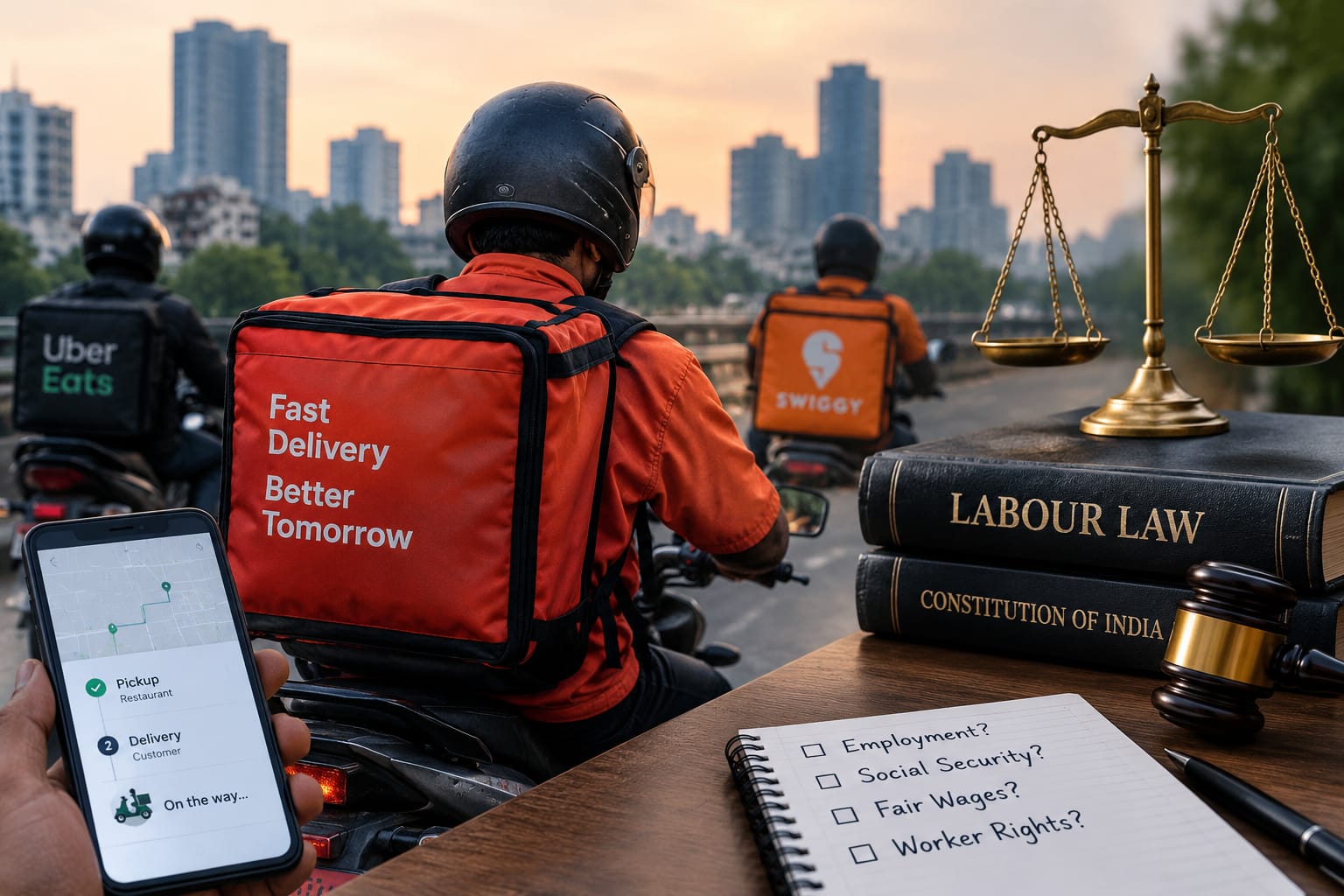
At half past five on a winter morning, a delivery partner
opens Swiggy, then Zomato, and waits. Neither app promises him anything. Each
decides which orders reach him, how long he has to deliver them, what bonus he
can earn this week, and whether a run of rejected orders or a few low ratings
will quietly shrink the work he is offered. On paper, he is an independent
partner who chooses when to log in. In practice, the app sets the price, the
route, the pace and the consequences. This combination of contractual
independence and platform control prompts the central question of this article:
do existing labour law categories adequately address platform work in India?
The Code on Social
Security, 2020, notified with effect from 21 November 2025[1], brings gig and platform
workers within the statutory definition under Sections 2(35) and 2(61)[2]. Such recognition,
however, creates a distinct category for social security purposes and does not,
by itself, reclassify platform workers as employees under the Code on Wages,
2019 or the Industrial Relations Code, 2020.
This article addresses two related questions. First, how
should employment status be determined for delivery partners when control is
exercised through technology instead of direct supervision?
Second, how can social security be made effective for
workers earning across multiple platforms, where contributions and entitlements
may be fragmented?
I argue that protection has to run on two tracks: a
functional test of employment that looks past contractual labels, and a
portable, Aadhaar-linked account that stays with the worker when the platform
changes.
The article also covers two connected problems, the adequacy
of earnings and the fairness of algorithmic decisions such as account
deactivation, because both depend on how these two tracks are built.
Employment Status: Substance over Form
The classification of a delivery partner cannot turn on
contractual nomenclature. Terms such as ‘partner’, ‘independent contractor’
used in platform agreements are not determinative of the relationship under
Indian law. The control test as enforced in Dharangadhara Chemical Works Ltd.
v. State of Saurashtra[3] is the starting point.
Later decisions broadened the inquiry beyond control. Silver Jubilee
Tailoring House v. Chief Inspector of Shops[4]
and Hussainbhai v. Alath Factory Thozhilali Union (1978) 4 SCC 257
looked at integration into the enterprise and at who in substance benefits from
the work. Balwant Rai Saluja v. Air India Ltd[5]
is useful mainly for its reminder that control must be real and not nominal,
although it arose in the contract-labour setting and should be cited with that
in mind.
Platform work requires adapting this test, as control is
exercised through algorithmic management rather than direct supervision.
Relevant indicators include unilateral setting of fares and
incentives, automated assignment allocation, real-time GPS monitoring,
rating-based access to future work, and the ability to suspend or deactivate
accounts. Although workers may have flexibility to log in and out, they face
significant constraints on pricing, route choices, and consequences for low
acceptance or high rejection rates.
No single indicator is decisive. Indian courts consider
factors such as vehicle ownership, the right to refuse orders, ability to work
on multiple apps, economic dependence on a single platform, and integration
into the platform’s core business as part of a cumulative assessment.
Classification as a gig or platform worker under Section
2(35) of the Code on Social Security, 2020, creates a statutory channel for
social security but does not prevent a finding of employee status under Section
2(29) of the Code on Wages, 2019 or Section 2(o) of the Industrial Relations
Code, 2020, if the facts support it. Conversely, using a digital intermediary
alone does not establish employment.
The Code on Social Security, 2020: Recognition and Its
Limits
The Code on Social Security, 2020 constitutes the first
statutory recognition of non-standard work in India. Section 2(35) defines a
gig worker as a person who participates in a work arrangement outside a traditional
employer-employee relationship. In contrast, Section 2(61) defines a platform worker
as one engaged through an online platform. This creates a third category,
distinct from an employee under Section 2(26).
The substantive provision is Section 114. It empowers the
Central Government to frame schemes for gig and platform workers under the
Seventh Schedule and enables contributions from aggregators, defined under Section 2(2), of 1-2% of annual turnover, subject to a cap of 5% of
amounts paid to workers.[6]
Section 141 mandates registration through Aadhaar-based
self-declaration on the e-Shram portal under Section 142.
However, recognition under Section 2(35) does not create an
enforceable right to benefits. As Deakin and Wilkinson note in the context of
social security law, statutory recognition is a gateway, not a guarantee.
Four distinct inquiries arise:
(a) whether Section 114 authorises a specific benefit;
(b) whether a scheme
has been notified under Section 114(2) read with Section 144;
(c) whether the
worker satisfies eligibility criteria relating to age, income ceiling and
e-Shram registration; and
(d) whether a
grievance redressal and claims disbursement mechanism exists at the district
level.
The Multi-Platform Worker: One Livelihood, Multiple
Relationships
Multi-apping is often presented as proof that riders are
independent businesspeople. The better reading is that it is how they cope with
a payment model that gives them little security. Consider a rider who keeps
both apps open through a slow afternoon. He is not running two businesses. He
is trying to cut the unpaid waiting time and reach a daily income he can live
on.
The analysis requires
bifurcation of two issues.
First, on employment status, multi-apping is neutral.
Working for multiple platforms does not preclude a finding of employment
against a single platform if that platform exercises the requisite control, as
held by the UK Supreme Court in Uber BV v Aslam and by the US Department of Labour
under its economic reality test. Conversely, single-platform engagement does
not automatically establish employment. The test remains the substantive nature
of control exercised by the relevant platform. Second, on social security,
fragmentation of records undermines eligibility verification. Each platform
maintains separate data on assignments, payments and active hours.
Under the present
framework of Section 114 read with draft Code on Social Security (Central)
Rules, 2021, Rule 50, aggregator contributions are calculated on
platform-specific turnover attributable to platform workers. Absent a
consolidated registry, a worker may be unable to demonstrate cumulative
engagement or to establish that contributions have been remitted by respective
platforms.
The Code does not make one platform liable for income earned
on another. Each platform’s obligation is limited to its own engagement.
Equally, the existence of a competing platform cannot reduce what a platform
owes under its own scheme. The real gap is therefore between records that are
split across platforms and a worker’s needs, which continue across them.
Registration, Portability and Administrative
Accountability
The e-Shram portal established under Section 142 provides a
foundational database for unorganised workers, including platform workers under
Section 2(61).
As of 2024, over 29 crore registrations have been reported,
yet the classification of platform workers within the portal remains based on
self-declaration without mandatory cross-verification with aggregator records
under Rule 50 of the Draft Central Rules[7]. Registration and
portability serve distinct legal functions. Registration under Section 142(1)
is an identification mechanism, enabling a worker to be recorded in the
National Database.
A worker-centred model would need three things:
1. an Aadhaar-seeded, e-Shram-linked Universal
Account Number (UAN)[8] on the lines of EPFO,
allowing authorised verification of contribution records under Section 114(4)
without exposing personal data beyond necessity.
2. A
statutory obligation on aggregators
under Section 114(4) read with Section 123(1)(e) to file periodic electronic
contribution statements to the National Social Security Board constituted under
Section 6.
3. A
correction and dispute resolution mechanism, including the right to access
personal data under Section 11 of the Digital Personal Data Protection Act,
2023, and grievance redressal under Section 114(8) read with Section 12. Portability
does not confer automatic eligibility. It merely prevents platform-switching
from operating as a break in service for benefits where continuity is a
condition precedent.
Portability does not guarantee eligibility. It only ensures
that moving between platforms does not count as a break in service where
continuity matters, for example where maternity or old-age benefits depend on a
minimum contribution period. A single consolidated record would also let the
State audit what aggregators have paid against what they have paid out to
workers, something no individual rider can currently check.
Minimum Wages Section – Problem:
Social security under Section 114 of the SS Code does not
address adequacy of current remuneration. Wage protections under the Code on
Wages, 2019, particularly Sections 5, 9 and 15, apply only where the person
falls within the definition of employee under Section 2(29)[9] read with the definition
of wages under Section 2(y).
Therefore, minimum wage applicability to platform workers
depends on satisfaction of the employment test discussed in Part I. Where
employment is not established, remuneration remains governed by contractual
terms, subject to transparency requirements that may be prescribed under
Section 114(8) schemes.
Algorithmic Decisions
This creates a procedural problem alongside the
employment-classification question. A worker may need to challenge an
inaccurate rating, disputed delivery record or account restriction without
first resolving whether the relationship legally constitutes employment.
The United Kingdom Supreme Court’s decision in Uber BV v
Aslam [2021] UKSC 5 illustrates the importance of examining the practical
relationship between a platform and the people performing work through it. The Court
considered statutory worker status and the real conditions under which drivers
provided services rather than treating contractual descriptions as conclusive.
The judgment does not determine the status of Indian delivery partners, but it
offers a useful comparative illustration.
India should consider safeguards requiring intelligible
reasons for serious adverse decisions, opportunities to correct factual errors
and meaningful human review of consequential account restrictions. Such
protections should be designed with appropriate regard to the applicable legal
framework and the practical needs of workers.
The constitutional argument needs care. Articles 14 and 21
bind the State, not private companies. The way in is through the State’s duty
to legislate and regulate, and through cases such as Olga Tellis v. Bombay
Municipal Corporation (1985 [10]where the Supreme Court
treated livelihood as part of the right to life under Article 21. Olga Tellis
fits this point better than Maneka Gandhi v. Union of India[11],
which concerned the impounding of a passport and is better cited for the
principle that procedure must be fair.
Recommendation
(a) Notify a Portable UAN under Section 142(3) linking
e-Shram ID to aggregator contribution statements filed under Rule 50(5) of
Draft Central Rules;
(b) Amend the Seventh Schedule to prescribe a pro-rata
aggregator contribution formula for workers active for less than 30 days on a
platform;
(c) Mandate monthly electronic payslips under Section 114(8)
scheme showing gross assignment pay, incentives, TDS and deductions;
(d) Create a deemed deactivation notice period of 7 days for
ratings-based deactivation with an appeal to the Regional Labour Commissioner
under Section 12;
(e) Include platform
worker representatives in the National Social Security Board under Section
6(2)(c).
Conclusion
The Code on Social Security, 2020 recognises platform work,
but it leaves the question of employment to the existing tests. Classification
as a platform worker under Section 2(61) does not confer employee status under
Section 2(26), nor does engagement with multiple platforms preclude such a
finding where the indicia of control are satisfied. Effective protection
therefore requires a twin-track approach. Two things are needed. Courts and
regulators should assess control as it actually operates through algorithms,
and the State should build an account system that keeps a worker’s
contributions together as he moves between apps. The aim is not to reclassify every
platform worker. It is to make sure a contract label does not defeat protection
where control exists, and that switching platforms does not erase what a worker
has already earned.
[1]
Ministry of Labour notification dated 21.11.2025
[2]
Section 2(35), 2(61) Code on Social Security
[3]
AIR 1957 SC 264
[4]
(1974) 3 SCC 498
[5]
(2014) 9 SCC 407
[6]
Ministry of Labour & Employment, e-Shram Portal: National Database of
Unorganised Workers, https://eshram.gov.in
[7]
Draft Code on Social Security (Central) Rules, 2021, Rule 50(5)
[8]
The Employees’ Provident Funds Scheme, 1952, section 26A
[9]
The Code on Wages, 2019, section 2(29)
[10]
3 SCC 545,
[11]
(1978) 1 SCC 248
