


Introduction
In the physical world, we have already defined the framework around death – laws, succession, administration of estate. Physical property is passed through a Will or rules of Intestate Succession; physical life comes to an end when the actual human body stops functioning.
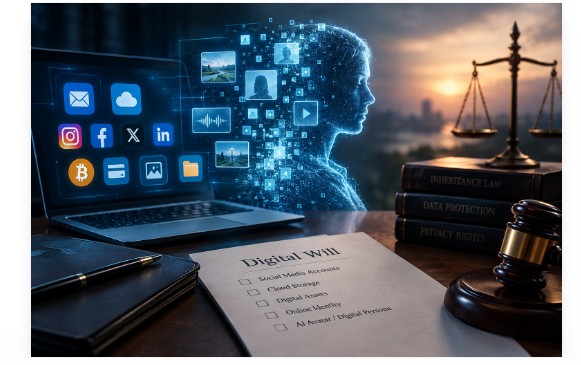
However, in the 21st century, all our lives are embedded in digital systems and after we die, our digital identity continues living on physical servers globally. Email accounts, cloud storage servers, social media pages, digital money, personal data-logs, subscriptions all continue long after we cease to exist physically.
This leads to a socio-legal situation where a new concept is evolving called digital afterlife or life after death in the digital sphere. Now, artificial intelligence models are also able to generate the persona of the deceased (avatar/ deepfake, textual chatbot, etc.) using personal data, raising further questions, the most important being – who will own, or control your online identity, data and digital assets post your death?
The Components of the Digital Estate
In order to ascertain who controls a digital afterlife, we should first categorize the elements making up an individual’s post-mortem digital corpus:
1. Monitory digital assets, i.e., financial resources, keys for cryptocurrencies, social media sites with revenues, domain names, intellectual property, or original digital content, and
2. Emotional digital assets (such as personal emails, photos, private documents or chat histories), and
3. Identity/Biometric Digital Assets that can be processed by algorithms on learning machines, and be used to compose new persons that may have to serve human purposes in the digital world such as personal communications or other interactive media, voice recordings, video media, or biometric (visual, facial) data.
Unlike tangible property to be assigned under traditional law of property through heir ship, digital content will frequently be assigned based on contract law – precisely those ToS agreements that users accept without being aware in clicking away their online accounts.
The Contractual Barrier: Terms of Service vs. Inheritance Rights
The greatest barrier that prevents families and estates from access to digital accounts of the deceased is the contractual terms of service and enforcing them legally.
- Non-Transferability and “Dead Man’s Privacy”
All significant technology platforms will have “non-transferability” clauses within the Terms of Service. This term has the effect that neither ownership of the account can pass to a successor upon the death of the individual, and that upon the death of the user the rights to use the account will expire totally.
From a technology company’s viewpoint it is believed that this severe control of access is required to protect the “post mortem privacy” of a deceased individual user. By way of example, a person might have sent confidential emails or Direct Messages under an assumed privilege of their privacy. If an executor has totally unrestricted access to an email account or Direct Messaging system, they might inadvertently breach the privacy of third parties with whom the individual corresponded.
2. Anti-Hacking Laws and Criminal Liability
In most states it can be technically against computer misuse acts to access someone else’s account using their passwords, regardless of whether it was a mourning child of the deceased or an authorized legal heir (executor, for example). Computer crime laws such as the Computer Fraud and Abuse Act in the U.S., and similar offenses such as illegal computer access according to the cyber law around the world, define illegal account access as a criminal activity. This places heirs in the dilemma of attempting to get family pictures back or recover account records of a loved one, which involves unauthorized access both according to the policy of the websites or apps and the laws.
The Emergence of “Ghostbots” and the Commercialization of Post-Mortem Persona
While the recovery of static digital artifacts provides some legal issues, generative AI has brought about a far more intrusive element to the digital afterlife: algorithmic resurrection. By implementing the aforementioned natural language processing models after being trained on an individual’s past emails, text messages, voice notes and social media communications, companies and startups can simulate an individual’s personality, tone and dialect in the form of a grief bot or interactive avatar.
This leads to various ethically and legally sensitive areas such as:
1. Impingement on posthumous human dignity:
Creating a new statement or behavior from a dead individual’s digital voice without the individual’s consent and intent before their death violates one’s human dignity.
2.Commercial Use and Right of Publicity:
Open creation of AI avatars post death enables businesses or entities and bad actors to commercially profit from a dead individual’s likeness, image and voice.
3. Negative Psychological Effects on the Mourning:
While conversations with these avatars might be seen as a tool to help the mourning process, mental health experts express their concern that realistic digital doppelgängers enable the distortion of grief, prevention of psychological completion, and even psychological manipulation.
Judicial Precedents and Evolving Statutory Frameworks
Courts and legislatures in many countries of the world are also struggling toward finding the balance between post-death privacy and heirs/executors interests.
The Constitutional Right to Post-Mortem Privacy and Dignity
Both the constitution courts around the world recognize that the right to privacy and human dignity, extends beyond death:
1. Indian Supreme Court (Puttaswamy Standard) : In K.S. Puttaswamy(Retd.) v. Union of India(2017), the SC of India recognized the right to privacy as part of fundamental rights and an aspect of Article 21 read with dignity and autonomy. The reasoning applied in latter judgments and further study of Indian jurisprudence affirms this right beyond life. It covers individual autonomy/dignity beyond physical life and holds it to include the right of an individual not to be subject to unreasonable post mortem use of their data.
2.German Federal Court of Justice(BGH) Inheritance Ruling, 2018: The highest civil court in Germany (BGH) passed a historic judgment holding that digital accounts fall within the estate which is to pass to legal heirs under German inheritance law, applying it in context to a dead teenage’s Facebook account.15 The decision held that it cannot logically be made out why digital correspondence should enjoy different treatment to paper documents, thus granting access to the parents of the deceased child.
Legislative Reforms: Uniform Fiduciary Access Laws
The specific legislation that has been introduced in various jurisdictions to solve the executors-tech platform conflicts are as follows:
1. Revised Uniform Fiduciary Access to Digital Assets Act (RUFADAA – USA): RUFADAA creates a three-tiered category for the online estate administration. First, the online preferences expressly stated by the user (via the platform’s legacy controls) are binding and must be honored before any other factor, and if this is not clear or made use of, then the instruction specified in the formal will or power of attorney is binding, otherwise if neither is given, the Terms of Service given by the tech platform are the guiding factor.
2. Digital Personal Data Protection Act (DPDPA – India): India’s contemporary data regime introduces clauses in line with which data principal can nominate an authorized representative to exercise one or more of the data principal’s right-be it right to get data deleted or one of access rights after one’s death/incapacity.
Strategies for Reclaiming Post-Mortem Digital Control
To stop Big Tech platforms and unauthorized algorithms taking over digital legacies, individuals and the legal system need a proactive strategy for Digital Estate Planning:
1. Codification of the Digital Estate: Create specific digital wills, or add specific digital asset clauses to traditional wills, establishing a ‘digital executor’ and providing clear direction for digital asset memorialization, archiving or outright deletion.
2. Use of Built-In Legacy Systems: Pre-plan access to digital accounts through platform-level legacy management features, like Google’s Inactive Account Manager and Apple’s, or Meta’s Legacy Contact, allowing you to select someone authorized to access or delete your digital files for you.
3. The Statute of Post Mortem Persona Rights (Right of Image): Develop and enact laws that enforce a Right of Publicity and post mortem right to protect your image that prevents your biometric data from being used to generate AI avatars or deepfakes of you, absent your written approval.
Conclusion
As our being shifts between our ephemeral corporeality and our enduring digital self, human identity faces a new conceptual challenge: when individuals are not properly instructed and planned on how to face death in the digital age, the rights over their post-mortem identity can become dependent on the terms of service of technology companies and caught between deadlocks or algorithmic violations.
This new right, above both the controlling greed of technology companies looking to trap our data and the manipulative algorithm trying to hook into our memories for higher traffic, belongs to us as sovereign individuals and should empower each of us to assert control over our post-mortem identity and privacy.
References
1. Justice K.S. Puttaswamy (Retd.) v. Union of India, (2017) 10 SCC 1: Supreme Court of India decision establishing privacy and personal autonomy as fundamental constitutional rights under Article 21.
2. Federal Court of Justice (Bundesgerichtshof – BGH), Germany: Judgment of July 12, 2018 (III ZR 183/17), ruling that digital user contracts and social media profiles pass to legal heirs under general inheritance law.
3. National Conference of Commissioners on Uniform State Laws (2015): Revised Uniform Fiduciary Access to Digital Assets Act (RUFADAA), establishing legal standards for executor access to deceased users’ digital accounts.
4. Harbin, B. (2025/2026): Post-Mortem Privacy Rights, Generative AI Avatars, and the Digital Estate, Journal of Law, Technology & Policy, analyzing legal frameworks governing post-mortem AI deepfakes and griefbots.
5. Ministry of Law and Justice, India (2023): The Digital Personal Data Protection Act, 2023 (DPDPA), providing statutory rights for data principal nominations in cases of death or incapacity.
