


Case Details
Case Name: Indian Young Lawyers Association & Ors. v. State of Kerala & Ors.
Court: Supreme Court of India
Bench: Five-Judge Constitution Bench
Date of Judgment: 28 September 2018
Bench: Chief Justice Dipak Misra, Justice R.F. Nariman, Justice A.M. Khanwilkar, Justice D.Y. Chandrachud and Justice Indu Malhotra
Citation: (2019) 11 SCC 1; AIR 2018 SC 2432
Introduction
The Sabarimala case is one of the most significant constitutional decisions concerning the relationship between religious freedom, gender equality and constitutional morality in India. The case arose from the traditional practice of excluding women between the ages of 10 and 50 from entering the Sabarimala Temple in Kerala, dedicated to Lord Ayyappa. The practice was defended on the ground that Lord Ayyappa was considered a Naishtika Brahmachari, and therefore women of menstruating age were traditionally prohibited from entering the temple.
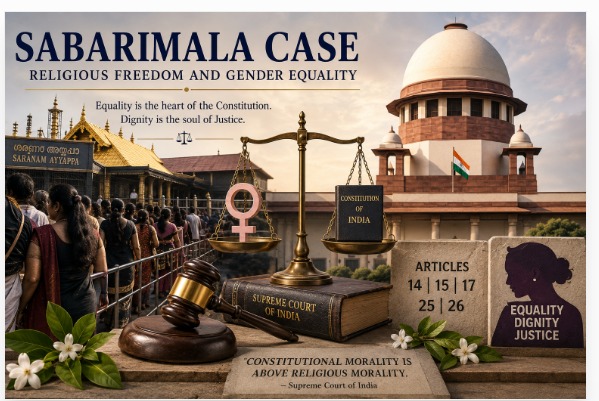
The Supreme Court was required to determine whether such exclusion was constitutionally valid. The Court examined Articles 14, 15, 17, 25 and 26 of the Constitution and considered whether the practice formed an essential part of the religion. By a 4:1 majority, the Court held that the exclusionary practice was unconstitutional.
The judgment placed individual dignity and equality at the centre of constitutional protection and emphasized that religious freedom cannot be used to justify practices that violate fundamental rights.
Facts of the Case
The Sabarimala Temple, situated in Kerala, is dedicated to Lord Ayyappa. The temple follows several distinctive religious traditions. One of the most controversial practices was the restriction preventing women belonging to the age group of approximately 10 to 50 years from entering the temple.
The restriction was based on the belief that Lord Ayyappa was a Naishtika Brahmachari, or an eternal celibate. According to the traditional practice, women of menstruating age were considered incompatible with the particular form of worship followed at Sabarimala.
The exclusion was supported through Rule 3(b) of the Kerala Hindu Places of Public Worship (Authorisation of Entry) Rules, 1965, which permitted restrictions on the entry of women where such exclusion was based on custom or usage.
The Indian Young Lawyers Association filed a Public Interest Litigation before the Supreme Court under Article 32. The petitioners challenged the practice of excluding women from the temple and argued that it violated the fundamental rights guaranteed by the Constitution.
The petitioners contended that women were being denied the right to worship solely because of their sex and biological characteristics. They argued that such exclusion violated Article 14, which guarantees equality before law, and Article 15, which prohibits discrimination on grounds including sex. They also relied upon Article 25, which guarantees every person the freedom of conscience and the right freely to profess, practise and propagate religion.
The respondents, including the State of Kerala and Travancore Devaswom Board, defended the practice by arguing that Sabarimala constituted a distinct religious denomination and that the temple’s customs were protected under Article 26.
The case was ultimately heard by a five-judge Constitution Bench, which delivered its judgment on 28 September 2018. The petition was allowed by a majority of 4:1.
Issues Before the Court
The Supreme Court considered several important constitutional questions:
- Whether the exclusion of women between the ages of 10 and 50 from the Sabarimala Temple violated their Fundamental Rights under Articles 14, 15, 17 and 25.
- Whether the devotees of Lord Ayyappa constituted a separate religious denomination entitled to protection under Article 26.
- Whether the exclusion of women constituted an essential religious practice protected by the Constitution.
- Whether Rule 3(b) of the Kerala Hindu Places of Public Worship (Authorisation of Entry) Rules, 1965 was constitutionally valid.
- Whether the exclusionary practice violated the constitutional principle of equality and dignity.
- Whether religious customs can continue to receive constitutional protection when they conflict with fundamental rights.
Arguments of the Parties
Petitioners’ Arguments
The petitioners argued that the exclusion of women was fundamentally discriminatory because it was based on sex and menstruation. They contended that women cannot be denied access to a public temple merely because they belong to a particular age group.
According to the petitioners, Article 25 protects every individual’s right to practise religion, and this right is equally available to women. The exclusion therefore deprived women of their right to worship.
They further argued that the practice violated Article 14, as it created an unreasonable classification between men and women. It also violated Article 15 because the exclusion was directly connected with sex.
The petitioners rejected the argument that the practice constituted an essential religious practice. They maintained that a religious practice cannot automatically receive constitutional protection simply because it has existed for a long period.
The Constitution, according to the petitioners, protects religion but does not protect discrimination in the name of religion.
Respondents’ Arguments
The respondents argued that the Sabarimala Temple had a unique religious character based upon the celibate nature of Lord Ayyappa. The restriction was therefore not a general prohibition against women but a specific religious practice associated with the particular deity.
They argued that devotees of Lord Ayyappa constituted a religious denomination and were therefore protected under Article 26. The temple authorities claimed that courts should not interfere with genuine religious practices merely because they appeared inconsistent with modern social values.
The respondents also argued that menstruation was traditionally associated with notions of ritual purity and that the restriction was based on religious belief rather than hostility towards women.
Judgment
The Supreme Court, by a 4:1 majority, allowed the petition and declared the exclusionary practice unconstitutional.
Chief Justice Dipak Misra, along with Justice A.M. Khanwilkar, held that the exclusion of women between the ages of 10 and 50 was discriminatory and violated their constitutional rights.
Justice R.F. Nariman agreed with the conclusion and held that the practice could not be protected as an essential religious practice.
Justice D.Y. Chandrachud also struck down the practice and emphasized the importance of individual dignity, equality and constitutional morality.
Justice Indu Malhotra gave the sole dissenting opinion. She argued that courts should ordinarily avoid interfering with matters of essential religious faith and that the Sabarimala devotees constituted a distinct religious denomination.
The majority also held Rule 3(b) unconstitutional to the extent that it permitted the exclusion of women based on the impugned practice.
The majority made it clear that religious freedom is subject to the constitutional guarantee of equality and dignity.
The writ petition was therefore allowed, and the exclusionary practice was declared unconstitutional.
Reasoning of the Court
The reasoning of the majority was primarily based upon equality, dignity, religious freedom and constitutional morality.
The Court first examined whether the exclusion of women violated Article 14. It found that the practice created a distinction between male and female devotees and denied women access to the temple solely because they belonged to a particular age group.The majority rejected the idea that biological characteristics could be used as a basis for denying women their fundamental right to worship.The Court also considered Article 15, which prohibits discrimination on grounds including sex. The exclusion was closely connected with the biological process of menstruation, and the majority viewed the practice as reinforcing a form of gender-based discrimination.
Another important question was whether the restriction constituted an essential religious practice. The Court examined the essential religious practices doctrine and held that not every practice associated with a religion is automatically protected under Articles 25 and 26.The mere fact that a practice is old or followed traditionally does not by itself make it constitutionally protected.
The Court also examined whether the devotees of Lord Ayyappa constituted a religious denomination. The majority did not accept that the Sabarimala devotees satisfied the necessary constitutional requirements in a manner that would allow the exclusionary practice to override the individual rights guaranteed by Article 25.The Court gave considerable importance to Article 25(1). This provision protects the religious freedom of every person, not merely the rights of religious institutions. Women therefore possess an equal constitutional right to enter and worship at a place of public religious worship.
One of the most significant aspects of the judgment was its emphasis on constitutional morality. Constitutional morality requires institutions and individuals to respect the values of equality, liberty, dignity and fraternity embodied in the Constitution.Justice Chandrachud particularly emphasized that practices based on ideas of impurity associated with menstruation could not be reconciled with constitutional dignity. A woman’s biological process cannot become a reason for denying her equal citizenship.
The Court also considered Article 17, which abolishes untouchability. The majority’s reasoning connected exclusionary practices involving notions of impurity with the constitutional rejection of social practices that stigmatize individuals.At the heart of the judgment was the idea that Fundamental Rights belong to individuals. Religious institutions cannot claim absolute authority to restrict those rights.
The majority therefore adopted a constitutional approach in which religious practices must operate within the boundaries of equality, dignity and individual freedom.Justice Indu Malhotra, however, disagreed with the majority. In her dissent, she cautioned that matters of deep religious faith should not ordinarily be subjected to judicial examination and warned against courts deciding what constitutes an essential religious practice.Thus, the judgment presented two competing constitutional approaches: the majority emphasized individual rights and equality, while the dissent emphasized religious autonomy and judicial restraint.
Significance of the Judgment
The Sabarimala judgment is significant because it placed gender equality and individual dignity at the centre of constitutional interpretation of religious freedom.
The decision reaffirmed that religious practices are not completely immune from constitutional scrutiny. Where a religious practice violates fundamental rights, courts can examine its constitutional validity.The judgment also strengthened the principle that women possess equal rights of religious participation. Their right to worship cannot be denied merely because of biological characteristics.
Another major contribution was the Court’s discussion of constitutional morality. The judgment demonstrated that constitutional morality can require society and institutions to move beyond traditional practices when those practices conflict with equality and dignity.The case also generated an important debate regarding the limits of judicial intervention in religious matters. Justice Indu Malhotra’s dissent raised concerns about courts determining the validity of religious practices and emphasized the importance of protecting genuine religious belief.
Therefore, the case remains significant not only for women’s rights but also for the broader constitutional debate concerning religious freedom versus individual rights.
The real significance of Sabarimala lies in the question it raises: when tradition and constitutional equality conflict, which should prevail? The majority answered that constitutional rights must prevail.
Conclusion
Indian Young Lawyers Association v. State of Kerala is a landmark decision in Indian constitutional law because it brought the principles of equality, dignity and religious freedom into direct conversation.
The Supreme Court’s majority held that the exclusion of women from Sabarimala based on age and menstruation was inconsistent with the constitutional promise of equality. The judgment reaffirmed that religious freedom is not absolute and must operate within the framework of Fundamental Rights.
At the same time, the dissent of Justice Indu Malhotra highlighted the equally important principle of religious autonomy and warned against excessive judicial interference.
Ultimately, the Sabarimala case represents the continuing constitutional struggle between tradition and transformation. It demonstrates that the Constitution is not merely concerned with preserving existing social practices but also seeks to ensure that every individual enjoys equality, dignity and liberty.
The judgment therefore stands as an important example of how constitutional values can challenge practices rooted in tradition while also raising difficult questions about the proper limits of judicial power.
References
Primary Sources
- Indian Young Lawyers Association & Ors. v. State of Kerala & Ors., (2019) 11 SCC 1.
- AIR 2018 SC 2432.
- Constitution of India — Articles 14, 15, 17, 25 and 26.
- Kerala Hindu Places of Public Worship (Authorisation of Entry) Act, 1965.
- Kerala Hindu Places of Public Worship (Authorisation of Entry) Rules, 1965, particularly Rule 3(b).
Important Cases Referred To
- Commissioner, Hindu Religious Endowments, Madras v. Sri Lakshmindra Thirtha Swamiar of Sri Shirur Mutt, AIR 1954 SC 282.
- Durgah Committee, Ajmer v. Syed Hussain Ali, AIR 1961 SC 1402.
- Seshammal v. State of Tamil Nadu, (1972) 2 SCC 11.
- Bijoe Emmanuel v. State of Kerala, (1986) 3 SCC 615.
- Shayara Bano v. Union of India, (2017) 9 SCC 1.
