

Telangana’s Alcohol Challenge: Beyond Excise Revenue
Abstract
1. Introduction: Development Must Be Measured by Human Welfare
2. Excise Revenue and the Public-Welfare Question
3. Alcohol and Public Health
-
Alcohol Consumption: Any self-reported use of alcoholic beverages.
-
Harmful Alcohol Use: A pattern of drinking that causes physical, mental, or social damage.
-
Alcohol Dependence: A clinical diagnosis requiring professional medical, psychological, and rehabilitative care.
4. Premature Widowhood: Epidemiological Evidence vs. Causation
5. Domestic Violence and Constitutional Protections
-
In Hiral P. Harsora v. Kusum Narottamdas Harsora (2016) 10 SCC 165 (para 43), the Apex Court struck down the restrictive words “adult male” from Section 2(q), permitting proceedings against any adult relative to prevent domestic abuse.
-
In Satish Chander Ahuja v. Sneha Ahuja (2021) 1 SCC 414 (paras 83–90), the Supreme Court affirmed a purposive interpretation of “shared household” under Section 2(s), securing a woman’s right to residency irrespective of property ownership technicalities.
6. Religious and Philosophical Perspectives
-
Christianity (Holy Bible): Proverbs 20:1 and Ephesians 5:18 caution against intoxication and reckless behavior, encouraging temperance and moral discipline.
-
Islam (Holy Quran): Surah Al-Ma’idah (5:90–91) explicitly prohibits intoxicants (Khamr), categorizing them as societal harms that breed animosity and distract from spiritual duty.
-
Hindu Philosophy (Bhagavad Gita): Chapter 6, Verses 16–17 advocate Yuktahara-vihara—regulated eating, recreation, and self-restraint—framing wellness as a product of balanced living rather than absolute statutory mandates.
-
Vedic Literature: Ancient texts mention ritual substances such as Soma (Rigveda, Mandala 9), illustrating complex historical contexts that focus on ethical restraint and social harmony.
7. Constitutional Mandate and Supreme Court Jurisprudence
-
State of Bombay v. F.N. Balsara (1951) SCR 682: The Court held that statutory restrictions on liquor under Article 47 serve valid public-interest goals.
-
Khoday Distilleries Ltd. v. State of Karnataka (1996) 10 SCC 304 (para 60): The Constitution Bench held that trading in potable liquor is res extra commercium (outside ordinary commerce). Citizens possess no fundamental right under Article 19(1)(g) to trade in liquor without State regulation.
7.1 Interrelationship Between Articles 21 and 47: The Right to Health
The constitutional framework governing alcohol regulation must be understood through the combined interpretation of Articles 21 and 47 of the Constitution of India. While Article 21 guarantees the right to life and personal liberty, courts have progressively recognised that the right to life includes protection of health, human dignity, and the conditions necessary for a meaningful existence.
In Consumer Education and Research Centre v. Union of India (1995) 3 SCC 42, the Supreme Court recognised the importance of health and medical protection as integral to the right to life under Article 21. Similarly, in Paschim Banga Khet Mazdoor Samity v. State of West Bengal (1996) 4 SCC 37, the Court emphasised the State’s obligation to provide adequate medical facilities.
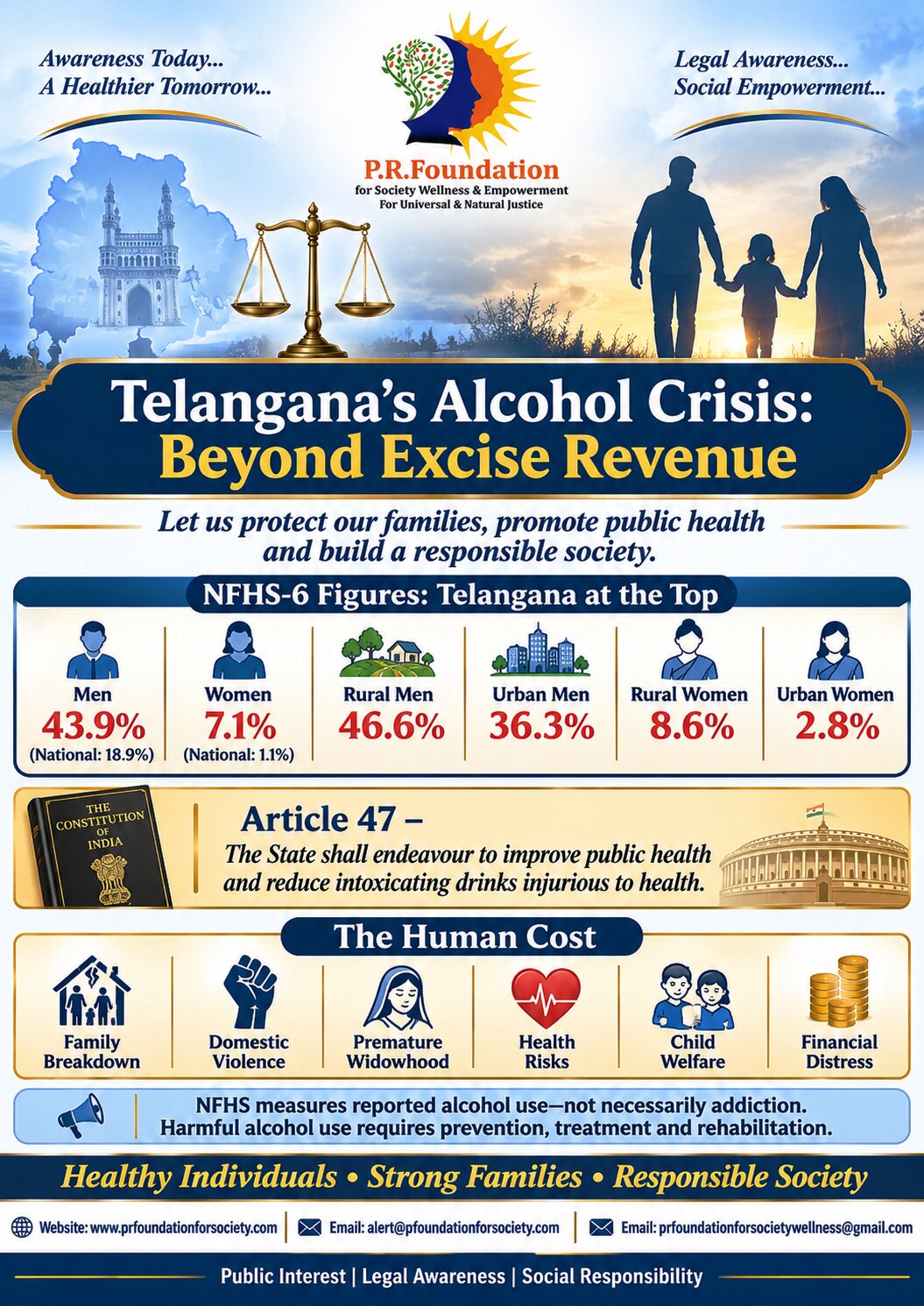
Article 47, forming part of the Directive Principles of State Policy, specifically directs the State to improve public health and endeavour to prohibit the consumption of intoxicating drinks, except for medicinal purposes. Although Article 47 is not independently enforceable under Article 37, it provides an important constitutional foundation for public health legislation and regulatory policies.
Read together, Articles 21 and 47 establish a constitutional basis for preventive healthcare, rehabilitation, responsible licensing, and protection against alcohol-related harm. However, these provisions must be implemented through valid statutory frameworks while respecting constitutional guarantees and individual liberties.
Therefore, Telangana’s alcohol policy should move beyond revenue-oriented administration towards a rights-based public health framework that prioritises prevention, treatment, rehabilitation, and social welfare.
8. Socio-Economic Impact on Vulnerable Families
9. Comparative Policy Lessons: The WHO SAFER Framework
-
Strengthen restrictions on alcohol availability.
-
Advance and enforce drink-driving countermeasures.
-
Facilitate access to screening, brief interventions, and treatment.
-
Enforce bans or comprehensive restrictions on alcohol advertising, sponsorship, and promotion.
-
Raise prices on alcohol through excise taxes and pricing policies.
10. Strategic Recommendations for Telangana
-
Establish an Independent Harm Assessment Body: Form a multidisciplinary committee of public health experts, economists, and legal professionals to evaluate alcohol-related social impact.
-
Publish Open Health Data: Disclose district-level statistics on alcohol-use disorders, liver disease hospitalizations, traffic injuries, and rehabilitation outcomes.
-
Commission Epidemiological Mortality Audits: Conduct scientific cause-of-death studies to differentiate alcohol-attributable deaths from other health and occupational factors.
-
Expand De-Addiction Infrastructure: Integrate voluntary screening, psychiatric care, and medically supervised rehabilitation into district hospitals.
-
Strengthen Protection Services: Adequately resource Protection Officers, legal services clinics, and shelters under the PWDVA.
-
Empower Young Widows: Expand social protection programs to include vocational training, educational aid, and self-employment support.
-
Regulate Commercial Availability: Audit vendor density, enforce mandatory age-verification checks, and restrict outlet operating hours near residential zones.
-
Enforce Drink-Driving Controls: Increase high-visibility breathalyzer checkpoints and strictly enforce road safety laws.
-
Transparent Revenue Allocation: Earmark a designated percentage of annual state excise collections specifically for public health campaigns and de-addiction infrastructure.
-
Interdepartmental Coordination: Establish a joint task force across Health, Excise, Home, and Social Welfare departments to implement clear, measurable policy goals.
10.1 Implementation and Institutional Accountability
The effectiveness of alcohol policy reform depends not merely on legislative recommendations but also on transparent implementation, institutional coordination, and measurable accountability.
The Government of Telangana should consider establishing a State Alcohol Harm Monitoring Committee comprising representatives from the Departments of Health, Excise, Home, Women and Child Welfare, Social Welfare, and Finance, alongside independent public health experts.
The proposed mechanism should incorporate the following measures:
-
Annual Public Health Assessment: Publish an annual report documenting alcohol-related hospital admissions, liver disease prevalence, road accidents, domestic violence complaints, and rehabilitation outcomes.
-
Budgetary Transparency: Introduce a clearly identifiable budgetary allocation for alcohol-related prevention, treatment, rehabilitation, and public awareness programmes.
-
Independent Auditing: Commission periodic independent assessments of excise revenue and the corresponding social and healthcare expenditure.
-
District-Level Monitoring: Establish district-level reporting mechanisms to monitor alcohol availability, treatment accessibility, and the effectiveness of public health interventions.
-
Performance Indicators: Evaluate government initiatives through measurable indicators, including rehabilitation completion rates, accessibility of counselling services, compliance with licensing conditions, and reduction in alcohol-related road accidents.
-
Public Accountability: Make annual findings accessible through government portals and legislative reporting mechanisms to enable public scrutiny.
-
Protection of Vulnerable Communities: Strengthen coordination between Protection Officers, legal services authorities, healthcare institutions, and welfare departments to ensure timely assistance to women and economically vulnerable families.
Such an accountability framework would help transform policy recommendations into measurable administrative outcomes. It would also ensure that excise revenue is evaluated alongside its broader social and economic implications.
11. Role of Civil Society and the Legal Fraternity
-
Legal Community: Bar associations and legal aid clinics can assist women and families by streamlining access to protection orders and maintenance under the PWDVA.
-
Civil Society & NGOs: Grassroots organizations can conduct community awareness initiatives, facilitate referrals to treatment facilities, and support economic rehabilitation.
-
Educational Institutions: Schools and universities should incorporate evidence-based awareness programs covering health risks, peer pressure, and wellness.
12. Conclusion: Public Health Central to Governance
References and Bibliography
A. Constitutional and Statutory Sources
-
Constitution of India, Articles 14, 21, 37 and 47. Read the Constitution of India.
-
Protection of Women from Domestic Violence Act, 2005. Read the Act.
-
Telangana Excise Act, 1968.
-
Telangana Prohibition Act, 1995.
B. Judicial Precedents
-
State of Bombay v. F.N. Balsara, AIR 1951 SC 318; 1951 SCR 682. Read Judgment.
-
Khoday Distilleries Ltd. v. State of Karnataka, (1995) 1 SCC 574. Read Judgment.
-
Consumer Education and Research Centre v. Union of India, (1995) 3 SCC 42. Read Judgment.
-
Paschim Banga Khet Mazdoor Samity v. State of West Bengal, (1996) 4 SCC 37. Read Judgment.
-
Hiral P. Harsora v. Kusum Narottamdas Harsora, (2016) 10 SCC 165. Read the Supreme Court Judgment.
-
Satish Chander Ahuja v. Sneha Ahuja, (2021) 1 SCC 414. Read Judgment.
C. Government Reports and Research Publications
-
International Institute for Population Sciences (IIPS), National Family Health Survey (NFHS-6), 2023–24: India and State/UT Fact Sheets (2026). Read the NFHS-6 Report.
-
World Health Organization, Alcohol: Health Risks and Consequences (28 June 2024). Read WHO Report.
-
World Health Organization, The SAFER Technical Package (2019). Read WHO Publication.
-
Pal, Avnish, Kim, Rockli and Subramanian, S.V., ‘Prevalence of Widowhood Across States and Union Territories in India, 1993–2021: A Repeated Cross-Sectional Study’, Journal of Global Health, Vol. 16 (2026). Read Research Article.
D. Revenue and Fiscal Sources
-
True Point News, ‘Telangana Excise Revenue Hits Record High’, 28 April 2026. Read Newspaper Report.
