


Introduction
Justice loses value when citizens cannot reach it. A villager may hold a strong legal claim. Yet the nearest court may lie many hours away. Travel costs money. Lost wages add to the burden. Moreover, unfamiliar procedures often push people towards middlemen.
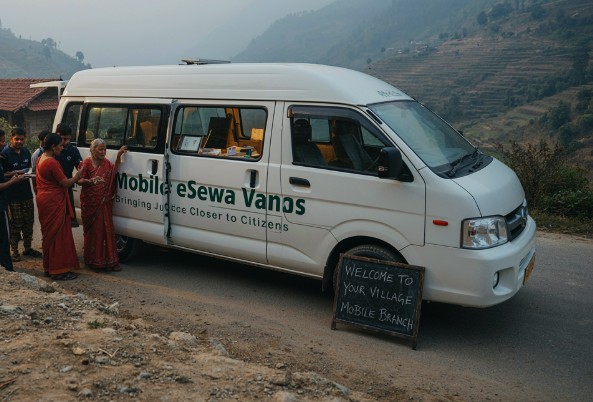
On 4 September 2026, Chief Justice Surya Kant flagged off 26 Mobile eSewa Vans in New Delhi. These vans form the first tranche of a planned fleet of 73.The eCommittee of the Supreme Court leads the initiative with NALSA and the Department of Justice.
This article explains what the vans are and how they work. It then examines their legal significance. Furthermore, it discusses real challenges. The vans are very new. To the author’s knowledge, no published evaluation exists yet. Therefore, this article treats their impact as a promise, not a proven result.
Understanding the Concept
A Mobile eSewa Van is a specially equipped vehicle. It brings court-related services and legal aid to communities far from a courthouse. The initiative extends the eCourts Project, India’s long-running programme to digitise court services.Officials link it to the 2005 National Policy and Action Plan for information technology in the judiciary.
The name needs some explanation. An eSewa Kendra is a help centre inside a court complex. It helps litigants with tasks such as electronic filing and payment. The eCourts Phase III scheme aims to place such centres in all court complexes. The van carries this idea onto the road.
The stated purpose is broad. Officials want to bridge the digital divide and support universal access to justice. The digital divide means the gap between people who use digital technology easily and people who cannot. Consequently, a court that works only online can exclude many citizens. The vans try to answer that problem directly. Officials also expect them to cut travel time and procedural costs for rural citizens.
How the Vans Work
The vans offer several services. Citizens can check case status and read orders and judgments. They can file pleadings and applications digitally. Citizens can also pay electronically. Moreover, the vans support legal awareness programmes in regional languages.
Legal aid and dispute resolution form a second group of services. The vans can host Mobile Lok Adalats. They can also facilitate pre-litigation settlements, including certain motor vehicle challans and utility disputes. Pre-litigation means settling a dispute before anyone files a court case.
Technology supports these services. The vans carry 4G and 5G multi-network connectivity and high-definition video-conferencing equipment. They also carry large displays, webcams, intercom and public-address systems, and CCTV. Batteries, inverters, and generators supply power where electricity fails.
At the flag-off, the Chief Justice inspected a van. He then spoke live with a High Court and a District Court through its onboard video link. The demonstration showed the possibility of remote hearings and witness depositions from the field. However, a demonstration does not prove routine use. Performance over time will decide that.
Legal Significance
A. Constitutional foundations
Article 39A of the Constitution directs the State to promote justice on the basis of equal opportunity. It also requires free legal aid, so that economic or other disabilities do not deny anyone justice. The Supreme Court has read free legal aid and speedy trial into that guarantee. In Hussainara Khatoon, the Court examined undertrial prisoners in Bihar who had waited in jail for years. Similarly, in Anita Kushwaha v Pushap Sudan, the Court treated access to justice as part of Article 21. It stressed reasonable access to a forum.
Therefore, the vans serve a constitutional goal. They do not create a new right. Instead, they give practical form to an existing one.
B. Legal aid and Lok Adalats
The Legal Services Authorities Act 1987 provides the statutory framework. It establishes NALSA and lists who may receive free legal services. These groups include women, children, members of Scheduled Castes and Scheduled Tribes, persons with disabilities, and persons in custody. People whose income falls below a prescribed limit also qualify.
A Lok Adalat, or “people’s court”, settles disputes through compromise. The parties must agree. If no compromise emerges, the case returns to the regular court. When the parties settle, the award has the force of a civil court decree and is final. Moreover, the Act lets legal services authorities organise Lok Adalats at such places as they think fit. Consequently, a Mobile Lok Adalat needs no new law. It changes the venue and eases attendance.
C. Digital proceedings and internet access
The Information Technology Act 2000 gives legal recognition to electronic records. The Bharatiya Nagarik Suraksha Sanhita 2023 also allows criminal trials, inquiries, and proceedings in electronic mode. These include the examination of witnesses.Earlier, in Swapnil Tripathi v Supreme Court of India, the Supreme Court supported live-streaming of court proceedings. It recognised that technology can widen public access to courts.
Furthermore, courts have recognised the importance of the internet. In Anuradha Bhasin v Union of India, the Supreme Court held that free speech and the freedom to practise a profession extend to the internet. The Kerala High Court went further in Faheema Shirin. It described internet access as a fundamental right within Article 21.
However, the eCourts scheme runs in a decentralised way through the High Courts. Therefore, e-filing and virtual hearing rules may differ between states. Van staff and litigants must follow the local High Court’s rules.
Real-Life Illustrations
Experience shows why this matters. Hussainara Khatoon revealed how poverty and distance can trap people inside the justice system. The vans address a different problem, but the concern remains the same.
The launch offers one documented example. The Chief Justice spoke live with two courts from inside a van. That exchange showed the connection working in principle.
Illustration: Consider an elderly woman in a remote hill village. Her land dispute is pending in a district court. She cannot travel easily. Today, she may depend on a relative or a middleman for updates. If a van visits her village, she could check her case status there. Trained staff could help her obtain the latest order.
Similarly, a daily-wage worker might learn whether he qualifies for free legal aid under the 1987 Act. A driver from a remote area, meanwhile, might settle a motor vehicle challan at a Mobile Lok Adalat. Thus, each person could save time, money, and dependence on others.
Advantages
- Cost: Officials expect lower travel time and procedural expense for rural citizens.
- Independence: Reports note that citizens in remote regions often depend on intermediaries for basic information. Direct access may reduce that dependence.
- Legal literacy: The vans support legal literacy in regional languages. People cannot claim rights they do not understand. The initiative also shifts the model from court-centric to citizen-centric. Courts no longer wait for citizens to arrive. This shift fits the “access and inclusion” philosophy of eCourts Phase III.
- Pre-litigation settlement may also ease pressure on courts
However, evidence for this effect is still awaited. This article therefore makes no claim about case pendency.
Practical Challenges
Connectivity: The vans carry multi-network systems and backup power. Even so, some areas may have no usable signal. Video hearings from such places could fail.
Digital literacy: Many elderly and first-time users cannot navigate online forms. Language barriers add to the difficulty. Consequently, human assistance must accompany every digital service.
Data privacy: Legal matters often involve sensitive facts. A van in a village square offers limited privacy. Moreover, e-filing creates personal data. The Digital Personal Data Protection Act 2023 sets rules for processing such data, subject to its exemptions. The Supreme Court also recognised privacy as a fundamental right in Puttaswamy. Similarly, CCTV inside a van needs clear limits on recording and storage.
Infrastructure: Seventy-three vans cannot serve every remote community quickly. Vans also need fuel, drivers, maintenance, and technical support. Backup power helps, yet mechanical breakdowns can still interrupt service.
Trained personnel: Technology cannot explain a legal right. Trained people must do that. The public announcements reviewed for this article do not describe staffing in detail.
Voluntariness: Lok Adalat settlements need consent. A poor or unfamiliar litigant may feel pressure to settle quickly. Therefore, staff must explain that parties can decline and pursue court remedies.
Suggestions
- Authorities should publish visit schedules early. They can use gram panchayats, District Legal Services Authorities, and local media.
- Van teams should include para-legal volunteers. NALSA already runs such a scheme.
- Each van should offer a private space for sensitive consultations.
- Authorities should collect minimal data and seek clear consent. They should follow the 2023 data protection law.
- Offline routes must remain available. Digital-only access would repeat the exclusion the vans aim to end.
- High Courts should set clear protocols for van-based hearings. These should cover identity checks and freedom from coercion.
- Planners should design for persons with disabilities. The Rights of Persons with Disabilities Act 2016 promises access to justice on an equal basis.
- Independent bodies should evaluate the vans and publish the findings.
Conclusion
Mobile eSewa Vans rest on solid constitutional and statutory ground. They give practical effect to Article 39A, Article 21, and the 1987 Act. They also recognise a simple truth. Rights matter little when citizens cannot reach the forum.
However, the vans cannot cure every barrier alone. Poor connectivity, low digital literacy, and weak privacy safeguards could limit their reach. Moreover, a fleet of 73 vehicles is a beginning, not a destination. Thus, the initiative deserves cautious optimism. Its real test will come in villages, not in launch ceremonies.
