


Case Details
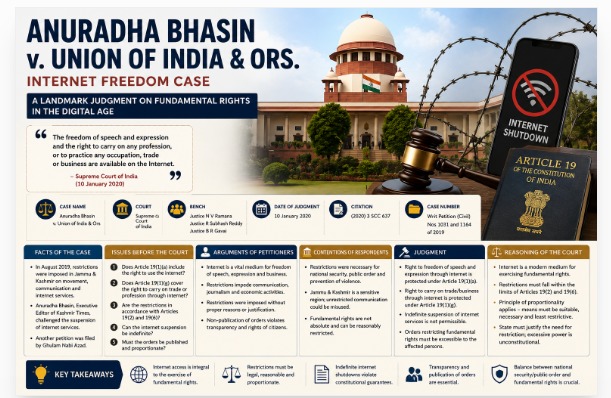
Case Name: Anuradha Bhasin v Union of India & Ors (Internet Freedom Case)
Court: Supreme Court of India
Bench: Justice N V Ramana, Justice R Subhash Reddy and Justice B R Gavai
Date of Judgment: 10 January 2020
Citation: (2020) 3 SCC 637
Case Number: Writ Petition (Civil) Nos 1031 and 1164 of 2019
Introduction
The Internet Freedom Case, Anuradha Bhasin v. Union of India, is a landmark Supreme Court judgment on Internet restrictions, freedom of speech and expression, and the right to carry on trade or business through the Internet. With the advancement of technology and reliance on the Internet, the ways of communication, working, doing businesses, and voicing opinions have been transformed. In this respect, the case of Anuradha Bhasin v Union of India presents a landmark decision regarding the interplay between fundamental rights and restrictions on the services provided via the Internet. This case was filed due to the restrictions introduced in Jammu and Kashmir in August 2019 after the constitutional amendments regarding Article 370. These restrictions concerned the limitation of the means of communication and Internet access. The petitioners argued that the restrictions had an influence on freedom of speech and expression and freedom to practice a profession or carry on any trade or business.
In this case, the Supreme Court considered whether there could be indefinite restrictions on the use of the Internet and whether these restrictions were reasonable and proportional. It is stated that freedom of speech and expression, as per Article 19(1)(a), and freedom to practice any profession or carry on any trade or business, as per Article 19(1)(g), are protected by the Constitution when used via the Internet.
Facts of the Case
In August 2019, the Government of India enacted several provisions of the constitution with regard to the status of Jammu and Kashmir. In anticipation of potential disturbances and threat to public order, certain restrictions have been placed in the region. Such restrictions have an effect on movement, communications, and use of the Internet.
Anuradha Bhasin, Executive Editor of the Kashmir Times, brought the matter before the Supreme Court under Article 32 of the Indian constitution. She objected to the restrictions that had been placed on the communication facilities in the area, especially the shutting down of Internet service. The restriction of such sort had a negative impact on the operations of the newspaper as well as the working of the journalists. The petitioners claimed that the restrictions had violated the fundamental rights that were conferred by Article 19 of the constitution.
Another petition was filed by Ghulam Nabi Azad, contesting the restrictions of movement and communication in the Jammu and Kashmir area.
The petitioners maintained that the restrictions were unreasonable and indefinite. The argument put forward by the petitioners was that the government could not put in place any restriction to fundamental rights merely based on fears concerning the issue of public order. Furthermore, the petitioners questioned the failure of the government to publish the orders concerned.
The respondents defended the restrictions imposed by the Union of India on the grounds that there were security considerations as well as issues of public order in Jammu & Kashmir. The government argued that in those circumstances, the restrictions were inevitable.
The challenge for the Supreme Court, in this case, was to consider two conflicting situations, namely, the obligation of the State to ensure public order and national security on the one hand, and fundamental rights on the other.
Issues before the Court
Several legal issues needed to be addressed by the Supreme Court in relation to the petitioners’ case.
Firstly, whether the freedom of speech and expression provided under Article 19(1)(a) included the right to use the internet as a mode of exercise of such freedom.
Secondly, whether the freedom to follow any profession or carry out any trade, business or occupation, provided under Article 19(1)(g), could be carried out through the internet.
Thirdly, whether the restrictions placed on the internet and the communications services were constitutional and complied with the provisions of Articles 19(2) and 19(6).
Fourthly, whether an indefinite suspension of internet facilities could be imposed by the government.
Lastly, whether the orders that imposed such restrictions had to be published and were proportionate.
Arguments of the Parties
Arguments of the Petitioners
The petitioners have argued that the restrictions levied by the government infringe upon the fundamental rights provided under Article 19 of the Constitution. In their view, the internet has become a crucial platform to exercise their freedom of speech and expression. Thus, the restrictions on internet service providers directly impeded their capacity to communicate and express their opinions.
The petitioners have further argued that internet connectivity is critical to conduct business and professional activities. Thus, the restrictions on the same impact the rights provided under Article 19(1)(g).
Further, the petitioners have argued that the government imposed restrictions without any proper reasons being stated and without adequately justifying why such restrictive measures were necessary.
The petitioners raised an issue regarding the non-publication of the orders. In their opinion, it was impossible for citizens to contest any restrictions if the orders forming the basis of these restrictions were not known to them.
Contentions of the Respondents
The government justified its actions on the basis of the threat to national security, public order, and prevention of violence. They contended that Jammu and Kashmir was an area of sensitivity and unrestricted communication had the potential to be misused in creating disturbance.
The respondents contended that it was necessary for the government to impose such restrictions in light of the prevailing situation and that the government had the right to take preventive action in case of public order and national security being jeopardized.
The government contended that fundamental rights under Article 19 were not absolute and could be reasonably restricted.
Judgment
The Supreme Court pronounced its judgment in the case on 10th January 2020. The bench comprising three judges dealt with the petitions before it while laying down principles regarding restrictions on the Internet services as well as the Fundamental Rights. The judgment was reported at (2020) 3 SCC 637.
The Supreme Court opined that the right of freedom of speech and expression through the use of the Internet was available under Article 19(1)(a) of the Constitution. In like manner, the right to carry on trade or business through the Internet was covered by Article 19(1)(g) of the Constitution. It was reiterated by the court that the above-stated rights were subject to the limitations of reasonableness permitted by the Constitution.
It was declared by the Supreme Court that the indefinite suspension of Internet services was not permissible under the law.
Transparency was also stressed by the Court. Any order restricting the fundamental rights had to be accessible to the person concerned as non-disclosure might deprive the individual of the opportunity to challenge such restrictions in the courts of law.
The judgment thus laid down significant safeguards with regard to the exercise of executive power while acknowledging the right of the State to impose valid restrictions.
The decision thus provided crucial procedural and constitutional guarantees to the exercise of executive powers while acknowledging the right of the State to place legal and proportionate restrictions when justifiable under the Constitution.
Reasoning of the Court
The reason of the court was important in the sense that it put some constraints on the use of internet within the constitutional framework of fundamental rights.
The court first acknowledged the significance of the internet as a means of exercising the fundamental rights guaranteed by the Constitution. The Internet was not mentioned in the Constitution in terms of fundamental rights, but since there are constitutionally protected fundamental rights that can be exercised through modern technological means, then freedom of speech and expression using the Internet comes under Article 19(1)(a). When the Internet is used for carrying out profession, trade or business, then it would fall under Article 19(1)(g).
But, the Court did not regard the use of the internet as a fundamental right. Constraints can be put on the use of Internet when such constraints meet the conditions of the Constitution. The constraints on freedom of speech and expression should fall within the scope of Article 19(2) while the constraint on trade and business should fall within the scope of Article 19(6).
One of the principles used by the Court was that of proportionality. The limitation of a fundamental right must be based on a valid reason and must be proper and necessary in view of the goal of the State. There should not be any excess in the limitation with respect to the goal to be achieved. This meant that it was up to the government to show that the limitation in question was appropriate and necessary for the stated objective.
The Court also examined the legal provisions concerning the suspension of telecom services. According to the Temporary Suspension of Telecom Services (Public Emergency or Public Safety) Rules, 2017, such orders had to comply with certain procedures. First of all, it was important that these orders had to be reasoned. Secondly, certain means of appeal were envisaged in the Rules.
Finally, there was the principle of publication. According to the decision, it was necessary for the affected persons to have access to the orders. Access to the orders was important for an individual to challenge the actions of the government. Therefore, publication was linked to the rule of law and the possibility of judicial review.
The issue of publication was another significant part of the decision. The Court decided that the affected parties should have access to the orders placing restrictions on them. Without the orders, people would find it difficult to challenge the government’s action. Therefore, the matter of publication was related to the rule of law and judicial review.
The Court further dismissed the notion that the suspension of the internet can go on endlessly. Even when the State had valid security reasons for taking such action, it must still be linked to the circumstances justifying the restrictions and must be regularly reviewed.
Therefore, the Court tried to maintain a balance between national security and liberty. It did not disregard the State’s authority to place restrictions but only asked for that authority to be applied within constitutional and statutory parameters.
Importance of the Judgment
The Anuradha Bhasin v Union of India case is one of the landmark judgments in the development of constitutional law in the digital era. It includes an important concept of the ability of constitutionally protected freedoms to be used through the Internet. The Court has therefore managed to link traditional fundamental rights with new modes of communication and business.
In particular, the judgment is important in relation to freedom of the press. Journalists in the modern world use the Internet extensively in their work of collecting information, reaching sources and communicating their news.
The judgment is also important as far as it reinforced the doctrine of proportionality in relation to the executive actions in the imposition of such limitations. Government authorities cannot impose any limitations on people because it would suit them. Such a limitation should have its legal grounds and be justified in certain circumstances.
Yet another significant development in this case is the importance given by the court on the need for transparency and publication of government orders. It is necessary for citizens to be aware of the legal justification of restrictions being imposed on their fundamental rights, in order to take the matter forward with relevant legal recourse.
Subsequently, the judgement has found application in matters relating to internet restrictions. For instance, in Foundation for Media Professionals v Union Territory of Jammu and Kashmir, the Supreme Court has cited the judgement in Anuradha Bhasin while considering internet restrictions.
On the other hand, the judgement is also subject to criticism as the court itself did not decide the constitutional validity of all individual restrictions imposed in Jammu and Kashmir. However, it framed certain guidelines and procedures which would assist in the evaluation of such restrictions. Despite that, these guidelines have become relevant in the context of governmental restrictions on digital communication.
Conclusion
Anuradha Bhasin v Union of India is a landmark case in bringing constitutional law to the digital age. It is now clearly established that technological advancement does not place fundamental rights outside the realm of constitutional protection. The exercise of freedoms like freedom of speech and expression and freedom to conduct a profession or carry on any trade or business can be done through the internet, and so the right to freedom of internet communication is also constitutionally protected.
On the other hand, the Supreme Court made it clear that constitutional rights are subject to restrictions that are constitutionally permissible. The significant point here is that these restrictions must be legal, reasonable, necessary and proportionate. The government cannot enforce indefinite restrictions on grounds of public order or national security.
The case thus maintains a constitutional balance between personal liberty and state interests. The use of concepts like proportionality, transparency, publishing orders and periodic review serves as valuable safeguards against any excesses of the executive branch. With the ever-increasing role of the internet in modern-day life, the principles laid down in this case remain highly relevant.
References
Cases
Anuradha Bhasin v Union of India (2020) 3 SCC 637.
Foundation for Media Professionals v Union Territory of Jammu and Kashmir (2020) 5 SCC 746.
Shreya Singhal v Union of India (2015) 5 SCC 1.
Maneka Gandhi v Union of India (1978) 1 SCC 248.
Constitutional and Statutory Materials
Constitution of India, arts 19, 21 and 32.
Indian Telegraph Act 1885, ss 5(2) and 7.
Temporary Suspension of Telecom Services (Public Emergency or Public Safety) Rules 2017.
