


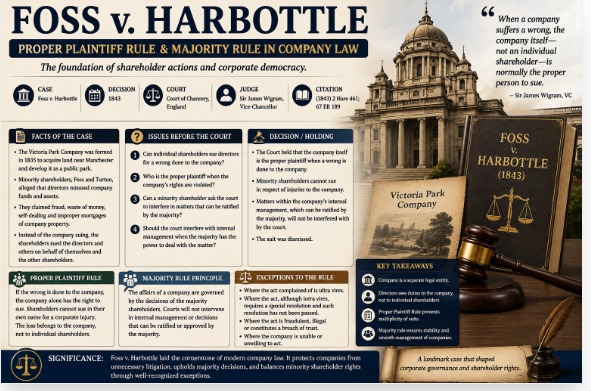
Details of the case
Case: Foss v. Harbottle
Citation: (1843) 2 Hare 461; 67 ER 189
Court: Court of Chancery, England
Judge: Sir James Wigram, Vice-Chancellor
Decision: 1843
The plaintiffs:
- Richard Foss
- Edward Starkie Turton
They were shareholders in the Victoria Park Company.
The defendants:
The defendants included several directors of the company, along with other persons associated with the alleged transactions, including the company’s solicitor and architect.
Foss v. Harbottle is one of the most important case in company law because it established the basic principle that when a company suffers a wrong, the company itself—not an individual shareholder, is normally the proper person to bring a legal action. It also established the principle of majority rule in the management of companies.
Background of the case
The Rule in Foss v. Harbottle is a foundational principle of company law, establishing the Proper Plaintiff Rule and the principle of majority rule in corporate decision-making.
The dispute arose in relation to the Victoria Park Company, which had been established to acquire land near Manchester and develop it into an ornamental public park.
Richard Foss and Edward Starkie Turton were shareholders in the company. They were unhappy with the way some of the company’s directors and other people connected with the company had dealt with its property.
They believed that the company’s money and property had been misused and wasted. Therefore, instead of waiting for the company itself to take action, they went to court as shareholders and brought a case against the directors and other defendants.
In simple words, the shareholders were essentially saying:
“The company’s directors have caused loss to the company, so the court should make them compensate the company.”
The important question was: Who has the right to sue when the company itself has been harmed?
Facts of the case
-
The Company: The Victoria Park Company was formed in 1835 to purchase 180 acres of land near Manchester and turn it into an ornamental public park with residential housing.
-
The Claimants (Plaintiffs): Two minority shareholders, Richard Foss and Edward Starkie Turton, initiated a lawsuit on behalf of themselves and all other shareholders (except the defendants).
-
The Defendants: Five directors of the company (including Thomas Harbottle), along with other associates such as the company’s solicitor and architect.
-
The Allegations: The plaintiffs alleged that the directors had committed various acts of wrongdoing and mismanagement, including:
-
Misappropriating and wasting company funds and assets.
-
Fraudulently mortgaging company properties for personal gain.
-
Self-dealing (selling land to the company at inflated prices).
-
The minority shareholders brought the suit directly to court, seeking to force the directors to compensate the company for its losses.
Issues raised before the Court
The main issues were:
Issue 1
Can individual shareholders sue directors for a wrong done to the company?
Issue 2
Who is the proper plaintiff when the company’s property or rights have been harmed?
Issue 3
Can a minority shareholder ask the court to interfere in a matter that can be approved or ratified by the majority of shareholders?
Issue 4
Should the court interfere with the company’s internal management when the majority shareholders have the power to deal with the matter?
These questions eventually led to what we now call the rule in Foss v. Harbottle.
Arguments of the shareholders — Foss and Turton
Foss and Turton’s position can be understood quite simply.
They argued that:
- The company’s property had been improperly dealt with.
- The directors had caused loss to the company.
- The directors and other defendants should therefore be required to compensate the company.
If individual shareholders could not approach the court, there could be a situation where directors who controlled the company could prevent the
- company from taking action against themselves.
- They therefore approached the court to protect the interests of the company and its shareholders.
In practical terms, their argument was:
“We are shareholders, the company is being harmed, and if the company is not taking action, the court should allow us to act to protect it.”
This argument is particularly important because it highlights the problem of minority shareholder protection.
Arguments of the defendants
The defendants challenged the shareholders’ right to bring the case.
Their basic position was:
First — The company itself had suffered the alleged wrong
The alleged misuse of property was an injury to the company, not a separate personal injury to Foss and Turton.
Therefore, if anyone had to sue, it should be the company itself.
Second — Shareholders are separate from the company
The company is a separate legal person. Its property does not belong directly to individual shareholders.
Therefore, shareholders cannot normally treat company property as if it were their own property.
Third — Majority shareholders should control corporate decisions
If the alleged acts could be approved or ratified by the company’s members through the appropriate majority, the court should not allow a minority shareholder to bypass the company’s internal decision-making process.
This argument became the foundation of the majority rule principle.
Laws and legal principles applied
There was no modern Companies Act equivalent to today’s legislation governing shareholder derivative actions. The Court primarily relied upon general principles of corporate personality, company procedure and equity.
The most important principles were:
A. Separate legal personality
A company is a legal person separate from its shareholders.
Therefore:
Company’s property ≠ shareholders’ personal property.
If someone damages company property, the legal wrong is normally against the company.
This idea is closely connected with the principle that the company can sue and be sued in its own name.
B. Proper Plaintiff Rule
This is the most famous principle arising from the case.
The rule is:
Where a wrong is done to the company, the company itself is normally the proper plaintiff.
For example, imagine that a director steals ₹10 lakh from a company.
The loss belongs legally to the company. A shareholder cannot ordinarily say:
“I personally lost ₹10 lakh, so I will sue the director.”
Instead, the company should bring the claim and seek recovery of the ₹10 lakh.
This is known as the Proper Plaintiff Rule.
The Majority Rule Principle
The second core takeaway is the majority rule principle.
At its heart, it comes down to a simple practical reality: if the majority of shareholders can legally approve or forgive an action, a minority shareholder can’t just run to court to overturn it.
Why does this rule exist?
-
Companies run on democracy: A business is a group effort. Decisions are supposed to be made through votes and internal rules, not judicial intervention.
-
Avoiding endless court battles: If any shareholder could sue every time they were outvoted or unhappy with a management decision, companies would be paralyzed by constant lawsuits.
As long as the majority stays within the bounds of the law, courts prefer to step back and let the company manage its own internal affairs.
Judgment
Sir James Wigram (Vice-Chancellor) dismissed the suit. The Court held that the individual shareholders did not have the legal standing (locus standi) to bring the lawsuit.
The judgment established two primary rules:
-
Proper Plaintiff Rule: Because a company is a separate legal entity distinct from its members, when a legal wrong is committed against the company, the company itself is the proper plaintiff to bring an action in court.
-
Majority Principle Rule / Non-Interference: The court will not interfere in internal corporate management if the alleged wrong or irregularity is one that the majority of shareholders can ratify, forgive, or resolve in a general meeting.
Exceptions to the Rule
Because a strict application of the Foss v. Harbottle rule could allow controlling majority shareholders to commit wrongs with impunity, courts subsequently developed specific exceptions where minority shareholders can sue (typically via derivative actions):
-
Ultra Vires or Illegal Acts: Actions beyond the statutory powers of the company.
-
Fraud on the Minority: Actions where the majority uses its power to defraud or deprive the minority of their rights.
-
Special Majority Requirement: Wrongs that can only be validly authorized or ratified by a special majority, rather than a simple majority.
Violation of Personal Rights: When an action directly infringes upon an individual shareholder’s personal rights (e.g., voting rights).
