


Historical Foundations and Constitutional Foundations.
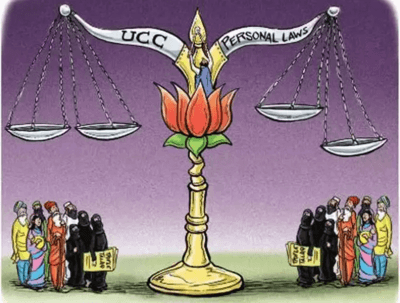
The conflict between UCC and Muslim Personal Law (MPL) has a long history connected to the plural legal tradition in India that was formed under the influence of the codifications of law during the colonial times and the idealism of the post-Independence era. The Shariat Application Act of 1937 gave the Muslims authority to use Islamic law, which was informed by the Quran, Sunnah, Ijma, and Qiyas, in matters touching on marriage, divorce, inheritance, and waqf, overriding the local practices. This indicated the needs of Muslim leaders to have Sharia autonomy, institutionalizing such practices as polygamy and fixed shares of an inheritance into law.
The Directive Principles of State Policy, Art. 44, is an objection to this disintegration:–The State shall strive to provide a standard civil law to the citizens across the territory of India. It was ratified in 1950 and represented a secular vision of Dr. B.R. Ambedkar to bring together a country that had been fragmented by caste, creed and custom. Although not binding (Article 37), it has been raised to a constitutional objective by the courts, which aligns with such Fundamental Rights as Article 14 (equality) and Article 15 (non-discrimination). Rulings Early rulings, including State of Bombay v. Narasu Appa Mali (1952) insulated the personal laws against judicial review by expressly declaring them not to be law in Article 13, but this has been undermined through the development of jurisprudence.
The case of Shah Bano (1985) summarized the conflict. In Mohd. Ahmed Khan v. The Supreme Court, headed by Shah Bano Begum, ordered a divorced Muslim woman maintenance under CrPC 125 outside of the iddat period (three lunar months) with reference to Article 44 and criticizing the ineffectiveness of MPL to support penniless women. In reaction to this political opposition, the Muslim Women (Protection of Rights on Divorce) Act, 1986, which restricted maintenance to iddat, a legislative withdrawal, restored UCC demands, and opened up the weaknesses of religious concessions.
Juridical Pressure toward Article 44: Out of Desire to Command.
Article 44 has continuously been turned by judges against discriminatory personal laws. Sarla Mudgal v. The case of Union of India (1995) struck down Hindu-to-Muslim conversion bigamy as it decried the practice of forum shopping and demanded that UCC be enforced in a manner that represented uniformity in monogamy. The Court noted that in that UCC was not in force on more than 80 percent of Indians, inequality was perpetuated by delay.
This was enhanced in successive cases. Personal laws were regarded as anachronistic as categorized in Jorden Diengdeh v. S.S. Chopra (1985), and as John Vallamattom v. The succession difference in Christianity was dismissed by the Union of India (2003) as it deplored the utter rejection of Article 44. The landmark Shayara Bano v. Triple talaq (talaq-e-biddat) was declared invalid by Union of India (2017) as clearly arbitrary, which contravened Articles 14, 15 and 21. Justices Nariman, Joseph and Chandrachud associated relief with UCC and claimed it as the safeguard of religion by scrutinizing under Shirur Mutt (1954).
The momentum is maintained with recent rulings. Mohd. Abdul Samad v. The case of State of Telangana (2022) supported secular maintenance without considering the 1986 Act. Article 44 against gender-biased shares (sons inheriting two daughters) on petitions on inheritance such as allowing opt-outs of Shariat by the Indian Succession Act, 1925. State experiments support the case: The UCC of Goa (received with the Portuguese law) with its compulsory marriage and succession; the UCC Act of 2024 of Uttarakhand, polygamy prohibited, live-in registrations obligatory, uniform age (21 years for men, 18 years for women), exempting tribals and acting as a national model.
In 2023-24 rhetoric by Prime Minister Narendra Modi restated UCC as a secular civil code, as is promised by BJP. The 2018 report of the 21st Law Commission found wholesale UCC unnecessary in favor of reforms, nevertheless parliamentary momentum is projected by 2023-26 consultations as Uttarakhand implements it.
The Potential UCC Shariat Act Provision Overhaul.
An official UCC would completely re-design the Shariat Act territory. Marriage within MPL is contractual (nikah), which allows polygamy (Quran 4:3, up to four wives with equity), unilateral talaq or khula. UCC would make marriage monogamous, like Hindu Marriage Act, 1955, with the only type of divorce being judicial, abolishing instant triple talaq (criminalised by 2019 Act) and nikah halala (marriage intermediary after revokable talaq).
Succession takes a different direction: the faraiz system of Shariat gives badla (male) and saba (female) shares of the inheritance, is agnatic (prefering the agnatas), and restricts wills to thirds of property. UCC looks forward to gender-equal coparcenary or testamentary liberality, which will overcome Article 14 difficulties in upcoming Supreme Court cases.
MPL limits maintenance to iddat nafaqah, and leaves women vulnerable after divorce; UCC requires lifelong CrPC Section 125 support. Adoption, which is not recognized in Sharia (kafala as guardianship), becomes entirely legal. The digitization of waqf and various boards that are predetermined by the 2025 Amendment Act hints at the UCC regulation.
The change triggers a sense of repugnancy as stipulated in Article 254 and could annul Shariat Act where it is inconsistent. Federal obstacles of hurdle–personal laws were state topics before 1956–but the national character of Article 44 merits central intervention.
- Community Resistance Sources and Dimensions.
The UCC is attacked by Muslims as an identity attack. All India Muslim Personal Law Board (AIMPLB) claims that MPL forms part of Article 25(1) of the religious practice and has made fatwas against reforms following the case of Shayara Bano. Triple talaq ban was protested as the Quranic interference, the Jamiat Ulema-e-Hind sued against the law on Article 25-26 in Uttarakhand (institution management and religious freedom).
Divisions within: Bharatiya Muslim Mahila Andolan promotes UCC as a women empowerment against the patriarchal ulema based on NFHS polygamy (15% of Muslims vs. 2% of the population). Orthodox voices are apprehensive of homogenization and they compare it to Hindu Undivided Family tax privileges that UCC logic can never help. According to the surveys conducted by Pew, 74 percent of Muslims favor Shariat which is related to the post-Babri (1992) and Gujarat (2002) insecurities.
Opponents refer to the heritage of Narasu Appa Mali, yet Shayara Bano was penetrating vital habits, making them subject to analysis. The world is learning a lesson, such as the successful secularism in Turkey under authoritarian conditions or the failures of uniformity in other countries.
Ways to Reconciliation and Reform.
Divides need to be closed with pragmatism. Incrementalism is based on achievements: 2019 criminalization of triple talaq, 2022 maintenance verdicts, and 2025 reforms of Waqf (enabling women on boards, surveying of property). The 2025 ban on polygamy in Assam foreshadows government transformation.
Another type of hybrid UCC, Goa-style uniforms the essentials (monogamy, ages) but allows ritual opt-ins. The Law Commission Report of 262 preferred codification based on communities. Article 44 could be incrementally implemented through judicial nudges through PILs as was the case in Sabarimala.
Statistics highlight the urgency: NCRB statistics reveal the soaring number of MPL cases; and Muslim women are disproportionately on the wrong end of family court pendency. Reforms do not contradict Article 21 dignity, but do not eliminate pluralism.
Towards Consensus
The vision of article 44 challenges the primacy of religion in Shariat, and UCC is promoting equality at the expense of pluralism. Uttarakhand is feasible, but must be nationally adopted, through legislative committees and minority conferences. A subtle code, cutting out discrimination and respecting essentials, achieves constitutional ethos. To compose legal writing, combine 2026 judgment, empirical attitudes (Lokniti-CSDS) and pendency statistics. The unity in diversity is put to test in this debate, which calls the India to be empowered but not divided.
