


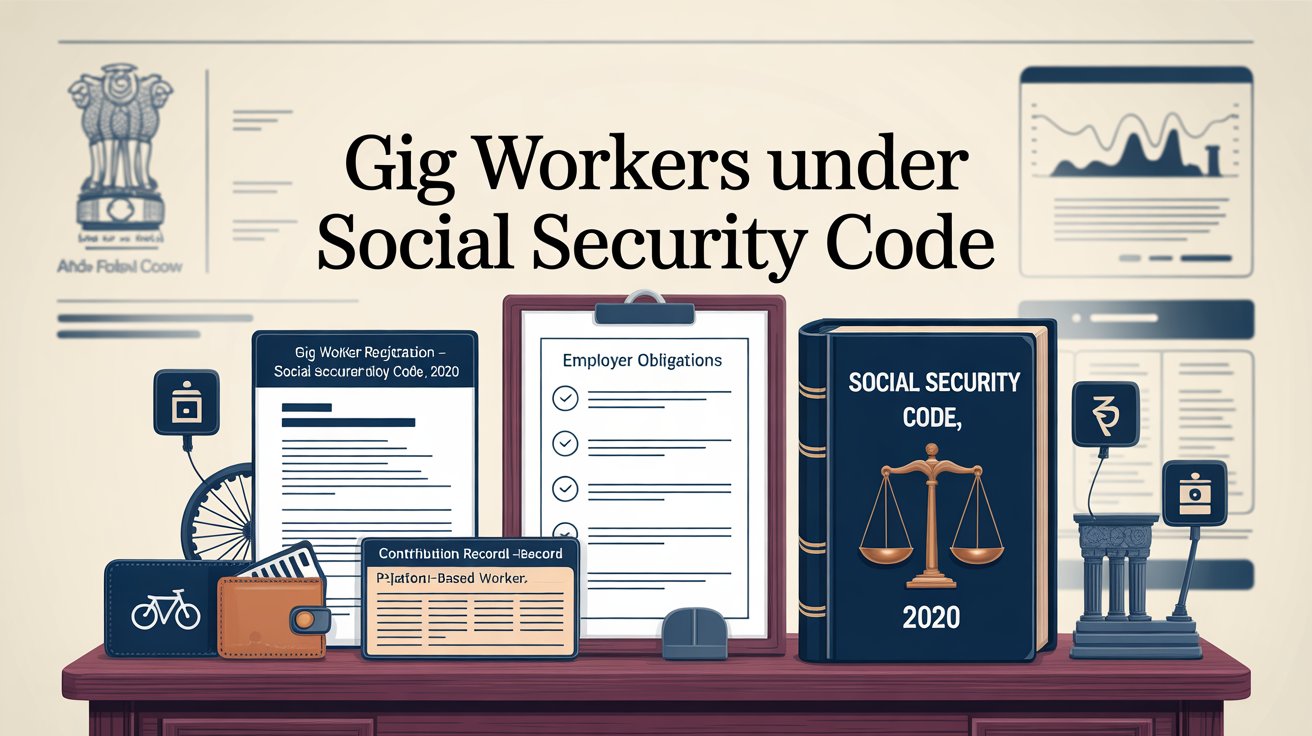
SOCIAL SECURITY FOR GIG AND PLATFORM WORKERS: A LEGAL ANALYSIS
Over the last two decades, the gig economy has become a massive source of work around the globe (and particularly in India). People like food delivery riders, taxi drivers, and freelance workers earn their livelihood through platform (or gig) work. The rapid expansion of the gig sector has created a new challenge for policymakers — how can they create social security systems for individuals who work as neither employees nor self-employed persons?
Traditionally, social security programmes have been designed for the employer-employee relationship. Most gig workers are classified as independent contractors, which means they do not receive the same rights and benefits (e.g., provident fund, health insurance, gratuity, paid leave, and unemployment insurance) as employees do. This has resulted in millions of gig workers lacking a safety net and being pushed to the margins of society. This blog examines these changes in the legal landscape in India, including successes, shortcomings, and the future direction, in order to assess their place within broader global trends.
I. The Rise of Gig Work and the Need for Social Security
Gig work refers to short-term engagements through online platforms that connect service providers and customers. Many individuals have praised gig work globally for providing a flexible way to earn money with easier access, particularly for youth and migrant workers. However, many have also voiced concern over the absence of worker protections.
The COVID-19 Pandemic provided significant growth to the gig economy but also exposed significant gaps for those workers, including:
### No Health Coverage
Workers have not been able to obtain health coverage through their employment due to the lack of formal ties to a specific employer.
### Unstable Income
Because most gig workers rely on contracts for each task, it will be impossible to have a stable income while gigging.
### No Access to Benefits
There is no access to basic employee benefits for gig workers. This includes Health Access, Sick Leave, Vacation, Pensions, or worker’s compensation for work-related injuries.
As a result, the regulatory gaps worker protection gaps have continued to raise the urgent need for policy directives regarding gig workers.
In India, there continues to be wide-ranging estimates of the number of gig workers. Some think tanks affiliated with the Government of India estimated that there may be approximately 65 lakh (6.5 million). However, estimates have been suggested that the number of gig workers may already exceed 2 crore (20 million) or more.
The number of gig workers continues to increase significantly throughout this period of expanding digital penetration and platform business expansion.
However, despite the number of gig workers increasing, most gig workers have historically worked outside of formal protections for labour. This lack of protection for gig workers continues to eliminate any mechanisms that will provide income security, health benefits, pension plans and/or coverage for injuries sustained while working.
II. Legal Recognition Under India’s Labour Reforms
A. Four New Labour Codes: A Game Changer
The inauguration of the Four New Labour Codes on November 21, 2025, was a landmark moment for reforming India’s labour law system and established a framework for achieving this through streamlining 29 diverse and fragmented labour laws to create a clearer and simpler system of administration, modernising the labour laws, and providing expanded coverage and protection to emerging forms of work, including gig and platform employment.
The Code on Social Security (2020) is particularly important for gig and platform workers as it provides, for the first time, a statutory definition of “gig worker” and “platform worker”, thus bringing all individuals engaged in such work into the scope of social security, like traditional employees and individuals working in the unorganised sector, who were previously only entitled to social security under existing labour law.
Under the Code,
• A gig worker is defined as an individual who has an arrangement with a third party to perform work outside of a traditional “employer / employee” relationship; and
• A platform worker is defined as an individual who accesses work through third-party online facilitation medium.
• Social security is to be understood as measures that provide access to healthcare and income security in the event of retirement, illness, maternity leave, work-related injury, unemployment, or the death of the supporter.
The formal recognition of gig and platform workers will provide the legal underpinning necessary to establish worker protections for a segment of workers in the country who, up until now, have not enjoyed similar rights under the .
B. Mandatory Contributions by Platforms
Key elements of the reform establish that digital platforms should contribute to an established Social Security Fund for workers who perform tasks as part of the “gig economy.” The reform mandates that food delivery companies, ride-hailing services, and other corporations that operate through aggregated platforms provide 1-2% of their gross annual revenue to Social Security Systems for gig or platform labor, with a cap of up to 5% of total amounts paid or to be paid to these contracted employees in the corresponding fiscal year.
This is a significant shift from a completely voluntary method of providing assistance through corporate social responsibility to one in which platforms will be sharing some of the responsibility for creating a social safety net for their contracted workforces with governments. Critics contend that how the exact amounts contributed are determined, the structure of contribution-sharing models, and how to calculate operational expenses will dictate if the contributions will result in real benefits to the workers.
III. Key Social Security Provisions and Access Rules
A. Proposed Eligibility Criteria
The legislation classifies both gig workers and platform workers within the legal framework however there still needs to be guidelines established under the Code on Social Security for these workers to be deemed eligible for benefits. Under the recent draft rule there are minimum criteria to be met by both gig and platform workers, in order to be eligible for benefits of social security in terms of health insurance, life insurance, and personal accidents.
The current proposed minimum qualifications as follows;
1. 90 days of engagement (work) earned based on a single aggregator (person or company) of the worker.
2. 120 days of Engagement ( work) accrued cumulatively based on multiple aggregators.
For gig workers, the period of their employment will be defined from when they actually began to earn income from that “Platform”. The 90 and 120 day thresholds are provided as guidance to balance the desire to include all workers in SOC Soc. Benefits, but also limit the possibility of misuse of these benefits (to keep gig work legitimate) By setting such criteria, there is an issue related to how part-time or seasonal gig workers will be impacted – some of these workers will not meet the minimum number of days needed for eligibility; therefore, they may be unfairly denied access to these types of benefits.
B. Range of Benefits
The Coalition of Work and Social Security to Gig Workers (CoSS) is looking to provide the following benefits to gig workers:
1) Health Insurance/ Medical Insurance – this is a critical component of risk protection and was previously unavailable to most gig workers.
2) Personal Accident/ Life Insurance – this insurance is extremely important for those who may be subject to dangerous road conditions (delivery riders, cab drivers, etc…)
3) Pension/ Retirement Benefits – We want to provide gig workers with access to long-term income security (similar to how you use a provident fund).
4) Disability/Old Age Protection – we recognize that gig work does not replace the need for comprehensive social protection for workers who are nearing or at retirement age.
Proposed rules suggest that we will create Universal Account Numbers (UANs) for Gig Workers linked to their Aadhaar ID, making it easier for them to maintain their social security when they switch platforms or move between states.
These benefits – when implemented – would greatly reduce workers’ insecurity related to income and increase dignity through enhanced job opportunities. However, we are still working on developing the specific convergence mechanisms between these benefits and the other schemes (like the EPF & ESI) that currently exist for our employees.
IV. State-Level Initiatives: Complementing National Policy
In addition to the nationwide code, various Indian states have implemented gig worker welfare laws prior to the enactment of the legislation, exemplifying many of the principles in the national framework.
In Rajasthan, the Platform Based Gig Workers (Registration and Welfare) Act, 2023 was passed; this establishes a welfare board, provides for a registration mechanism as well as offers access to insurance and pension benefits for platform workers.
In Karnataka, the Platform-Based Gig Workers (Social Security and Welfare) Scheme was initiated via an ordinance funded through a fee assessed on transactions processed by aggregators.
Multiple other states such as Jharkhand, Bihar and Tamil Nadu are progressing through similar ethical legislative frameworks or developing welfare boards with specific focuses on registration, grievance redressal and social security.
Each of these state-based laws generally innovates on financing tools such as welfare levies tied to individual platform transactions and will further strengthen worker representation in governance of social security through inclusion of workers as representatives on welfare boards and in social security decisions made at the state-level.
V. Challenges and Critical Gaps
While these reforms will undoubtedly help the situation, many things may prevent social security from being effective for gig and platform workers.
1. Uncertain Future for Implementation
Having clear, legal entitlements is only the first step; in order for workers to access benefits, the detailed rules, administrative capacity, and other components of those entitlements need to be implemented. For example, there remain many questions regarding how the funds will be pooled, how they will identify and verify gig workers, and how they will maintain portability of these funds across platforms and states.
2. Eligibility Thresholds
Although defining a minimum requirement of 90-120 days of engagement may seem logical, this could unintentionally result in excluding workers that engage with multiple platforms and/or have intermittent engagement with that platform. In addition, there could be many gig workers who are eligible to receive social security benefits, but do not qualify because they do not fill the minimum engagement requirement.
3. Compliance Burdens
Smaller platforms with limited resources may be especially burdened by the compliance requirements set forth in the reforms. Therefore, in order to avoid the unintended consequence of reducing the size of the gig economy, there must be a balance between providing sufficient protection to gig workers while maintaining ease of doing business.
4. Worker Representation & Awareness
It is critical that gig workers know their legal rights and understand how to use the grievance redressal mechanisms available to them, which will only happen if state boards and worker organizations are strengthened and actively engaged in representing and enforcing the rights of workers.
VI. International Comparisons and Best Practices
Different countries around the world have different ways to provide social protection for people who work through the gig economy. There are those that offer traditional forms of social protection to all self-employed or platform-based workers (like Argentina and Brazil), and then there are countries that have created specific systems of social protection just for gig workers (like Austria, Colombia and Sweden). In particular, several countries, including Mexico, have recently adopted laws granting app-based delivery and ride-hailing workers (i.e., “gig” workers) access to social benefits, such as medical care, paid leave and pension rights, while still allowing them to be flexible in when they want to work. All of these countries demonstrate similar lessons: all of the legal obligations associated with providing social protection to gig workers must be combined with the structured delivery of benefits and the compulsory provision of coverage.
VII. Conclusion: Towards Inclusive Social Protection
India’s legal path to incorporating social protection for gig/Platform Employment is a pivotal moment in the changing narrative of India’s workforce; Code(s) on Social Security Act As well as all of the various State Programs to date have given at least some statutory recognition to millions who previously didn’t have any form of basic protection. Platform mandated costs to keep workers protected and the constant evolution of India’s legal framework is indicative of the Indian nations desire to close the gap between the informal economy and social protections.
Success, however, depends greatly on active participation by both platforms and workers through sufficient education and constant refinement of current policy to ensure that it is applied evenly and effectively. With gig work now firmly established is integral to India’s labour market, having a sound and effective system of social support is a necessity, not a luxury, to protect and promote the dignity, health, and economic success of millions of gig workers living today’s digital economy.
