


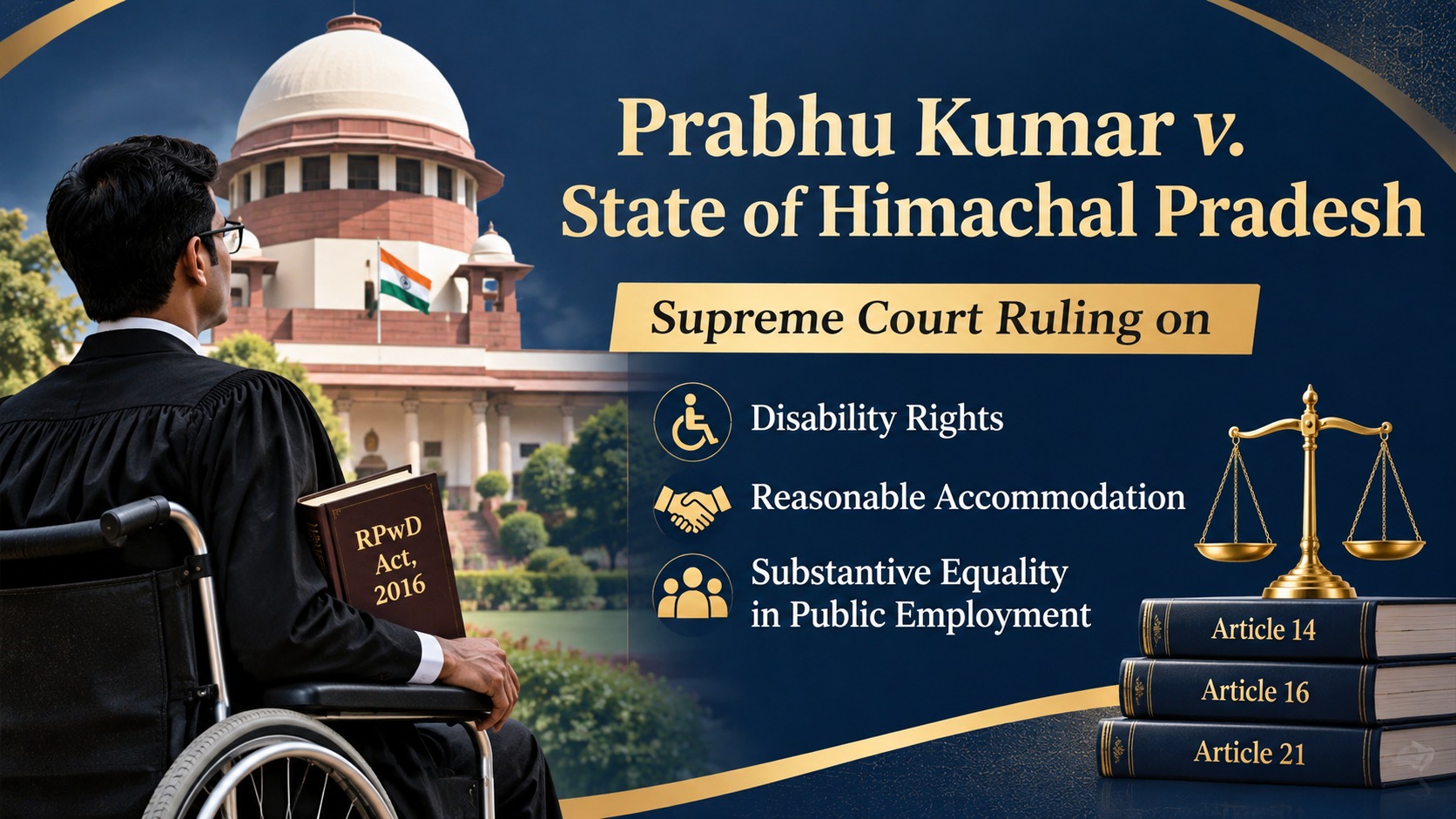
Introduction
When Protection Becomes Exclusion
Reservation is meant to open a door. For Prabhu Kumar,
it became a wall. He has practiced as an advocate since 2015. He cleared the
written examination. He cleared the interview. He topped among the five
candidates shortlisted under the physically handicapped category. He was
recommended for appointment as Assistant District Attorney. The State then
refused to appoint him — not because he could not do the job, but because, in
its view, he was too disabled to do it.
His disability was assessed at 90%. The advertisement permitted only 40% to
60%. That difference cost him eight years of litigation.
On 11 March 2026, a Bench of Justice Vikram Nath and
Justice Sandeep Mehta (Mehta, J., authoring) held that the Rights of Persons
with Disabilities Act, 2016 (RPwD Act) prescribes a floor, not a ceiling.
This case is not only about one candidate and
one post. It asks a deeper question: do we measure a person by a medical
percentage, or by what that person can actually do?
The Facts: A Number Becomes a Disqualification
On 2 May 2018, the Himachal Pradesh Public Service Commission issued an
advertisement for 24 posts of Assistant District Attorney, Class-I (Gazetted).
Out of these, 20 were advertised on requisition, and 4 were backlog posts. Two
posts were reserved for persons with disabilities.
The advertisement stated that a candidate under the disabled category should
have a disability of at least 40% and no more than 60% in one leg or one arm.
Prabhu Kumar had a 90% permanent locomotor disability
due to disarticulation of his left shoulder. He submitted his application with
his disability certificate and Bar experience certificate. He was allowed to
appear in the written test on 30 September 2018. The result was declared on 4
July 2019. He qualified under the Physically Handicapped (General) category.
He was called for an interview on 2 August 2019. The
result was declared on 3 August 2019, and by press note of the same date, the
Commission recommended his name for appointment under the physically
handicapped quota.
The select list was forwarded to the Government. The Government issued
appointments to 16 out of 17 recommended candidates. Prabhu Kumar’s name was
withheld and not included in the notification dated 19 September 2019.
On seeking information under the Right to Information Act, 2005, he was given a
communication dated 19 September 2019 stating that his recommendation was not
accepted because his 90% disability was well above the 60% threshold fixed in
the advertisement.
He challenged this before the Himachal Pradesh High Court in C.W.P. No. 3634 of
2019. On 29 September 2020, the High Court dismissed his petition. He then
filed Civil Appeal No. 868 of 2024 before the Supreme Court. By order dated 8
November 2021, the Supreme Court had directed that the vacancy be kept reserved
for him.
The Submissions: Two Competing Views
The Appellant’s Case: Mr. P.V. Dinesh, learned senior
counsel, argued that the denial was illegal, unjustified and arbitrary. There
was no intelligible or rational criterion for fixing 60% as an upper limit. The
restriction had no rational nexus with the duties of an Assistant District
Attorney.
He emphasised that the appellant had practised law for nearly a decade without
impediment on account of his shoulder disability, and had topped amongst the
five candidates shortlisted under the handicapped category.
He further pointed out that the High Court itself had observed that the
respondents were not clear about the extent of maximum disability that could be
prescribed, yet had declined relief.
Most importantly, he argued that the High Court’s
reliance on V. Surendra Mohan v. State of Tamil Nadu was untenable
because that judgment had been expressly overruled by a three-judge Bench in
Vikash Kumar v. U.P.S.C.
The State’s Case
The State argued that the advertisement contained an
unambiguous condition of 40% to 60% disability in one arm or one leg. The
appellant’s certificate showed 90% disability, and therefore he was outside the
prescribed range. It also raised estoppel: the appellant had participated in
the selection process knowing the condition. If he was aggrieved, he should
have challenged it before participating. Having taken part without objection,
he could not assail it after denial of appointment. The Court rejected
both arguments.
What the Court Held
The Statute Prescribes a Minimum
Threshold, Not an Upper Ceiling
Section 2(r) of the RPwD Act defines a “person
with benchmark disability” as a person with “not less than forty per
cent of a specified disability where specified disability has not been defined
in measurable terms and includes a person with disability where specified
disability has been defined in measurable terms, as certified by the certifying
authority.”
Section 33 mandates identification of posts, constitution of an expert
committee with representation of persons with benchmark disabilities, and
periodic review at an interval not exceeding three years.
Conjoint reading of these provisions, the Court held, shows the legislature
intended to create a threshold of inclusion. The Act defines the
“floor” for reservation eligibility but does not empower the State to
create an arbitrary “ceiling” that excludes those with higher degrees
of disability, provided they are otherwise capable of performing the functional
requirements through reasonable accommodation.
By fixing a 60% maximum limit, the respondents had
essentially rewritten the statutory definition to the detriment of those very
persons whom the Act aims to protect.
Surendra Mohan Does Not Survive Vikash
Kumar
The High Court had relied heavily on V. Surendra
Mohan, which had upheld a 40-50% ceiling for Civil Judge (Junior Division) on
the ground that a judicial officer must possess a reasonable limit of hearing,
sight and speech, and that accommodating a judge above the ceiling would create
“avoidable complications.”
The Supreme Court in Prabhu Kumar reproduced paras 68-73 of Vikash Kumar at
length to show why that reasoning fails.
Vikash Kumar had held that Surendra Mohan was innocent
of the principle of reasonable accommodation. It did not ask whether the
candidate could discharge duties after being provided accommodation. It asked
only whether accommodation would cause complications. The Court in Vikash Kumar
clarified that reasonable accommodation, by definition, demands departure from
the status quo. The relevant question is not whether complications will arise,
but whether accommodation would impose a disproportionate or undue burden.
Since Surendra Mohan was decided under the 1995 Act
and without any reasonable accommodation analysis, it stood on a “legally
vulnerable footing” and would not be a binding precedent after enforcement
of the 2016 Act.
Applying that test, the 60% ceiling for ADA was
clearly arbitrary, having no nexus with the nature of duties, and prescribed in
sheer ignorance of reasonable accommodation.
Suitability Must Be Assessed by the
Functions of the Post
The Court examined the job description as portrayed in
the advertisement: an ADA is supposed to conduct litigation on behalf of the
State Government in various courts, teach law in various institutions of the
Himachal Pradesh Government, and advise the Government in legal matters.
For performing these duties, the Court observed that
disability in the arm, whatever the percentage, could never be an impediment,
as the job would primarily require mental alacrity, legal acumen and analytical
ability.
The appellant had demonstrated his competence by
clearing the selection process and securing the highest position among
candidates in the physically handicapped category. A higher degree of locomotor
disability does not necessarily translate into compromised functionality for a
law professional.
A. The General Category Test
The Court added a powerful hypothetical, which is
often missed in summaries of this case.
If the appellant had applied under the general category, cleared the written
examination and interview, and secured a position in the merit list, could the
respondents have denied him appointment solely on account of the extent of his
disability?
The answer, the Court said, would evidently be in the negative. The
advertisement contained no stipulation that a general category candidate who
otherwise qualified could be denied appointment merely because of a certain
degree of disability. The selection process included an interview where
suitability could best be adjudged. The appellant passed that test. There was
no doubt about his suitability.
B. The Medical Education Cases
From Percentage to Functional Assessment
The Court then drew on three recent medical education decisions to show that
the principle is now settled across fields: Om Rathod v. Director General of
Health Sciences, Anmol v. Union of India, and Kabir Pahariya v. National
Medical Commission.
In Om Rathod and Anmol, candidates denied MBBS admission despite merit were
directed to undergo an objective medical examination to assess actual
suitability, rather than relying on abstract disability figures.
In Kabir Pahariya, the appellant had multiple deficiencies in both hands and
left foot due to birth complications. Yet, on review by a medical board, he
demonstrated in a simulation laboratory chest compressions, intravenous
cannulation, assembly of a laryngoscope, intubation, and suturing.
The Court directed the National Medical
Commission to revise its guidelines so that systemic discrimination, whether
direct or indirect, is eliminated and capabilities are assessed through an
individualised and evidence-based process rather than stereotypical
assumptions.
Quoting Kabir Pahariya, the Court reiterated:
reasonable accommodation is not a matter of charity but a fundamental right
flowing from Articles 14, 16 and 21. Assessment must be individualised,
evidence-based, and free from stereotypical assumptions that have no scientific
foundation.
C. No Objective Basis, No Expert
Consultation.
Perhaps the most damaging finding against the State
was factual, not legal.
Even the High Court had noted that the respondents had placed no material on
record to show how, by what process, and under which provision the 60% ceiling
was fixed. There was no record of deliberation with the Department of Social
Justice and Empowerment. No committee of experts in locomotor disability was
constituted.
The State’s own reply admitted confusion: it said the
matter was being taken up with the Department of Social Justice and Empowerment
to provide details of identification of posts and extent of disability, and it
reserved its right to file a supplementary reply.
The High Court had in fact directed the State to fix maximum eligibility limits
in future only after due deliberation with the Department of Social Justice and
Empowerment in consultation with a committee of experts.
The Supreme Court held that the fixation of the 60% limit was not preceded by
any objective evaluation of functional requirements or expert consultation as
contemplated under the RPwD Act.
In the absence of any rational basis, it was clearly
unjust and invalid. The denial was therefore held to be arbitrary, unjustified,
and in gross violation of Articles 14 and 16 and the mandate of the RPwD Act.
D. From Formal Equality to
Substantive Equality
This is where Prabhu Kumar moves beyond service law
and becomes a constitutional case.
Formal equality requires treating everyone identically. Substantive equality
requires treating people in a manner that gives them a real opportunity to
participate.
In Jeeja Ghosh v. Union of India, the Court emphasised
dignity and non-discrimination. In Rajive Raturi v. Union of India, it
examined accessibility and removal of structural barriers. In Vikash
Kumar, it made reasonable accommodation an essential component of equality
itself.
Prabhu Kumar applies this shift to recruitment. The
relevant question is no longer, “Can this candidate perform the job in the
same manner as a person without disability?”
The relevant question is, “Can this candidate
perform the essential functions of the job with reasonable adjustments? “That
change in the question changes the outcome.
E. Is a Disability Ceiling a Form of
Discrimination?
The ceiling here was direct discrimination because it
expressly used disability percentage to disqualify. However, the broader
principles of indirect discrimination remain relevant.
In Anuj Garg v. Hotel Association of India, the Court warned against
restrictions based on protective stereotypes.
In Lt. Col. Nitisha v. Union of India, it held that
apparently neutral criteria can perpetuate structural inequality if their
effect is discriminatory.
The lesson is clear: a restriction cannot be justified
by administrative convenience or past practice. It must be supported by
objective material showing a genuine connection between the condition and the
essential duties of the post. The authority must also consider whether
reasonable accommodation can remove the alleged barrier.
In this case, the State failed on each count. It also
failed to address the estoppel argument properly: estoppel cannot be invoked to
sustain a condition that is itself contrary to statute and the Constitution.
The Limits of the Judgment
The holding must be understood within its proper limits.
First, suitability is not abolished.
The State retains the power to identify posts under Section 33. That
identification, however, must follow the statutory process, be based on
objective assessment, and be periodically reviewed. It cannot be done by
inserting a percentage cap in an advertisement.
Second, the nature of the post remains
relevant. The functions of an Assistant District Attorney are
primarily legal and analytical. A different post may involve specific physical
or sensory functions requiring separate assessment. Even then, the percentage
of disability cannot be treated as conclusive evidence of incapacity.
Third, the judgment does not automatically
revise every recruitment rule. Public authorities must
proactively review existing notifications. Otherwise, candidates will continue
to face exclusion and be forced to approach courts individually.
This last point is the real systemic concern. The advertisement was issued in
2018. Relief came in 2026. Eight years of litigation is not access to justice;
it is endurance.
Relief Granted
The Court set aside the High Court judgment dated 29
September 2020.
It directed Respondent No.1, State of Himachal Pradesh, to issue the
appointment letter to the appellant for the post of ADA within two weeks. If
the designated vacant post was unavailable for any technical reason, the State
was directed to create a supernumerary post to accommodate him.
The appointment was to relate to 19 September 2019,
with all notional benefits from that date. Considering that the appellant,
despite standing in merit, was unjustly denied appointment and compelled to
pursue prolonged litigation, the Court imposed costs of ₹5 lakh on the State,
to be paid within four weeks.
What Public Authorities Must Do Now
Three practical changes are required if this judgment
is to have effect beyond this candidate.
A. Remove arbitrary
caps: Recruiting bodies must audit their advertisements and delete upper
percentage limits that have no basis in the RPwD Act
B. Move from medical
assessment to functional assessment: A disability certificate records a
percentage. It does not state whether a person can draft, argue, advise, or
teach. Assessment must be linked to the job description and supported by expert
consultation under Section 33
C. Make accommodation
part of recruitment: At the stage of selection, the question should be what
adjustment is required and whether it imposes a disproportionate burden, not
whether the candidate fits a template designed for persons without
disabilities.
Courts must also apply Vikash Kumar and Prabhu Kumar
together, rather than falling back on pre-2016 precedents.
Conclusion
Prabhu Kumar does not hold that every person with disability must be appointed
to every post. It holds something more fundamental: a person cannot be
disqualified because his disability is “too much.”
A disability percentage is a medical classification.
It is not a measure of professional worth. Prabhu Kumar had already proved his
worth – at the Bar and in a competitive selection process. The State’s ceiling
did not test his ability. It punished his disability.
The real test of this judgment will not be in the
courtroom. It will be in the next recruitment advertisement that is issued
without a 60% cap. Reservation creates an opportunity. Reasonable accommodation
and the removal of arbitrary barriers make that opportunity meaningful.
References
[1] Prabhu Kumar v. State of Himachal Pradesh, 2026 LiveLaw (SC) 254, 2026 INSC
253 (India)
[2] Himachal Pradesh Pub. Serv. Comm’n, Advertisement dated 2 May 2018 for
Assistant Dist. Att’y, Class-I (Gazetted).
[3] V. Surendra Mohan v. State of Tamil Nadu, (2019) 4 SCC 237
[4] The Rights of Persons with Disabilities Act, No. 49 of 2016, S 2(r), India
Code (2016).
[5] Id. S 33
[6]. Vikash Kumar v. Union Pub. Serv. Comm’n, (2021) 5 SCC 370, paras. 68- 73
[7] Om Rathod v. Dir. Gen. of Health Scis., 2024 SCC OnLine SC 3130; Anmol v.
Union of India, 2025 INSC 256; Kabir Pahariya v. Nat’l Med. Comm’n, 2025 INSC
623
[8] Jeeja Ghosh v. Union of India, (2016) 7 SCC 761
[9] Rajive Raturi v. Union of India, (2018) 2 SCC 413
[10] Anuj Garg v. Hotel Ass’n of India, (2008) 3 SCC 1
[11] Lt. Col. Nitisha v. Union of India, (2021) 15 SCC 125
