


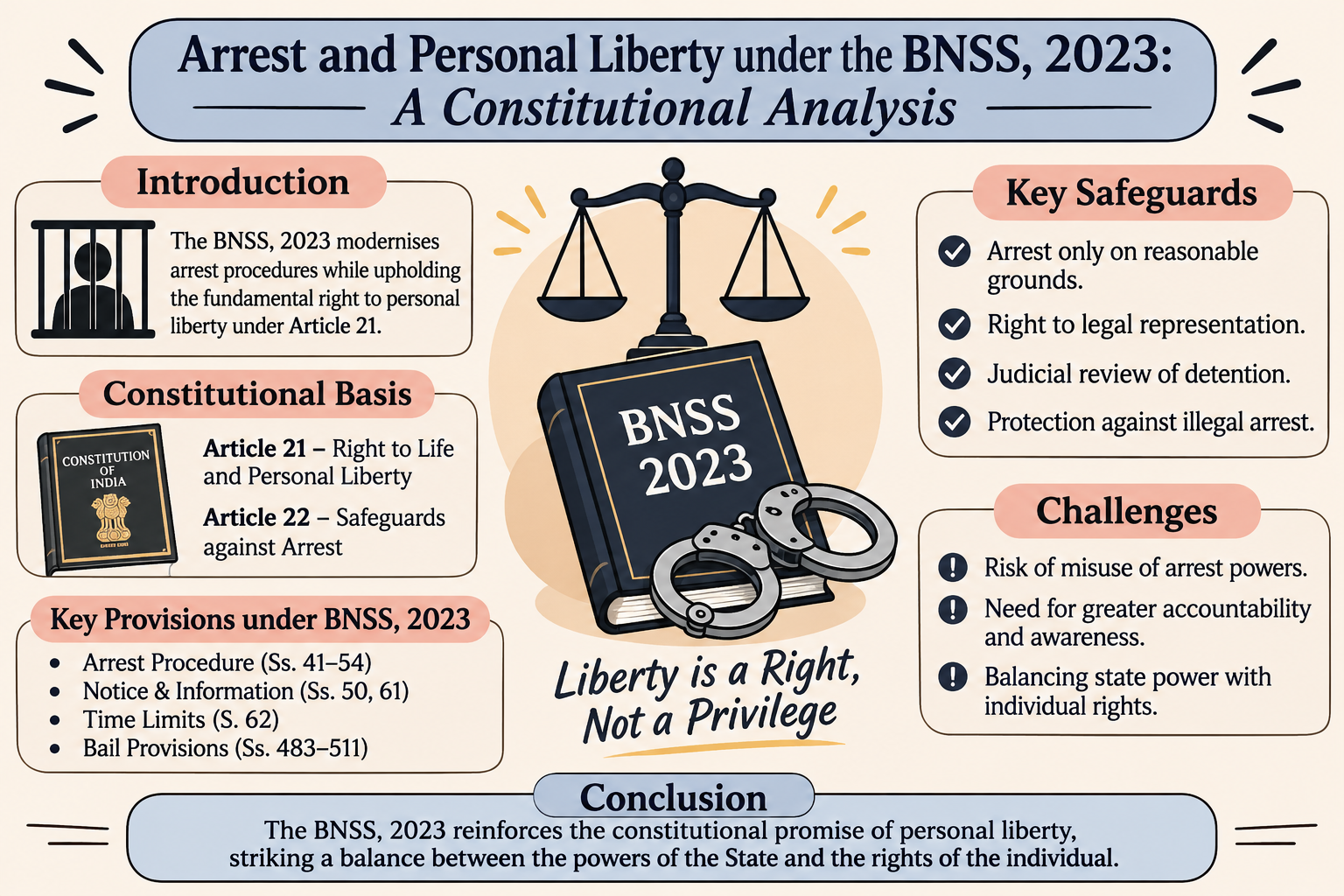
is a vital instrument of criminal investigation; however, its exercise must
remain subject to constitutional obstacles. The Bharatiya Nagarik Suraksha
Sanhita, 2023 (BNSS), which replaced the Code of Criminal Procedure, 1973 (CrPC)
with effect from 1 July 2024, regulates arrest and detention in India. This
article examines the relationship between the arrest provisions of the BNSS and
the fundamental rights assured under Articles 21 and 22 of the Constitution of
India. It analyses safeguards regarding arrest without a warrant, conversion of grounds of arrest, access to criminal assistance, manufacturing before a
Magistrate, and judicial oversight. It also considers vital Supreme Court
judgments and the realistic challenges concerned in imposing those safeguards.
The article argues that the effectiveness of the BNSS has to be measured now
not merely by means of investigative performance but additionally via its
potential to protect non-public liberty, prevent arbitrary arrest, and uphold
constitutional governance.
Introduction
The
strength to arrest is one of the most widespread powers exercised by way of the
State inside the management of crook justice. Although arrest may be necessary
to investigate offences, prevent further crime, and ensure the presence of an
accused before a court, its arbitrary exercise can severely infringe a
person’s liberty and dignity. Therefore, arrest has to be ruled with the
aid of legality, necessity, proportionality, and judicial oversight.
The
Bharatiya Nagarik Suraksha Sanhita, 2023 (BNSS), Act No. Forty-six of 2023,
replaced the Code of Criminal Procedure, 1973, with effect from 1 July 2024.
Chapter V of the BNSS, comprising Sections 35– sixty-two, deals with the arrest
of folks and establishes procedural safeguards supposed to alter police powers.
The
constitutional analysis of the BNSS requires analysing whether these statutory
provisions thoroughly defend non-public liberty under Articles 21 and 22 of the
Constitution of India. The important question is whether or not investigative
powers can be exercised efficiently without undermining personal freedom and
constitutional justice.
Constitutional Framework of
Personal Liberty
Article
21 of the Constitution presents that no person will be disadvantaged of life or
private liberty besides in keeping with the technique installed by means of
regulation. The Supreme Court has interpreted this provision to require that this be done in a truthful manner, simply, and reasonably, as opposed to arbitrarily or oppressively.
Article
22 affords specific safeguards against arrest and detention. Under Article
22(1), an arrested character must be informed of the grounds of arrest and
can’t be denied the right to consult and be defended by means of a legal
practitioner of their choice. Article 22(2) calls for the arrested individual
to be produced before the closest Magistrate within 24 hours of arrest,
except for the time necessary for the journey, and prohibits detention without the Magistrate’s authority.
These
constitutional provisions establish that personal liberty isn’t simply a
statutory entitlement but an essential property. Consequently, each arrest
ought to satisfy both the applicable criminal procedure and constitutional
requirements.
Arrest under the BNSS, 2023
Section
35 of the BNSS regulates arrest without a warrant. In offences punishable with
imprisonment up to seven years, arrest is subject to precise conditions, such
as the police officer’s reasonable belief that the individual committed the
offence and the need for arrest for functions consisting of proper investigation,
stopping further offences, protecting evidence, or ensuring the person’s
presence before the court. The officer should record the reasons in writing when making an arrest and, where arrest is unnecessary, the reasons for not
arresting.
This
provision reflects a critical principle: the circumstances in which police officers arrest do not routinely make arrest necessary. Investigation and arrest
are distinct functions, and the circumstances of each case should justify the
deprivation of liberty.
Section
36 prescribes the method for arrest and the responsibilities of the arresting
officer, including identity and preparation of an arrest memorandum. Section
forty-three governs how an arrest is made, whilst Section forty-six prohibits
unnecessary restraint. Section sixty-two similarly calls for arrests to be made
strictly in accordance with the Sanhita.
Together,
those provisions seek to promote responsibility, transparency, and
lawful police conduct.
Constitutional Safeguards against
Arbitrary Arrest
- Communication
of grounds of arrest
Section
47 requires the person arrested without a warrant to be informed directly of the overall details of the offence or different grounds for arrest.
It also calls for information about the right to bail in the situations specified
through the provision.
This
guard corresponds to Article 22(1). Merely bringing up an offence or statutory
provision may not meaningfully explain why a person has been arrested.
Effective verbal exchange enables the arrested individual to protest the
arrest, seek advice, and oppose remand.
- Right to legal assistance
Section
38 recognises the right of an arrested character to satisfy some advice in their
desire all through police interrogation, although not during the interrogation.
This provision reinforces the importance of felony help at some stage in a criminal investigation.
Access
to counsel is specifically vital wherein an individual may be unfamiliar with
crook procedure or not able to apprehend the prison results of police thinking.
However, the sensible effectiveness of this protect depends upon timely get
admission to a recommend and the supply of criminal useful resource for people
who cannot manage to pay for illustration.
- Information to relatives or friends
Section
48 requires information regarding an arrest and the area of custody to be
communicated to a nominated relative, buddy, or different person, as
prescribed. It also requires applicable information to be maintained and
locations a responsibility upon the Magistrate to verify compliance with
distinct necessities.
This
provision reduces the risk of secret detention and allows households to
discover the arrested man or woman. It additionally assists in establishing
responsibility for the circumstances and period of custody.
- Production before a Magistrate
Sections
fifty-seven and fifty-eight adjust the production of arrested folks before
the right authority and restrict detention past twenty-four hours without the legally
required authority. These provisions ought to be examined alongside Article
22(2) and the remand framework under Section 187 of the BNSS.
Judicial
oversight is critical as it allows examining the legality of
detention and the justification for continued custody. A Magistrate must
exercise independent judicial judgment in preference to mechanically approving a
request for remand.
Judicial Interpretation and
Important Judgments
The
Supreme Court has continuously emphasised that arrest powers have to be
exercised in accordance with constitutional safeguards.
In
Maneka Gandhi v. Union of India (1978), the Court held that the system contemplated
underneath Article 21 need to be fair, simply, and reasonable. Although
the case no longer addresses arrest under the BNSS, its constitutional
principle is fundamental to evaluating all laws affecting private liberty.
In
D.K. Basu v. State of West Bengal (1997), the Supreme Court established safeguards
relating to arrest and detention to prevent custodial abuse. These protected
requirements regarding arrest facts, notification of household, and
accountability of law enforcement officials these principles stay crucial when
decoding the procedural protections contained inside the BNSS.
In
Arnesh Kumar v. State of Bihar
(2014), the Court advised against automatic
arrests and emphasised compliance with the statutory conditions governing arrest.
The judgment is specifically relevant to Section 35 because it reinforces the
principle that arrest need to now not be habitual simply due to the fact the
police own the criminal power to make it.
More
lately, in Vihaan Kumar v. State of Haryana (2025), the Supreme Court
reiterated the constitutional significance of speaking the grounds of arrest
and examined the connection between Article 22 and the statutory safeguards
below the BNSS. The judgment reinforces the proposition that informing an
arrested person of the grounds is a major constitutional protection, no
longer an empty formality.
Further,
in its judgment dated 15 January 2026 concerning Section 35 of the BNSS, the
Supreme Court emphasised that, for offences punishable with imprisonment up to
seven years, issuing an order to appear under Section 35(3) is the
guideline, while arrest is an exception requiring strict necessity. This interpretation strengthens the difference between the power to
arrest and the need to exercise it.
Conclusion
The
BNSS, 2023, establishes a statutory framework governing arrest, detention, and
procedural safeguards. Its provisions, in particular Sections 35, 36, 38, 47,48, 57 and 58, should be interpreted constantly with
Articles 21 and 22 of the Constitution.
However,
the real measure of constitutional protection lies not simply within the
existence of legal provisions but in their faithful implementation. Arbitrary
arrest, useless detention, and insufficient verbal exchange of grounds
undermine the rule of law and public self-belief in crook justice.
Ultimately,
private liberty must continue to be the rule, even as arrest must be justified
by way of regulation and the specific circumstances of the case. A constitutional
criminal justice device ought to protect society from crime at the same time as
making sure that investigative authority is in no way exercised at the expense of
human dignity, fairness, and essential rights.
