


1. Introduction:
A contractual dispute often becomes clear only after something has gone wrong. A supplier fails to deliver goods, a purchaser does not pay the agreed consideration, a developer abandons a project, or a business arrangement collapses after substantial investment. At that stage, one party may allege that the other never intended to perform the agreement in the first place.
The allegation raises a difficult question. If a party has failed to honour a promise, how can a court determine whether the promise was dishonest when it was made, rather than genuine but later frustrated?
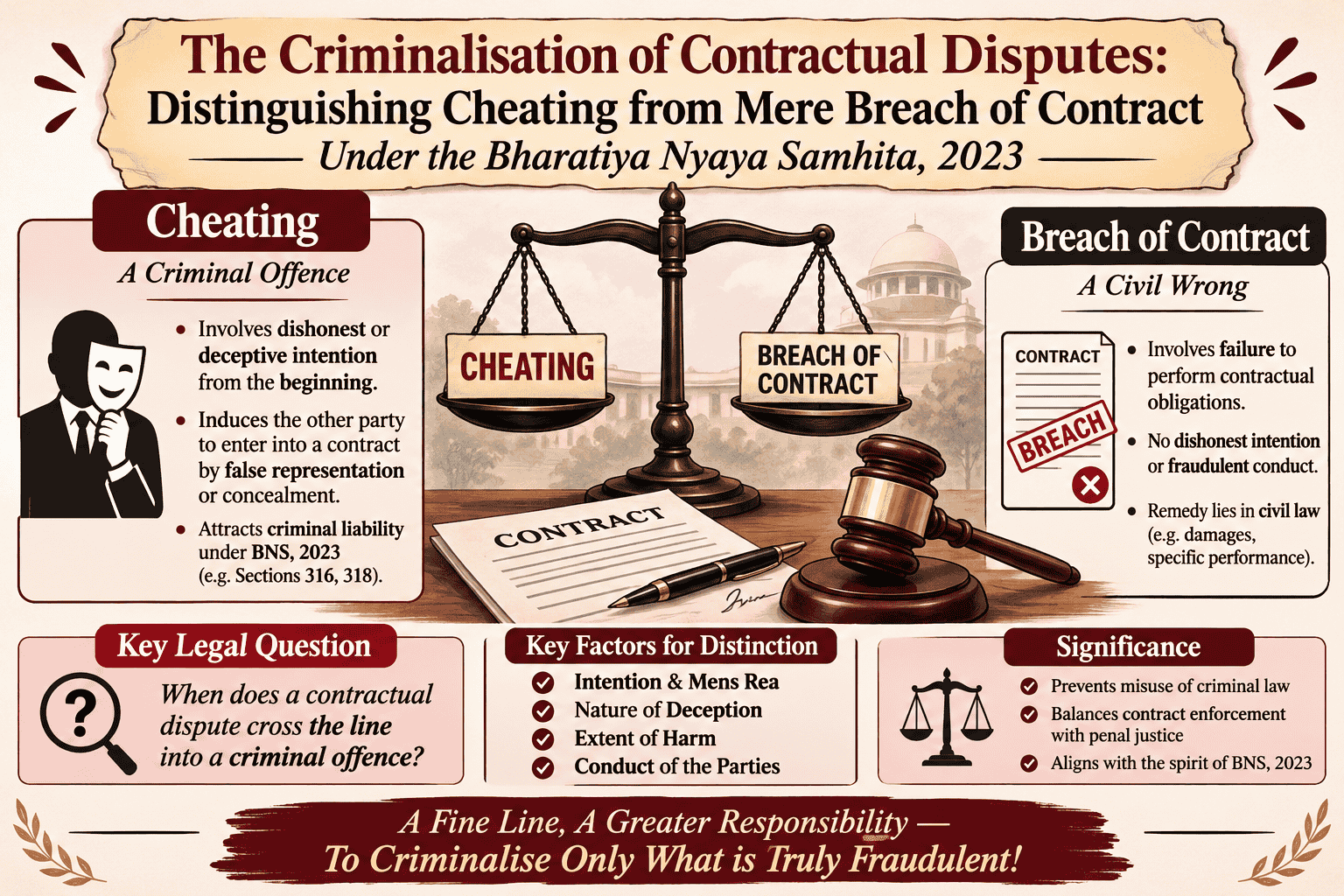
The distinction matters because the law does not equate every failure to perform a contractual obligation with cheating. Under Section 318 of the Bharatiya Nyaya Sanhita, 2023 (BNS), cheating involves deception and the legally required form of inducement. In cases involving delivery of property, Section 318(4) provides for a more serious punishment. The offence is therefore not established simply because a person has suffered financial loss or because a contractual obligation remains unfulfilled.
The Supreme Court’s decision in Hridaya Ranjan Prasad Verma v. State of Bihar remains central to this distinction. The Court explained that the intention of the accused at the time of inducement is relevant, and that subsequent conduct may assist in assessing that intention, but cannot be treated as the sole test. The decision recognises the very difficulty addressed in this article: the need to infer an earlier state of mind without allowing later events to determine the answer automatically.
This article approaches the issue from an evidentiary perspective. Its argument is that the legal distinction between cheating and breach of contract is already familiar, but its application requires a disciplined method of evaluating evidence. The relevant question should not simply be whether the contract was ultimately performed. It should be whether the evidence supports the allegation that a particular representation was dishonest when it induced the other party to act.
2. The Statutory Question: What Must the Evidence Establish?
Section 318 BNS defines cheating through deception and inducement. The statutory inquiry requires attention to the representation or conduct alleged to be deceptive, the effect of that deception on the person concerned, and the relevant intention of the accused.
Section 318(4) applies where cheating dishonestly induces a person to deliver property, or to make, alter, or destroy a valuable security, or something signed or sealed which may be converted into a valuable security. The provision is particularly relevant to commercial transactions involving advances, investments, payments, and transfers of property.
The existence of a transaction involving money, however, does not by itself establish the offence. A payment may have been made under a valid agreement that later became impossible to perform. A party may have underestimated costs, encountered financial difficulties, or failed to obtain a necessary approval. Such circumstances may lead to contractual liability, but their criminal significance depends on whether the statutory elements of cheating are disclosed.
The evidentiary issue is therefore specific. The prosecution must identify the alleged deception and establish its connection with the inducement. A general assertion that the accused “never intended to perform” is a conclusion. The facts supporting that conclusion must be examined.
This distinction is also important when considering the corresponding provisions of the Indian Penal Code, 1860. Several leading authorities were decided under the IPC, including Sections 415 and 420. Their principles remain relevant to the interpretation of corresponding provisions of the BNS, but the statutory provision applicable to the date of the alleged conduct must be identified accurately.
3. The Problem of Retrospective Inference
The central evidentiary risk in contractual cheating cases is that a court may read the transaction backwards.
Suppose a company receives an advance payment under an agreement to supply machinery. The machinery is not delivered. The purchaser alleges that the company accepted the advance while knowing that it would never supply the goods.
The failure to deliver is an established event. The allegation of dishonest intention at the time of receiving the advance, however, is a separate proposition. The first does not automatically prove the second.
A court may be presented with several kinds of evidence:
* the statements made before the agreement;
* the terms and conditions of the contract;
* the accused’s financial and operational position at the time;
* communications exchanged during performance;
* attempts to fulfil the agreement;
* the use of the advance payment;
* explanations given after the dispute arose.
These materials may point in different directions. Some may support the allegation of deception; others may indicate that the transaction was genuine but unsuccessful.
The danger lies in selecting only the evidence that is consistent with the eventual failure of the contract. If non-performance is treated as the starting point and earlier dishonesty is inferred from it without further analysis, the reasoning becomes circular: the contract failed because the accused was dishonest, and the accused was dishonest because the contract failed.
The Supreme Court’s reasoning in Hridaya Ranjan and Vesa Holdings P. Ltd. v. State of Kerala cautions against such an approach. The relevant intention must exist at the inception of the transaction. A dishonest intention that develops later does not retrospectively convert an earlier genuine promise into cheating.
The evidentiary inquiry must therefore distinguish between proof of non-performance and proof of the intention accompanying the original inducement.
4. A Transaction-Stage Approach to Evidence
A more disciplined assessment can be undertaken by examining the transaction in stages. This is not a separate legal test or a replacement for Section 318 BNS. It is a proposed method of organising the evidence so that the relevant intention is assessed at the legally appropriate time.
4.1 Before the agreement: What was represented?
The first stage concerns the statements or conduct that allegedly induced the complainant to enter into the transaction.
The court should identify the specific representation alleged to be false. Was the accused claiming to own particular property? Did the accused represent that goods were already available? Was a licence, approval, or financial capacity represented as existing? Was a future promise made in circumstances suggesting that the accused had no intention of fulfilling it?
The nature of the representation matters. A statement about an existing fact may be assessed differently from a promise concerning future performance. A promise about the future is not necessarily dishonest merely because it is not fulfilled. The relevant issue is whether the promise was made with the required dishonest intention.
The more clearly the alleged representation is identified, the easier it becomes to examine whether the evidence supports the allegation of deception.
4.2 At the formation of the agreement: What did the parties know?
The second stage concerns the circumstances in which the agreement was made.
Relevant evidence may include contemporaneous correspondence, records of negotiations, disclosed risks, contractual conditions, and documents showing the accused’s position at the time. These materials may help determine whether the accused made a representation that was knowingly false or whether the parties entered into a genuine arrangement that later encountered difficulties.
For example, a contract may expressly contemplate that a project depends on regulatory approval or that performance is subject to a specified condition. The eventual failure to obtain approval may be relevant to contractual liability, but it does not automatically demonstrate that the party making the agreement intended to deceive the other party.
In International Advanced Research Centre for Powder Metallurgy and New Materials v. Nimra Cerglass Technics (P) Ltd., the Supreme Court considered the relevance of contractual terms and the circumstances of a technology-related agreement while examining allegations of cheating. The decision illustrates why the agreement itself, including the risks contemplated by the parties, may be relevant to the assessment of intention.
4.3 During performance: What does the conduct reveal?
The third stage concerns the conduct of the parties after the agreement was made but before the dispute fully emerged.
Attempts to perform, requests for extensions, partial delivery, communication about difficulties, and efforts to resolve the problem may be relevant. Such conduct can provide context for assessing the original intention.
However, later performance is not conclusive. A party may make limited performance in order to maintain the appearance of a genuine transaction. Conversely, a party may fail to perform despite having entered into the agreement honestly.
The evidentiary value of subsequent conduct must therefore depend on its relationship with the alleged original deception. It should not be treated as a substitute for identifying what was represented and what the accused intended at the time of inducement.
4.4 After the dispute: What is the explanation for failure?
The final stage concerns the events following non-performance.
The accused’s explanation, the complainant’s response, the initiation of civil proceedings, or the commencement of arbitration may form part of the factual context. Yet none of these circumstances should be treated as independently decisive.
The existence of civil proceedings does not necessarily exclude criminal liability. In Indian Oil Corporation v. NEPC India Ltd., the Supreme Court clarified that the availability or use of a civil remedy does not, by itself, bar criminal proceedings where the complaint discloses an offence.
Equally, the initiation of criminal proceedings does not establish that the original transaction was dishonest. The question remains whether the allegations and supporting material disclose the statutory ingredients of cheating.
The transaction-stage approach is intended to preserve this distinction by ensuring that each item of evidence is considered for the proposition it can reasonably support.
5. The Importance of Contemporaneous Evidence
A central feature of the proposed approach is the importance of evidence created at or near the time of the transaction.
Contemporaneous documents may include emails, messages, invoices, payment records, project reports, board communications, contractual drafts, and records of negotiations. Such material may help reconstruct what was represented, what was known, and what was contemplated when the parties entered into the agreement.
This does not mean that contemporaneous evidence is always more reliable than later evidence. Documents may be incomplete, misleading, or created for a particular purpose. Nor does the absence of a document necessarily establish dishonest intention.
The point is narrower: evidence that directly relates to the alleged representation may be more useful in determining the intention accompanying that representation than evidence that merely records the eventual failure of the contract.
For instance, if the allegation is that a seller falsely represented that a particular asset existed, documents concerning the asset’s existence at the time of the agreement may be central. If the allegation concerns the use of an advance payment, financial records may be relevant. If the allegation concerns a promise to obtain regulatory approval, the communications and steps taken towards obtaining approval may provide context.
The evidentiary inquiry should therefore be tailored to the deception alleged. A generic examination of whether the contract was performed is unlikely to resolve every case.
6. The Limits of the Proposed Approach
The transaction-stage approach must not be used to impose a higher threshold than the law requires at the stage of considering a complaint or quashing proceedings.
At the preliminary stage, the court does not ordinarily conduct a full trial or finally determine the credibility of every piece of evidence. The question is whether the allegations, taken at the applicable standard, disclose the ingredients of the alleged offence.
In Indian Oil Corporation, the Supreme Court recognised that a commercial transaction may give rise to both civil and criminal consequences. The availability of a civil remedy cannot be treated as a categorical reason to terminate criminal proceedings.
Similarly, Rikhab Birani v. State of Uttar Pradesh emphasises the need for careful scrutiny of complaints and chargesheets in matters that are essentially contractual. The Court considered whether the material disclosed the offences alleged and cautioned against setting criminal proceedings in motion without the necessary factual foundation.
These principles operate together. Courts should not presume criminal intention from non-performance alone. But they should also avoid deciding disputed questions of intention prematurely where the allegations and material disclose a genuine issue requiring investigation or trial.
The proposed method is therefore not designed to produce automatic quashing. Its purpose is to improve the reasoning by which the relevant intention is assessed.
7. Implications for Investigation and Judicial Scrutiny
The evidentiary problem has practical consequences for both investigation and judicial decision-making.
An investigation into alleged contractual cheating should begin by identifying the representation said to have induced the complainant. The inquiry can then focus on whether the representation was false, whether the accused knew or believed it to be false in the legally relevant sense, and whether it induced the complainant to act.
This approach may help prevent an investigation from becoming a general exercise in recovering contractual dues. It also helps ensure that potentially criminal conduct is not overlooked merely because the parties have a contractual relationship.
At the judicial stage, the complaint and supporting material should be assessed against the elements of the alleged offence. The court should distinguish between allegations that merely describe non-performance and those that identify a particular deception connected with the original inducement.
Where the complaint does not disclose the necessary ingredients, the High Court may consider its inherent jurisdiction under Section 528 of the Bharatiya Nagarik Suraksha Sanhita, 2023 (BNSS), subject to the established limits on that power. The provision preserves the High Court’s inherent powers to prevent abuse of process and secure the ends of justice.
The legal consequence of this distinction is significant. A person should not face criminal prosecution solely because a contractual obligation remains unfulfilled. At the same time, a genuine allegation of deception should not be excluded merely because the transaction was documented as a contract.
8. Conclusion
The distinction between cheating and breach of contract is not a new problem in Indian law. The Supreme Court has repeatedly held that dishonest intention must exist at the time of inducement and that a subsequent failure to perform cannot, by itself, establish that intention.
The continuing difficulty lies in applying this principle to evidence that emerges after the transaction has failed. The risk of retrospective inference arises when later non-performance is treated as proof of earlier dishonesty without a careful examination of the representation, the circumstances in which it was made, and the evidence connected with it.
This article proposes a transaction-stage approach as a method of organising that inquiry. By separating pre-contractual representations, agreement formation, performance, and subsequent conduct, courts and investigators can assess the evidentiary value of each stage without allowing the ultimate failure of the contract to determine the original intention automatically.
The approach does not alter the statutory ingredients of cheating under Section 318 BNS. Nor does it suggest that civil and criminal remedies are mutually exclusive. Its purpose is to ensure that the inference of criminal intention remains connected to the evidence and the time at which the law requires that intention to exist.
The central question in contractual cheating should therefore be framed with precision: what evidence supports the allegation that the representation was dishonest when it induced the other party to act? Answering that question carefully is essential to distinguishing genuine criminal deception from contractual failure, while preserving the ability of criminal law to respond to transactions deliberately designed to deceive.
References:
Statutes
1. Bharatiya Nyaya Sanhita, 2023, Section 318.
2. Bharatiya Nagarik Suraksha Sanhita, 2023, Section 528.
3. Indian Penal Code, 1860, Sections 415 and 420, where applicable to conduct preceding the commencement of the BNS.
Cases
1. Hridaya Ranjan Prasad Verma v. State of Bihar, (2000) 4 SCC 168.
2. Indian Oil Corporation v. NEPC India Ltd., (2006) 6 SCC 736.
3. Vesa Holdings P. Ltd. v. State of Kerala, (2015) 8 SCC 293.
4. International Advanced Research Centre for Powder Metallurgy and New Materials v. Nimra Cerglass Technics (P) Ltd., (2016) 1 SCC 348.
5. Rikhab Birani v. State of Uttar Pradesh, 2025 INSC 512.
