


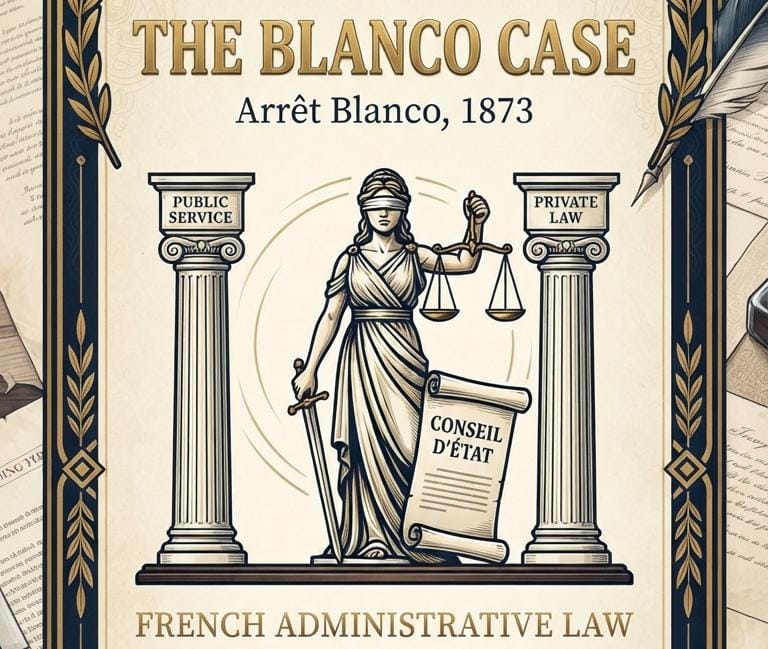
Case Details
Case Name: Blanco v. Prefect of Gironde / Blanco
Plaintiff: Mr. Blanco, father of Agnès Blanco
Defendant: Prefect of Gironde, representing the State
Court: Tribunal des conflits, France
Date of Judgment: 8 February 1873
Citation: D. 1873, III, 20; Rec. 1er suppl. 61
Introduction
The Blanco case of 1873 is regarded as one of the foundational decisions of modern French administrative law. The case established that the liability of the State for damage caused by persons employed in public services cannot simply be governed by the ordinary rules of the French Civil Code applicable to private individuals. Instead, State liability is subject to special rules connected with the requirements of public service.
The judgment also played an important role in establishing the separate jurisdiction of administrative courts over disputes concerning State liability arising from public services.
Facts of the Case
Agnès Blanco, a young girl, was injured by a wagon operated by workers employed by the State tobacco administration in Bordeaux. Her father, Mr. Blanco, brought an action against the Prefect of Gironde, representing the State, seeking compensation for the injuries suffered by his daughter.
The claim was based on Articles 1382, 1383 and 1384 of the French Civil Code, which deal with civil liability. A conflict arose concerning which court had jurisdiction to decide the claim: the ordinary civil courts or the administrative authorities.
The matter was therefore referred to the Tribunal des conflits, which resolves jurisdictional conflicts between the ordinary and administrative judicial systems.
Issues Raised
The main issues were:
- Whether the ordinary provisions of the Civil Code governing private liability applied to the liability of the State.
- Whether the ordinary courts or administrative authorities had jurisdiction over a claim arising from damage caused by a public service.
- Whether State liability should be governed by special principles of administrative law.
Arguments of the Parties
- Plaintiff Arguments
- Blanco’s side argued that the State should be held liable for the injury caused to his daughter by the employees operating the State tobacco administration.
- The claim relied upon the general principles of civil liability contained in the Civil Code.
- Defendant Arguments
- The State’s position was that its liability could not automatically be determined according to the same rules applicable between private individuals.
- Since the damage arose from the operation of a public service, the dispute fell within the sphere of administrative law and should be determined according to special rules.
Judgment of the Court
The Tribunal des conflits held that the ordinary rules of the Civil Code governing relationships between private individuals could not simply be applied to determine the State’s liability for damage caused by persons employed in a public service.
The Court stated that State responsibility is neither general nor absolute. It is governed by special rules that vary according to the requirements of public service and the need to reconcile the interests of the State with the rights of private persons.
Accordingly, jurisdiction over such matters belonged to the administrative jurisdiction, rather than the ordinary civil courts.
Ratio Decidendi
The ratio decidendi of Blanco is that State liability arising from the operation of public services is governed by special principles of administrative law rather than the ordinary rules of private civil liability.
The extent of State liability depends upon the requirements of public service and cannot be treated as identical to the liability of a private individual. Consequently, disputes concerning such liability fall within the administrative jurisdiction.
Significance
The Blanco decision is considered a landmark in the development of French administrative law. It helped establish the principle that public authorities cannot always be treated in the same manner as private persons when exercising public functions.
The case also reinforced the concept that administrative law has its own principles and rules, particularly concerning State liability and public services. Modern scholarship frequently describes Blanco as a foundational or formative decision in the development of French public-law liability.
Its importance extends beyond France because the distinction between public-law liability and private-law liability has influenced comparative administrative-law scholarship and discussions of State liability in other legal systems.
Conclusion
The Blanco case marked a major development in administrative law by recognizing that the liability of the State for acts connected with public services requires a distinct legal framework. The decision separated State liability from ordinary private-law liability and confirmed the importance of administrative jurisdiction in public-service disputes.
Thus, Blanco (1873) remains a foundational authority for the principles of State liability, public service and administrative jurisdiction.
References
- Blanco v. Prefect of Gironde, 8 February 1873, D. 1873, III, 20; Rec. 1er suppl. 61.
- https://www.scribd.com/document/972803587/The-Blanco-case-admin-case-study-pdf-version
- French Civil Code, art 1382, 1383 & 1384.
