


Introduction
The Reserve Bank of India (RBI) plays an important role in maintaining India’s economic and financial stability. Its Monetary Policy Committee (MPC) regularly reviews the country’s economic conditions and decides the policy repo rate.
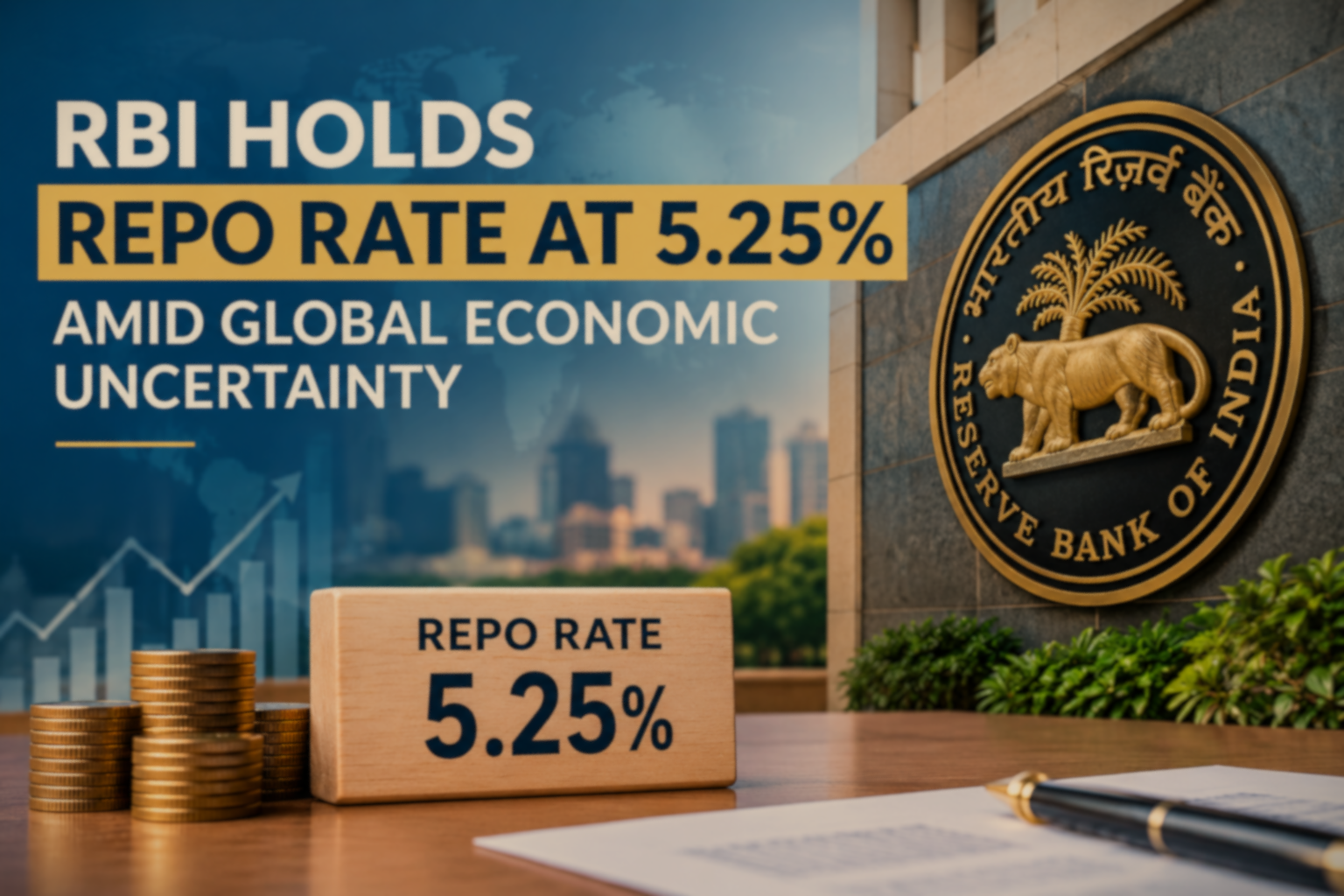
In its latest meeting held from August 3 to 5, 2026, the RBI’s Monetary Policy Committee (MPC) decided to keep the policy repo rate unchanged at 5.25 per cent. The decision reflects the central bank’s cautious approach amid evolving domestic economic conditions and global uncertainties.
At the same time, India’s domestic economic growth remains supported by consumption, government spending, and the services sector. The RBI’s decision reflects a cautious and data-driven approach towards balancing economic growth and price stability.
RBI Keeps Policy Rate Unchanged
The Reserve Bank of India (RBI), in its Monetary Policy Committee (MPC) meeting held from August 3 to 5, 2026, decided to keep the policy repo rate unchanged at 5.25 per cent. The MPC voted unanimously to maintain the existing rate, continuing its cautious approach while assessing economic and financial developments.
In simple terms, the central bank wants to support economic growth without letting prices rise too much, so it’s playing safe and making decisions based on incoming data rather than rushing into changes.[1]
After announcing the decision in the MPC meeting, the RBI state that while Indian’s domestic economic is holding up well, but problem like global trade issue, geopolitical tensions, as well changing commodity prices they are continuing to create causing of external pressures. Therefore, by maintaining the current policy rate the same, the RBI is choosing prefers to observe how inflation and economic growth trend before taking any decision nor changing the direction of its monetary policy.
The repo rate is the interest rate at which the RBI gives loans to these commercial banks, and it plays a critical role in decides how expensive or cheap it is to borrow money across the whole economy. When this rate changes, loan interest rates, bank deposit returns, and the flow of money are usually affected also.
Since the RBI has kept the rate unchanged, banks are not likely to change their loan or deposit interest rate structures. This brings short-term stability and clarity for borrowers and investors.
Inflation and Economic Growth Outlook
According to the RBI, monetary policy statement, inflation has moderated compared to previous high levels, but it is still easily affected by supply problem, especially in food and fuel categories prices. Seasonal changes in food prices, weather-related risks, and movement in global energy prices can make inflation rise or fall. The RIB made it clear that keeping inflation aligned with its medium-term target remains one of its main goals. [2]
The Indian economy is growing faster, this is mainly because people are spending money on goods and services, the government capital expenditure, growth in the services sector. However, the RBI also state that external demand from other countries is uncertain because of some big economies are slowing down and global trade is changing. Export performance and capital flows may therefore remain exposed to global shifts.
Global Trade Uncertainty and External Risks
Global trade has become an important factor for the RIB when making monetary policy decisions. Changes in global trade, tariff measures in other countries, and shifts in supply chains are causing uncertainty in prices as well in currency values. These factors can affect the cost of imports and the value of India’s currency. The RBI order to carefully notices on these developments before making policy decisions.
The RBI also talked about how much cash is available in banks. It said it is ready to use tools like repo and reverse repo operations to keep the markets running smoothly. This flexible approach allows the RBI to deal with temporary cash shortages quickly without changing interest rate.
Market and Industry Reaction
After the RBI decided to keep rates unchanged, the financial markets stayed mostly stable, just as most experts had expected no change. The Government bond yields moved limited movement, and stock markets remained steady. Market investors saw this as a sign that the RBI is being careful as well predictable policy, which helps to avoid sudden market shocks.
Industry have generally been supportive of the RBI’s decision to keeps rates unchanged. Business groups stated that policy rate stability helps companies plan investments and manage loan more easily. Interest-sensitive sectors like real estate and automobiles appreciated the pause, as steady rates support sustain demand. Small and medium enterprises also benefit from predictable credit during uncertain global conditions.[3]
Future Monetary Policy Outlook
The RBI’s latest decision indicates that the central bank is continuing to monitor inflation, growth and global economic developments before making any change to the policy rate. The next MPC meeting is scheduled for October 5 to 7, 2026, when the committee will again assess the evolving economic conditions.
Economists are divided about the RBI future policy path. Some believe that if inflation stays low and global commodity prices remain stable then the RBI may cut rates in the future to support growth. Others argue that persistent global risks and domestic food price may mean the RBI will keep rates unchanged for a longer time.[4]
The RBI stated that future policy decisions will depend on data, rather than a fixed schedule. This means inflation readings, economic growth, liquidity trends, as well global developments will guide its next move. Such an approach gives the RIB flexibility while keeping markets alert.[5]
Conclusion
The decision to keep the policy repo rate unchanged at 5.25 per cent reflects the RBI’s cautious approach towards maintaining economic stability. With global economic conditions continuing to evolve, the central bank is focusing on inflation, growth and other economic indicators before making further policy changes. The upcoming MPC meeting in October 2026 will provide further indication of the RBI’s future monetary policy direction. [6]
- Press Releases – Reserve Bank of India
- Home – Reserve Bank of India
- https://economictimes.indiatimes.com/markets/news
- India’s central bank holds rates as trade deals ease pressure | Reuters
- RBI Policy Highlights: MPC holds repo rate steady at 5.25%, stance ‘neutral’; growth raised, inflation benign, RBI keeps repo rate at 5.25% after India US, EU trade deals boost outlook| Business News
- RBI monetary policy: Repo rate kept at 5.25% – what’s the GDP, inflation outlook & what does status quo mean for your EMIs, fixed deposits? – The Times of India
- Business News, Finance News, India News, Stock Markets BSE/NSE News, SENSEX, NIFTY, Personal Finance News
