


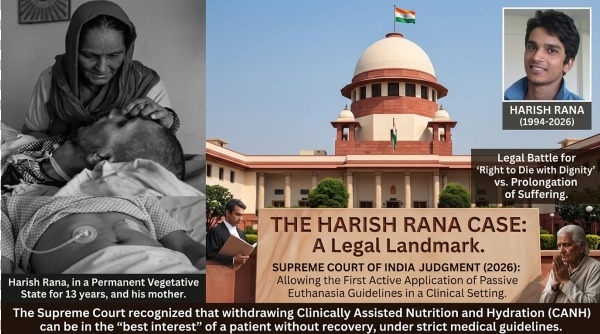
Case Details
- Case Name: Harish Rana v. Union of India & Ors.
- Citation: 2026 INSC 222
- Court: Supreme Court of India
- Bench: Justice J.B. Pardiwala and Justice K.V. Viswanathan
- Date of Judgment: 11 March 2026
- Proceeding: Miscellaneous Application No. 2238 of 2025 in Special Leave Petition (Civil) No. 18225 of 2024
- Prior History: Delhi High Court dismissed Writ Petition (C) No. 4927 of 2024 on 2 July 2024
Introduction
Harish Rana v. Union of India addresses a painful constitutional question. Can courts permit withdrawal of treatment from a patient who cannot consent? The Supreme Court answers this question through Article 21 jurisprudence. It builds directly on Common Cause v. Union of India, the 2018 Constitution Bench ruling. Harish Rana v. Union of India applies that framework to real, prolonged suffering. The Court examines whether feeding through a tube counts as medical treatment. It also refines the best-interest principle for incompetent patients.
This commentary explains the facts, the arguments, and the Court’s reasoning. It also evaluates the judgment’s constitutional and practical significance.
Facts of the Case
Harish Rana, aged 32 at the time of judgment, once pursued a B.Tech degree. On 20 August 2013, he fell from the fourth floor of his hostel. He suffered a diffuse axonal brain injury. Doctors first treated him at a local hospital in Garhwal. They then shifted him to PGI Chandigarh for specialised care. He received ventilator support, tracheostomy, and nasogastric feeding there. His condition never improved after discharge on 27 August 2013.
Doctors later replaced the nasogastric tube with a surgically placed PEG tube. This tube has since delivered his Clinically Assisted Nutrition and Hydration(CANH). Medical certificates from 2014 and 2016 confirmed his permanent vegetative state. He showed complete sensorimotor dysfunction and total physical impairment. For thirteen years, he remained bedridden, unaware, and unresponsive to stimuli.
His parents first approached the Delhi High Court in 2024. The High Court dismissed their plea, reasoning that no mechanical ventilation sustained him. The Supreme Court later disposed of the resulting SLP by directing home-based care. It granted liberty to approach the Court again if needed. Following further deterioration, the parents filed the present Miscellaneous Application. They sought constitution of medical boards and a declaration on CANH’s legal status.
The Supreme Court directed formation of a primary medical board in Ghaziabad. This board found negligible chances of neurological recovery. It then directed AIIMS, New Delhi, to constitute a secondary medical board. This board confirmed permanent vegetative state and found CANH offered no therapeutic benefit. Both parents and siblings unanimously requested withdrawal of treatment, citing dignity and prolonged suffering.
Issues Before the Court
The Supreme Court framed several core issues in Harish Rana v. Union of India.
- First, whether CANH administered through a PEG tube qualifies as medical treatment.
- Second, what the best-interest principle means and how it applies.
- Third, whether continuing treatment served Harish Rana’s best interests.
- Fourth, what procedural steps must follow any withdrawal decision.
- Fifth, how the Common Cause guidelines needed streamlining for practical use.
- Sixth, whether legislative intervention remained necessary despite existing judicial guidelines.
Arguments of Both Parties
Counsel for the applicant argued that:
- CANH constitutes life-sustaining medical treatment. She relied on concurring opinions in Common Cause 2018 describing feeding tubes as life support. She cited English precedents, including Airedale NHS Trust v. Bland, supporting withdrawal of artificial nutrition.
- She argued the real question was not whether death served Harish Rana’s interests. Instead, courts must ask whether prolonging artificial feeding served any purpose.
- She also flagged implementation gaps in the Common Cause guidelines nationwide. She proposed measures like nominating custodians for advance directives and clarifying board procedures.
The Additional Solicitor General, representing the Union, largely supported the applicant’s position. She submitted that:
- futile treatment serving no therapeutic purpose may lawfully be withdrawn. She confirmed that Common Cause 2018 already treats CANH as medical treatment, not basic care.
- She distinguished lawful withdrawal from unlawful killing, framing withdrawal as an omission.
- She highlighted that both medical boards found the condition irreversible and treatment futile.
- She requested that palliative arrangements accompany any withdrawal, ensuring comfort and dignity.
Judgment
Justice Pardiwala, writing for the Bench, first examined Common Cause (2018) in detail. He clarified that active and passive euthanasia involve different legal concepts. Active euthanasia directly causes death through a positive medical intervention. In contrast, passive euthanasia allows an existing fatal condition to take its natural course.
The Court explained that an act’s physical form does not determine its legal character. For example, withdrawing a feeding tube involves a physical act. However, the law treats that withdrawal as an omission because it allows the underlying condition to progress.
The Court then firmly recognised the right to die with dignity under Article 21. It relied on Gian Kaur v. State of Punjab and Common Cause (2018) while developing this principle. The Court held that constitutional dignity does not end when life approaches its final stage.
For competent patients, autonomy, privacy, and self-determination support this right. However, incompetent patients require a different approach. Therefore, the Court recognised dignity as an independent basis for protecting their interests.
The Court reaffirmed three conditions for non-voluntary passive euthanasia.
- First, the patient must suffer from a terminal or PVS-like condition.
- Second, treatment must have continued for a prolonged period.
- Third, the condition must remain irreversible without any realistic possibility of recovery.
The Court also held that CANH constitutes medical treatment. It accepted the reasoning in Airedale that artificial nutrition through medical devices amounts to treatment. Consequently, courts can consider withdrawing CANH under the principles established in Common Cause. The Court rejected an absolute rule that treats tube feeding as basic care.
Court’s Reasoning
The Court then developed the best-interest principle through comparative legal analysis. It examined legal approaches from several jurisdictions, including the United States and United Kingdom. It also considered approaches from Ireland, Italy, Australia, New Zealand, and the European Union.
The Court identified both medical and non-medical factors for determining a patient’s best interests. Medical factors include diagnosis, prognosis, treatment outcomes, and the possibility of recovery. Non-medical factors include the patient’s previous wishes, personal values, dignity, and quality of life.
However, the Court clarified an important distinction. The inquiry does not determine whether death would benefit the patient. Instead, the court must determine whether continued treatment still provides a meaningful purpose.
The Court applied this principle to Harish Rana’s circumstances. Medical boards found no neurological improvement despite thirteen years of continued care. They also found no realistic possibility of meaningful recovery.
Furthermore, Harish Rana’s family unanimously supported the withdrawal of CANH. The family had cared for him devotedly throughout this period. Therefore, the Court found their decision reflected concern for his dignity rather than convenience.
The Court consequently concluded that continued CANH no longer served Harish Rana’s best interests. It therefore permitted withdrawal of the treatment while applying the safeguards required under the law.
Ratio Decidendi
The core ratio of Harish Rana v. Union of India establishes several propositions. Clinically Assisted Nutrition and Hydration constitutes medical treatment, not mere basic care. Consequently, courts may permit its withdrawal under the Common Cause framework.
Non-voluntary passive euthanasia rests on dignity as an independent constitutional basis. Three threshold conditions must exist: irreversibility, prolonged treatment, and terminal or vegetative status. The best-interest inquiry asks whether treatment still serves a therapeutic purpose. It never asks whether the patient would benefit from dying. Where medical boards and family unanimously find treatment futile, withdrawal may lawfully follow the Common Cause procedure.
Critical Analysis
Harish Rana v. Union of India offers welcome clarity on a long-uncertain question. Since 2018, hospitals hesitated over whether feeding tubes counted as treatment. This judgment resolves that hesitation with a clear, reasoned classification. The Court’s comparative survey strengthens its reasoning through cross-jurisdictional consistency. Its careful distinction between acts and omissions avoids conceptual confusion for practitioners.
Yet certain concerns remain worth noting. The judgment relies heavily on medical board unanimity and family consensus. Cases involving family disagreement or absent relatives may prove harder to resolve. The best-interest test, though refined, still leaves considerable discretion to courts. Critics may also question whether “dignity” as a standalone basis risks subjective application. Without binding legislation, guideline compliance across states may remain uneven. The Court itself acknowledges this gap and repeatedly urges parliamentary action.
Despite these limitations, the balance the Court strikes appears principled and humane. It neither dilutes the sanctity of life nor ignores prolonged, purposeless suffering. It anchors difficult medical decisions within transparent, medically verified procedures.
Constitutional Significance
Harish Rana v. Union of India substantially advances Article 21 jurisprudence in India. It confirms that the right to live with dignity spans life’s entire arc. It extends this dignity-based protection meaningfully to incompetent, non-communicative patients. The judgment also reinforces institutional respect for medical boards over routine judicial intervention. Courts, the Bench emphasised, should intervene only when the statutory process reaches an impasse. This preserves separation between medical expertise and judicial oversight, respecting both domains. The ruling further cements dignity as an independent constitutional value, not just derivative.
Impact and Subsequent Developments
As the first full implementation of Common Cause, Harish Rana v. Union of India carries considerable precedential weight. Hospitals and clinicians now possess clearer guidance on classifying CANH withdrawal requests. The Court directed streamlining measures addressing several practical gaps. These include clearer checkpoints protecting doctors from undue hesitation. They include a defined role for next of kin in decision-making. They also address patients receiving treatment in home settings, like Harish Rana himself. The Court directed Chief Medical Officers to nominate registered practitioners for secondary boards. It introduced a reconsideration period before final withdrawal, adding a further safeguard. The judgment again urged Parliament to enact comprehensive end-of-life legislation. It referenced the 196th and 241st Law Commission Reports and the 2024 draft guidelines. Legal commentators and medical journals have since discussed the judgment’s clinical implications extensively.
Conclusion
Harish Rana v. Union of India brings compassionate clarity to India’s euthanasia jurisprudence. It confirms CANH as medical treatment capable of lawful withdrawal. It refines the best-interest principle through careful comparative analysis. Most importantly, it honours dignity for a patient who could no longer speak for himself.
The judgment strengthens, rather than dilutes, the constitutional commitment to life with dignity. It leaves a lasting procedural framework for future cases involving irreversible suffering.
References
- Harish Rana v. Union of India & Ors., 2026 INSC 222, Miscellaneous Application No. 2238 of 2025 in SLP (C) No. 18225 of 2024, Supreme Court of India, decided 11 March 2026.
- Common Cause (A Regd. Society) v. Union of India, (2018) 5 SCC 1.
- Common Cause (A Regd. Society) v. Union of India, (2023) 14 SCC 131.
- Gian Kaur v. State of Punjab, (1996) 2 SCC 648.
- Aruna Ramachandra Shanbaug v. Union of India & Ors., (2011) 4 SCC 454.
- Airedale NHS Trust v. Bland, (1993) All ER 821.
- Constitution of India, Article 21.
- Law Commission of India, 196th Report on Medical Treatment to Terminally Ill Patients.
- Law Commission of India, 241st Report on Passive Euthanasia.
FAQs
Q1. What did the Supreme Court decide in Harish Rana v. Union of India?
Ans. The Court permitted withdrawal of CANH from a patient in a permanent vegetative state for thirteen years.
Q2. Why does Harish Rana v. Union of India matter for CANH?
Ans. It confirmed that tube-administered nutrition and hydration counts as medical treatment, not basic care.
Q3. How does the best-interest principle apply in this case?
Ans.Courts ask whether continued treatment serves any therapeutic purpose, not whether death benefits the patient.
Q4. Does this judgment legalise active euthanasia in India?
Ans.No. The Court reaffirmed that only passive euthanasia remains constitutionally permissible under Article 21.
Q5. Did the Court rely on Common Cause v. Union of India?
Ans.Yes. The judgment applies and streamlines the guidelines from Common Cause 2018 and its 2023 modification.
