


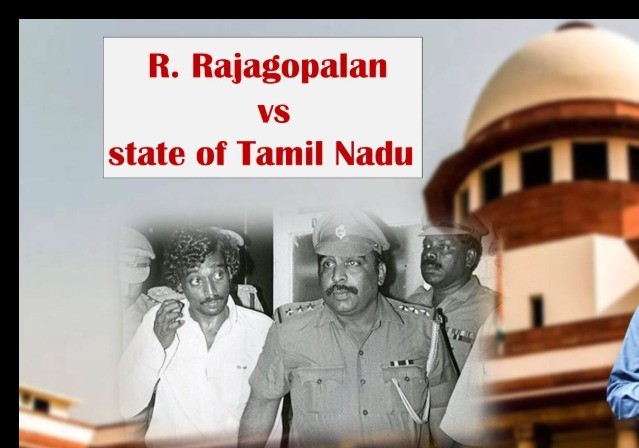
The “Auto Shankar” Case: Privacy, Press Freedom and Prior Restraint in Indian Constitutional Law
Citation: Rajagopal v. State of Tamil Nadu, (1994) 6 SCC 632; AIR 1995 SC 264; Judgment: 7th October, 1994.
Author’s Note
This article is an original analytical draft prepared in formal legal style. It paraphrases the judicial reasoning rather than reproducing the language of the judgment. The case was decided under the Constitution of India, the Indian Penal Code, 1860 and the then applicable procedural law.
The Bharatiya Nyaya Sanhita, 2023, Bharatiya Nagarik Suraksha Sanhita, 2023 and Bharatiya Sakshya Adhiniyam, 2023 came into force from 1 July 2024. They do not retrospectively govern the 1994 cause of action. Their relevance is therefore comparative and contemporary.
In R. Rajagopal v. State of Tamil Nadu (popularly known as the Auto Shankar case), a Supreme Court bench of Justices B.P. Jeevan Reddy and S.C. Sen held that the right to privacy is implicit under Article 21, but it cannot be used by public officials to place a prior restraint on the press from publishing material based on public records.
Introduction
The decision in R. Rajagopal v. State of Tamil Nadu occupies a foundational position in Indian constitutional jurisprudence concerning the relationship between the right to privacy, the freedom of speech and expression, the freedom of the press, and the power of the State to impose prior restraint upon publication.
The proceedings arose from a proposed publication by the Tamil magazine Nakkheeran of the alleged autobiography of a condemned prisoner known as “Auto Shankar”. The proposed narrative purportedly contained allegations concerning the prisoner’s criminal activities and his alleged connections with public officials and prison authorities. The prison administration warned the magazine against publishing the material, asserting that it was defamatory and unauthorized.
The Supreme Court was consequently required to determine whether the State could prevent publication before it occurred and whether publication of a person’s life story without consent violated the constitutional right to privacy. The Court also examined the legal position of public officials, the ability of the Government to sue for defamation, and the remedies available after publication.
The judgment is commonly regarded as the Indian Supreme Court’s earliest comprehensive articulation of the constitutional right to privacy in the context of media publication. Its central contribution lies in establishing that prior restraint is constitutionally disfavoured, while also recognizing that privacy, reputation and press freedom require a careful case-by-case balance.
Abstract
This article examines R. Rajagopal v. State of Tamil Nadu, popularly known as the “Auto Shankar” case, as a landmark decision on privacy and freedom of the press under Articles 19(1)(a) and 21 of the Constitution of India.
The Supreme Court held that the right to privacy is implicit in the right to life and personal liberty under Article 21. It acknowledged that an individual ordinarily possesses the right to protect the privacy of personal matters, including family life, marriage, procreation, motherhood, child-bearing and education. Publication of such matters without consent may constitute an actionable invasion of privacy.
Simultaneously, the Court identified important limitations. Matters appearing in public records, including court records, may ordinarily be reported or commented upon without obtaining consent. Public officials cannot ordinarily restrain publication relating to their official conduct merely because they anticipate reputational harm. The remedy for defamation generally arises after publication and must be pursued through legally accepted civil or criminal remedies.
The Court rejected the proposition that the State or its officials possess a general power to prevent publication in advance. It nevertheless clarified that the media remains subject to laws relating to defamation, contempt, official secrecy and other constitutionally permissible restrictions.
The article further evaluates the continuing significance of the judgment in the era of digital journalism, electronic evidence and data-driven publication, while distinguishing the 1994 legal framework from the present statutory regime under the Bharatiya Nyaya Sanhita, 2023, the Bharatiya Nagarik Suraksha Sanhita, 2023 and the Bharatiya Sakshya Adhiniyam, 2023.
Background
The case emerged during a period when constitutional privacy jurisprudence in India remained under development. The Constitution does not expressly enumerate a general “right to privacy”. Nevertheless, the Supreme Court had previously derived aspects of privacy from the guarantees of life, personal liberty, movement and dignity under Article 21.
The dispute in *Rajagopal* concerned the extent to which privacy could be asserted against the press. The case was therefore not merely about publication of a prisoner’s narrative. It required the Court to balance competing constitutional interests:
- the individual’s interest in privacy and reputation;
- the press’s freedom to investigate and publish;
- the public’s interest in receiving information;
- the State’s duty to maintain prison administration; and
- the constitutional prohibition against arbitrary governmental interference.
The Court approached the dispute through the framework of Articles 19(1)(a), 19(2) and 21. Article 19(1)(a) protects freedom of speech and expression, which includes freedom of the press. Article 19(2) permits only constitutionally authorized and reasonable restrictions, including restrictions relating to defamation, contempt of court, public order, decency and morality. Article 21 protects life and personal liberty against deprivation except according to procedure established by law. The Constitution is available through the official Legislative Department and India Code repositories. [legislative.gov.in]
Facts
The petitioners were associated with the Tamil magazine ”Nakkheeran”. They proposed to publish what was represented as the autobiography or life story of a condemned prisoner known as Auto Shankar.
Auto Shankar had been convicted in connection with serious offences, including multiple murders, and had been sentenced to death. The proposed autobiography was alleged to contain accounts of his criminal life and his purported connections with prison officials, police personnel and other public functionaries.
The petitioners asserted that the prisoner had authored or permitted the publication of the material through his wife and that the material was intended to be serialized in Nakkheeran. The Inspector-General of Prisons issued a communication warning the petitioners that publication would be unlawful. The State authorities claimed that the material was false, defamatory and unlicensed.
The petitioners approached the Supreme Court seeking protection against governmental interference and sought an appropriate writ restraining the State, prison authorities and officials from obstructing publication.
The Court noted that Auto Shankar, his wife and his counsel were not parties to the proceedings. Since the petition involved disputed questions concerning authorship and accreditation, the Court proceeded on the assumption, solely for the purpose of deciding the writ petition, that the prisoner had neither written nor licensed publication. The Court expressly clarified that this assumption did not constitute a final finding of fact. [indiankanoon.org]
Issues
The principal issues before the Supreme Court were as follows.
- Right to privacy and unsanctioned biography
Whether a person could prevent another individual from writing and publishing his life story without consent, and whether such publication would infringe the person’s right to privacy.
- Freedom of the press
Whether Article 19(1)(a), including the freedom of the press, protected publication of an unauthorized life story.
- Public records
Whether the press could publish information concerning a person where the information was already available from public records, including judicial records.
- Defamation and prior restraint
Whether the Government or its officials could restrain publication in advance on the ground that the proposed material might be defamatory.
- Defamation of the Government
Whether the State, the Government or governmental institutions could maintain an action for damages for defamation.
- Prison authorities and representation of the prisoner
Whether prison officials could intervene to protect the alleged privacy rights of the prisoner, even without his express authorization.
The judgment records these questions in substantially similar terms and treats them as questions involving the interaction between privacy, press freedom, defamation and governmental power. [indiankanoon.org]
Arguments
Arguments of the petitioners
The petitioners contended that publication of the proposed autobiography was protected by the freedom of speech and expression under Article 19(1)(a). They argued that the State lacked authority to prevent publication merely because public officials anticipated embarrassment or reputational harm.
They further submitted that the threatened prohibition amounted to unconstitutional prior restraint. According to the petitioners, if any individual believed that publication had caused defamation or unlawful invasion of privacy, that person could pursue a remedy after publication in accordance with law.
The petitioners also maintained that the State could not assume the role of a private individual and seek to protect officials from criticism or alleged defamation. The media, they argued, had a legitimate constitutional role in exposing possible abuse of public office and misconduct within governmental institutions.
Arguments of the State
The State contended that the proposed publication contained false and defamatory allegations against public officials and prison authorities. It argued that the publication could damage reputations and disturb the functioning of public institutions.
The authorities also asserted that the prisoner had not authorized publication and that prison officials were entitled to prevent unauthorized exploitation of the prisoner’s life story. They relied upon the need to preserve prison discipline and protect the interests of the prisoner, who was incarcerated and therefore allegedly unable to take legal action himself. The State’s position was effectively that publication could be stopped before dissemination where the proposed material was likely to be defamatory or invasive of privacy.
Reasoning of the Supreme Court
- Privacy as an aspect of Article 21
The Court held that the right to privacy is implicit in the right to life and personal liberty under Article 21. Although privacy was not expressly set out as an independent fundamental right in the constitutional text, the Court treated it as an emanation of constitutionally protected liberty and dignity.
The Court identified that an individual has a right to be left alone and to safeguard the privacy of matters such as family life, marriage, procreation, motherhood, child-bearing and education. Publication of such matters without consent could give rise to an action for damages, whether the publication was favourable or critical.
This principle was not absolute. The Court accepted that the protection may be weaker where a person voluntarily places himself or herself at the center of a public controversy. The scope of privacy must therefore depend on the nature of the information, the circumstances of publication and the public interest involved.
- Public records and the limits of privacy
The Court drew a significant distinction between private information and information contained in public records.
Where a fact appears in a public record, including a court record, the right to privacy in relation to that fact ordinarily ceases to operate in the same manner. Such information becomes a legitimate subject of comment by the press and media.
The Court’s reasoning was not that every public record may be republished without restraint in every circumstance. Rather, it recognized that information formally available through public judicial or governmental records is generally subject to public discussion.
The press cannot be prevented from reporting a matter merely because the person concerned would prefer that the matter remain undisclosed.
The Court nevertheless identified an important exception concerning victims of sexual assault, kidnapping, abduction or similar offences. The publication of the identity or details of such victims may violate decency and dignity and may amount to a further injury to the victim.
- Public officials and official conduct
The Court held that public officials do not ordinarily possess a right to privacy in relation to acts and conduct relevant to the discharge of their official duties.
This principle rests upon the public character of governmental office. Public officials exercise public power and are consequently subject to public scrutiny. A publication concerning official conduct cannot be prohibited merely because it may cause embarrassment or damage to reputation.
The Court also indicated that, in appropriate circumstances, a public official may pursue a remedy where publication is false and actuated by malice or personal animosity. A distinction must therefore be maintained between:
- criticism or reporting concerning official conduct;
- careless or inadequately verified reporting;
- deliberate falsehood;
- malicious publication; and
- publication concerning the official’s private life unrelated to public duties.
The judgment emphasized that public office does not destroy privacy altogether. An official’s private conduct, unrelated to official duties, remains protected in the same manner as the private life of any other person.
- No general governmental right to sue for defamation
The Court held that the Government, local authorities and other organs or institutions exercising governmental power cannot ordinarily maintain an action for damages for defaming them as governmental entities.
This principle is central to democratic accountability. If the State could sue for defamation whenever it was criticized, public debate would be substantially weakened and the constitutional role of the press would be impaired.
The rule does not immunize individual officials from lawful proceedings. An official may have a personal remedy where the publication concerns the official individually and satisfies the elements of the applicable civil or criminal law. The State itself, however, cannot use the law of defamation as a general instrument to suppress criticism.
- Defamation is ordinarily a post-publication remedy
The Court refused to express a final opinion on the petitioners’ possible liability under Sections 499 and 500 of the IPC. It held that the existence of a possible defamation action did not authorize the State to prohibit publication in advance.
Under the law applicable in 1994, Sections 499 and 500 IPC governed criminal defamation. The judgment correctly treated those provisions as potential post-publication remedies rather than as a general source of executive power to impose prior restraint.
Under the present statutory framework, the corresponding substantive provision is Section 356 of the Bharatiya Nyaya Sanhita, 2023, which defines and penalizes defamation. The BNSS contains the procedural framework governing prosecution for defamation. The current provisions must, however, be applied according to their statutory commencement and transitional rules and cannot retrospectively alter the legal position applicable to the 1994 dispute. [indiacode.nic.in]
- Prior restraint is constitutionally suspect
The Court held that neither the State nor its officials possess a general legal authority to impose prior restraint upon the press.
Prior restraint is particularly serious because it prevents speech before the factual and legal controversy has been adjudicated. The burden rests heavily upon the authority seeking such restraint to demonstrate a clear and lawful constitutional basis.
The Court’s approach was consistent with the principle that restrictions upon speech must be authorized by law and must fall within the grounds specified in Article 19(2). Executive displeasure, institutional embarrassment or the mere possibility of defamation cannot independently justify a prohibition upon publication.
The Court therefore distinguished between:
– a lawful remedy pursued after publication; and
– an executive prohibition imposed before publication.
The first may be available where the publication violates a recognized legal right. The second is impermissible unless supported by a clear legal and constitutional foundation.
- Prison officials could not act without authority
The Court rejected the proposition that prison officials could automatically assume responsibility for protecting the prisoner’s privacy.
No material was placed before the Court showing that Auto Shankar had authorized the prison authorities to institute proceedings on his behalf. Nor was any prison rule identified that empowered officials to impose a publication ban for this purpose.
The Court further held that any cause of action relating to privacy or defamation would ordinarily arise after publication. The prison administration could not pre-emptively restrain the press merely by asserting that publication might harm the prisoner or public officials.
- The Court’s limited approach to disputed facts
The Court declined to conclusively decide whether Auto Shankar had actually written the autobiography or authorized its publication. Since the prisoner and the alleged authorizing persons were not before the Court, the issue could not properly be adjudicated in the Article 32 proceedings.
This aspect of the judgment demonstrates procedural restraint. The Court decided the constitutional questions on an assumed factual basis without transforming a writ petition into a full trial concerning disputed authorship, consent or authenticity.
Judgement
The Supreme Court allowed the writ petition in the relevant terms and restrained the State and its officials from preventing publication of the alleged autobiography solely on the ground that it was unsanctioned or defamatory.
The Court held that the petitioners could publish material concerning Auto Shankar insofar as the material was drawn from public records. If the proposed publication went beyond public records and disclosed private matters without consent, the publisher could face legal consequences in accordance with law.
The Court also held that the State and public officials could not impose a prior restraint upon publication. Their available remedies, if any, had to be pursued after publication and under the applicable law of privacy, defamation or other legal protection.
The judgment was delivered by a Bench comprising Justice B.P. Jeevan Reddy and Justice S.C. Sen. The operative conclusion appears in the final portion of the judgment, where the writ petition was allowed without an order as to costs. ([indiankanoon.org]
Final Verdict
The final legal position emerging from the case may be stated as follows.
- The right to privacy is implicit in Article 21 of the Constitution.
- A person ordinarily has a right to protect the privacy of personal and family matters.
- Publication of private facts without consent may constitute an actionable invasion of privacy.
- Publication based upon public records, including court records, is ordinarily permissible.
- Public officials cannot claim privacy in relation to conduct relevant to the discharge of their official duties.
- Public officials may retain privacy in relation to matters unrelated to their official functions.
- The Government and governmental institutions cannot ordinarily maintain an action for damages for defamation.
- The State and its officials do not possess a general power to impose prior restraint upon publication.
- Defamation and privacy remedies generally arise after publication and must be pursued through recognized legal procedures.
References
-
- Supreme Court judgment text in R. Rajagopal v. State of Tamil Nadu, dated 7 October 1994. [indiankanoon.org]
- Legislative Department, Government of India, Constitution of India. [legislative.gov.in]
- India Code, Bharatiya Nyaya Sanhita, 2023. [indiacode.nic.in]
- India Code, Bharatiya Nagarik Suraksha Sanhita, 2023. [indiacode.nic.in]
R. Rajagopal v. State of Tamil Nadu, (1994) 6 SCC 632; AIR 1995 SC 264.
Constitution of India, Articles 19(1)(a), 19(2) and 21.
Indian Penal Code, 1860, Sections 499 and 500, as applicable in 1994.
Bharatiya Nyaya Sanhita, 2023, Section 356 concerning defamation. [indiacode.nic.in]
Bharatiya Nagarik Suraksha Sanhita, 2023, provisions concerning prosecution and procedure for defamation. [indiacode.nic.in]
Bharatiya Sakshya Adhiniyam, 2023, Sections 61 to 63 concerning electronic and digital records. [indiacode.nic.in]
India Code, Bharatiya Sakshya Adhiniyam, 2023. [indiacode.nic.in]
Prison authorities cannot act as representatives of a prisoner without lawful authority or the prisoner’s consent.These principles were expressly described by the Court as broad principles rather than exhaustive rules. The Court recognized that privacy and press freedom would require continuing development through fact-sensitive adjudication. [indiankanoon.org].
Key Takeaways
The case establishes a constitutional presumption against prior restraint. The State cannot prevent publication merely by asserting that the proposed material may be defamatory, embarrassing or politically inconvenient.
The judgment also makes clear that press freedom is not unlimited. The press remains subject to lawful restrictions relating to defamation, contempt of court, official secrecy, decency, morality and other grounds recognized under Article 19(2).
The Court’s public-records principle must be applied carefully. The fact that information appears in a public record does not necessarily authorize reckless, misleading or malicious republication. Courts must still consider statutory restrictions, victim-protection rules, confidentiality orders and the broader requirements of dignity and fair procedure.
The decision also distinguishes public-interest reporting from private-life exposure. Public officials may be scrutinized in relation to official acts, but their unrelated private life does not become automatically available for publication.
The judgment does not grant the media an unrestricted licence to publish allegations. It protects the constitutional right to publish while preserving post-publication remedies where the publication is unlawful.
Why the Case Is Important for Lawyers
- It provides the foundational privacy framework
Before the Supreme Court’s later privacy jurisprudence, Rajagopal offered a structured constitutional basis for recognising privacy under Article 21. The judgment anticipated the modern understanding that personal autonomy, dignity and decisional freedom are integral to life and liberty.
The constitutional understanding of privacy was subsequently strengthened by Justice K.S. Puttaswamy (Retd.) v. Union of India, (2017) 10 SCC 1. Puttaswamy confirmed privacy as a constitutionally protected right and placed it within the broader framework of dignity, autonomy and constitutional morality.
- It is central to media law and constitutional litigation
Lawyers appearing in matters involving publication bans, injunctions, gag orders and media reporting continue to rely upon the principle that prior restraint is exceptional and constitutionally suspect.
A party seeking a pre-publication injunction must therefore establish more than reputational anxiety. The applicant must identify a clear legal right, demonstrate a legally cognizable injury and satisfy the applicable standards governing interim and equitable relief.
- It distinguishes public interest from public curiosity
A matter may attract public attention without satisfying the legal standard of public interest. The case assists lawyers in distinguishing:
- legitimate scrutiny of public office;
- publication of court-record material;
- disclosure of private facts;
- sensational reporting;
- malicious allegations; and
- unlawful intrusion into personal life.
This distinction has become even more important in the era of digital platforms, where publication is instantaneous, permanent and capable of mass dissemination.
- It limits the State’s use of defamation law
The judgment prevents the Government from converting public criticism into a claim for institutional defamation. Lawyers representing public authorities must therefore identify the individual legal injury, statutory cause of action and procedural route rather than treating criticism of the Government as independently actionable.
- It remains relevant under the new criminal-law framework
The original dispute was governed by the IPC and the procedural law then in force. Following the commencement of the new criminal laws on 1 July 2024, legal analysis must refer to:
– Section 356 of the Bharatiya Nyaya Sanhita, 2023 for substantive criminal defamation;
– the relevant provisions of the BNSS for prosecution and criminal procedure; and
– the Bharatiya Sakshya Adhiniyam, 2023 for proof of documentary and electronic records.
The BSA expressly identifies electronic and digital records and provides a statutory framework for their admissibility, subject to prescribed requirements. This is particularly relevant to online publication, digital archives, social-media content, electronic correspondence and metadata. [indiacode.nic.in]
- It supports disciplined pleading and evidence
A lawyer litigating a privacy or defamation claim should carefully identify:
– the specific statement or disclosure complained of;
– whether it concerns public records or private facts;
– whether the claimant is a public official;
– whether the conduct relates to official duties;
– whether consent was given;
– whether the publication was malicious or reckless;
– the precise injury to reputation, dignity or privacy;
– the statutory basis for relief; and
– whether the claimant seeks post-publication damages, injunction, criminal prosecution or another remedy.
The Rajagopal framework discourages vague claims based merely on embarrassment or institutional discomfort.
Conclusion
Rajagopal v. State of Tamil Nadu remains a leading authority on the constitutional balance between privacy and freedom of the press. Its central holding is that the State cannot ordinarily prevent publication in advance merely because the proposed material may be defamatory or embarrassing. The proper remedy ordinarily arises after publication and must be pursued through a legally recognized cause of action.
The case simultaneously affirms that privacy is a substantive constitutional value. Individuals retain control over intimate and personal aspects of their lives, and unofficial publication of private facts may attract legal liability. The judgment therefore does not establish an unrestricted right of the press to publish everything it obtains. Instead, it develops a principled distinction between private facts, public records, official conduct and matters of legitimate public concern.
Its enduring importance lies in its insistence upon constitutional discipline. The State must act under law. Restrictions upon speech must fall within Article 19(2). Public officials must tolerate scrutiny concerning their official conduct. The media must exercise editorial responsibility. Courts must balance privacy, reputation, dignity and public interest through fact-sensitive adjudication.
In the contemporary legal environment, the principles of Rajagopal must be applied alongside the privacy doctrine developed in Puttaswamy, the constitutional protection of dignity under Article 21, the statutory law of defamation under Section 356 of the Bharatiya Nyaya Sanhita, 2023, procedural provisions under the BNSS and evidentiary rules under the Bharatiya Sakshya Adhiniyam, 2023. The constitutional core, however, remains unchanged: democracy requires a free press, but constitutional liberty requires respect for the individual’s privacy and dignity.
References
Primary authorities:-
- R. Rajagopal v. State of Tamil Nadu, (1994) 6 SCC 632; AIR 1995 SC 264.
- Constitution of India, Articles 19(1)(a), 19(2) and 21.
- Indian Penal Code, 1860, Sections 499 and 500, as applicable in 1994.
- Bharatiya Nyaya Sanhita, 2023, Section 356 concerning defamation. [indiacode.nic.in]
- Bharatiya Nagarik Suraksha Sanhita, 2023, provisions concerning prosecution and procedure for defamation. [indiacode.nic.in]
- Bharatiya Sakshya Adhiniyam, 2023, Sections 61 to 63 concerning electronic and digital records. [indiacode.nic.in]
Related constitutional authorities
- Kharak Singh v. State of Uttar Pradesh, AIR 1963 SC 1295.
- Gobind v. State of Madhya Pradesh, (1975) 2 SCC 148.
- People’s Union for Civil Liberties v. Union of India, (1997) 1 SCC 301.
- Justice K.S. Puttaswamy (Retd.) v. Union of India, (2017) 10 SCC 1.
- Subramanian Swamy v. Union of India, (2016) 7 SCC 221.
- Sahara India Real Estate Corp. Ltd. v. Securities and Exchange Board of India, (2012) 10 SCC 603.
Research sources
-
-
-
- Supreme Court judgment text in R. Rajagopal v. State of Tamil Nadu, dated 7 October 1994. [indiankanoon.org]
- Legislative Department, Government of India, Constitution of India. [legislative.gov.in]
- India Code, Bharatiya Nyaya Sanhita, 2023. [indiacode.nic.in]
- India Code, Bharatiya Nagarik Suraksha Sanhita, 2023. [indiacode.nic.in]
- India Code, Bharatiya Sakshya Adhiniyam, 2023. [indiacode.nic.in]
-
-
